
 Mythic
Orphic brotherhood: the purification of the divine spark trapped in the body
 UB
UBThought Adjuster indwelling and the purification of the soul through moral life
Full Article
Read the deep-dive article on this connection
Thought Adjuster indwelling and the purification of the soul through moral life = Orphic brotherhood: the purification of the divine spark trapped in the body
The Connection
The UB at 98:2.10 calls the Orphic brotherhood "the best of the cults," whose "moral preachments and promises of salvation made a great appeal to many." Orphic teaching held that the human soul contains a divine spark of Dionysus, imprisoned in the body through a primordial fault, and that purification through ethical life and ritual initiation is necessary for the spark to return to its divine source. The teaching of an indwelling divine fragment that must be cultivated through moral life for eventual reunion with the divine is the Thought Adjuster teaching in mystery-cult form.
UB Citation
UB 98:2.10, 108-111 (Adjusters)
Academic Source
Burkert, Ancient Mystery Cults (1987); West, The Orphic Poems (1983); Guthrie, Orpheus and Greek Religion (1935)
Historical Evidence(Strong evidence)
The UB singles out the Orphic brotherhood as the highest of the mystery cults. M.L. West's The Orphic Poems reconstructs the Orphic anthropogony: humans arose from the ashes of Titans who had consumed the infant Dionysus, so every human carries a divine Dionysian spark within a Titanic body. W.K.C. Guthrie traced the ethical-purificatory practice of the Orphic life. The teaching of an indwelling divine fragment that must be cultivated is the structural parallel to the Adjuster doctrine, with the UB adding precision (the fragment is from the Father, not from Dionysus, and the mechanism is fusion rather than liberation).
Deep Dive
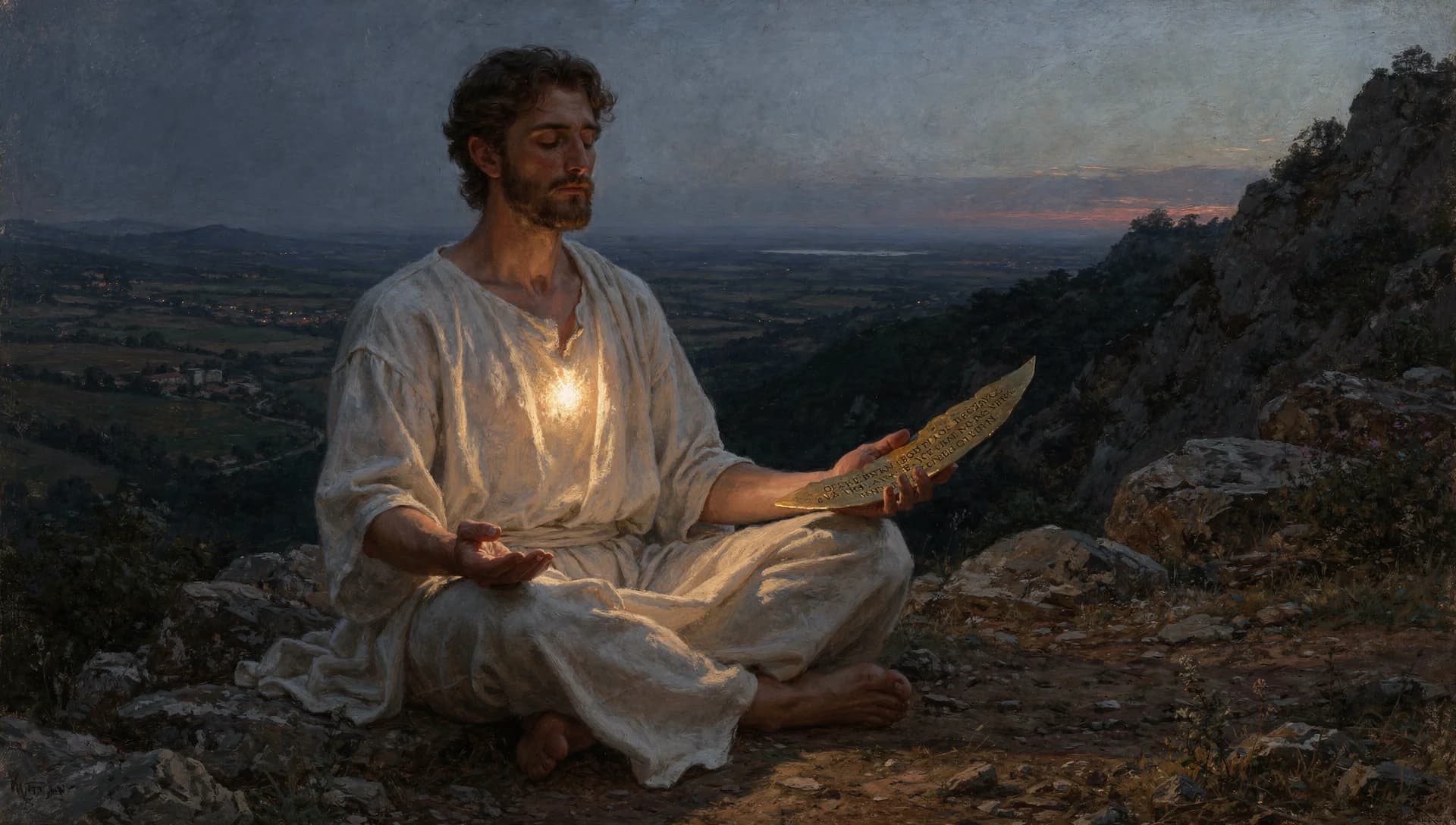
Among the gold-foil tablets recovered from late classical and Hellenistic graves in southern Italy, Crete, and Thessaly, a particular instruction recurs. The tablet, often inscribed in tiny hexameters and folded inside a locket placed over the heart of the deceased, tells the soul what to say when it reaches the underworld. The soul is to declare that it is a child of Earth and starry Heaven, but that its origin is heavenly. It is to identify itself, to claim its divine ancestry, to ask for a drink from the cold water flowing from the Lake of Memory rather than the river of forgetfulness. The tablets are the surviving liturgy of the Orphic brotherhood, a loose network of religious specialists, wandering priests, and householder initiates who carried, across the Greek world from the sixth century BCE through late antiquity, a doctrine that the human soul contains a divine fragment imprisoned in the body and that purification through ethical life and ritual initiation is necessary for the fragment to return to its divine source.
The Urantia Book at 98:2.10 names the Orphic brotherhood as the best of the mystery cults, whose moral preachments and promises of salvation made a great appeal to many. This is a striking ranking. The UB elsewhere is severe with the mystery cults as a whole, treating them as Salem-derived teachings degraded into ritual emotionalism. The Orphic brotherhood gets singled out as the exception. The reason becomes clear when the Orphic doctrinal content is examined. The Orphic anthropogony, reconstructed from the surviving fragments by M.L. West in his 1983 monograph The Orphic Poems, holds that humans arose from the ashes of Titans who had consumed the infant Dionysus, so every human carries within a divine Dionysian spark within a Titanic body. The soul's task is to purify the spark through ethical life so that it may return to its divine source.
This is, in mystery-cult form, the Thought Adjuster doctrine of the Urantia Book. The UB teaches in Papers 107 through 112 that every normal-minded human is indwelt by a literal fragment of God, the Mystery Monitor, the Thought Adjuster, sent from Paradise to indwell the human mind and to guide the human personality toward eventual fusion with the divine. The fragment is not the human personality; it is a separate prepersonal divine entity, a real piece of the First Source and Center, on loan to the mortal pilgrimage. The human task is the ethical and spiritual cooperation with the indwelling fragment that culminates, after mortal death, in the final fusion that makes the mortal a Paradise ascender.
The Orphic teaching of an indwelling divine fragment that must be cultivated through moral life for eventual reunion with the divine is precisely this teaching in mystery-cult form. The metaphysics differ in important respects: the Orphic spark is from Dionysus, the UB Adjuster is from the Father; the Orphic mechanism is liberation from the body, the UB mechanism is fusion of the personality with the indwelling fragment in a transformed morontia state; the Orphic frame is dualistic with body as prison, the UB frame is integrative with body as the legitimate first stage of the ascent. But the structural core, that the human carries a divine fragment, that ethical life is the cultivation of that fragment, that the fragment seeks reunion with its divine source, is exactly the same teaching.
W.K.C. Guthrie's 1935 monograph Orpheus and Greek Religion documented the Orphic ethical-purificatory practice: vegetarianism, abstention from blood sacrifice, ritual purifications, attention to the moral quality of life, recitation of the sacred poems. The Orphic life was a structured ethical practice oriented toward the cultivation of the divine spark within. Plato draws on this framework throughout, with the Phaedo's argument for the immortality of the soul, the Republic's myth of Er, the Phaedrus's myth of the soul's celestial origin, all carrying Orphic substrate.
The strongest counterargument is that the Orphic anthropogony with its Dionysian spark is a Hellenistic-period elaboration of an originally simpler doctrine, and the structural match with the Adjuster doctrine may be coincidental convergence on a common theme of indwelling divinity. The reply is that the structural specifics, the indwelling fragment from a higher divine source, the ethical-purificatory practice as the cultivation of the fragment, the eschatological fusion or reunion as the goal, are precisely the cluster of features the UB attributes to the Salem-derived teaching that was transmitted into the Mediterranean basin in the centuries leading up to the Orphic emergence. The Orphic doctrine appears at exactly the place and time where Salem-derived theological content would be expected to surface in fragmentary form.
What the parallel implies is that the Orphic brotherhood was carrying, with unusual fidelity, real Salem-derived teaching about the indwelling divine fragment. This is the highest-quality content the mystery cults preserved. The UB ranks it accordingly. For contemporary readers of Plato and the pre-Socratics, the Orphic substrate of Greek philosophical religion becomes intelligible as something other than primitive shamanism: it is the fragmentary preservation of real teaching about a real cosmological reality that the UB makes available in fuller form. The Adjuster doctrine of the UB is the historical fulfillment of what the Orphic poets were trying to describe.
Key Quotes
“The Eleusinian mysteries grew up within the Olympian pantheon, a Greek version of the worship of fertility; Dionysus nature worship flourished; the best of the cults was the Orphic brotherhood, whose moral preachments and promises of salvation made a great appeal to many.”
“West reconstructs the Orphic anthropogony in which humans contain a divine Dionysian spark within a Titanic body, and the soul's task is to purify the spark through ethical life so it may return to its divine origin.”
“Guthrie documents the Orphic ethical-purificatory practice as a structured discipline oriented toward the cultivation of the indwelling divine fragment for eventual reunion with its divine source.”
Cultural Impact
The Orphic teaching is one of the most influential streams in the history of Western philosophy and religion. Through Plato's appropriation of the Orphic framework, the doctrine of the soul as a divine fragment temporarily housed in the body became the architectural backbone of Platonic and later Neoplatonic philosophy, and through Neoplatonism it shaped Christian mysticism (Augustine, Pseudo-Dionysius, Bonaventure, Eckhart), Jewish Kabbalah (the doctrine of the divine sparks scattered in the world that must be gathered back), Islamic Sufism (the soul's longing for the divine Beloved), and Renaissance Hermeticism (the divine spark in matter that the alchemist liberates). Through Plotinus and the Christian mystics it shaped the entire Western mystical tradition's understanding of the inner divine presence. Carl Jung's archetype of the Self, the divine center of the psyche, is a direct intellectual descendant of the Orphic divine spark. The contemporary psychedelic-spirituality movement's framework of the divine within all things draws on the same substrate. Beyond the high tradition, the simpler Orphic teachings of vegetarianism, ethical attention, and care for the soul shaped popular Greek and Roman ethics in ways that fed into early Christian asceticism and the monastic tradition.
Modern Resonance
The Orphic doctrine of the indwelling divine fragment has unusually strong resonance with contemporary spiritual seekers, particularly those drawn to the language of "the divine within" or "your true self." The UB framework offers a refinement of this language: the divine within is not your true self, it is a separate prepersonal divine entity (the Thought Adjuster) on loan to your mortal life, with which your true self (your evolving personality) is invited to cooperate toward eventual fusion. This is more precise than the popular formulation but is structurally continuous with the Orphic teaching. For contemporary readers, the Orphic-Adjuster parallel offers a way to take seriously the long Western tradition of teaching about the indwelling divine without slipping into the New Age conflation of the human ego with the divine. The fragment is real. It is divine. It is not you. You are invited to cooperate with it, and the cooperation is what makes the ascent possible. This is one of the cleanest mystery-cult-to-UB inheritances and one of the most useful for contemporary spiritual practice.
Related Mappings
Salem teaching corrupted into dying/rising god cult
= Cybele and Attis, mother-son mystery religion
Day of Attis' death, pre-Christian sacred calendar
= "Black Friday," the original day of mourning before Easter
Pre-Christian mother-goddess cult in Rome
= Mother of God temple on the site of St. Peter's Basilica
Paul's composite Christianity
= Jewish morality + Greek philosophy + mystery cult ritual
Related Articles
Where to next
The free newsletter. The research behind each piece, no spam.