
 Mythic
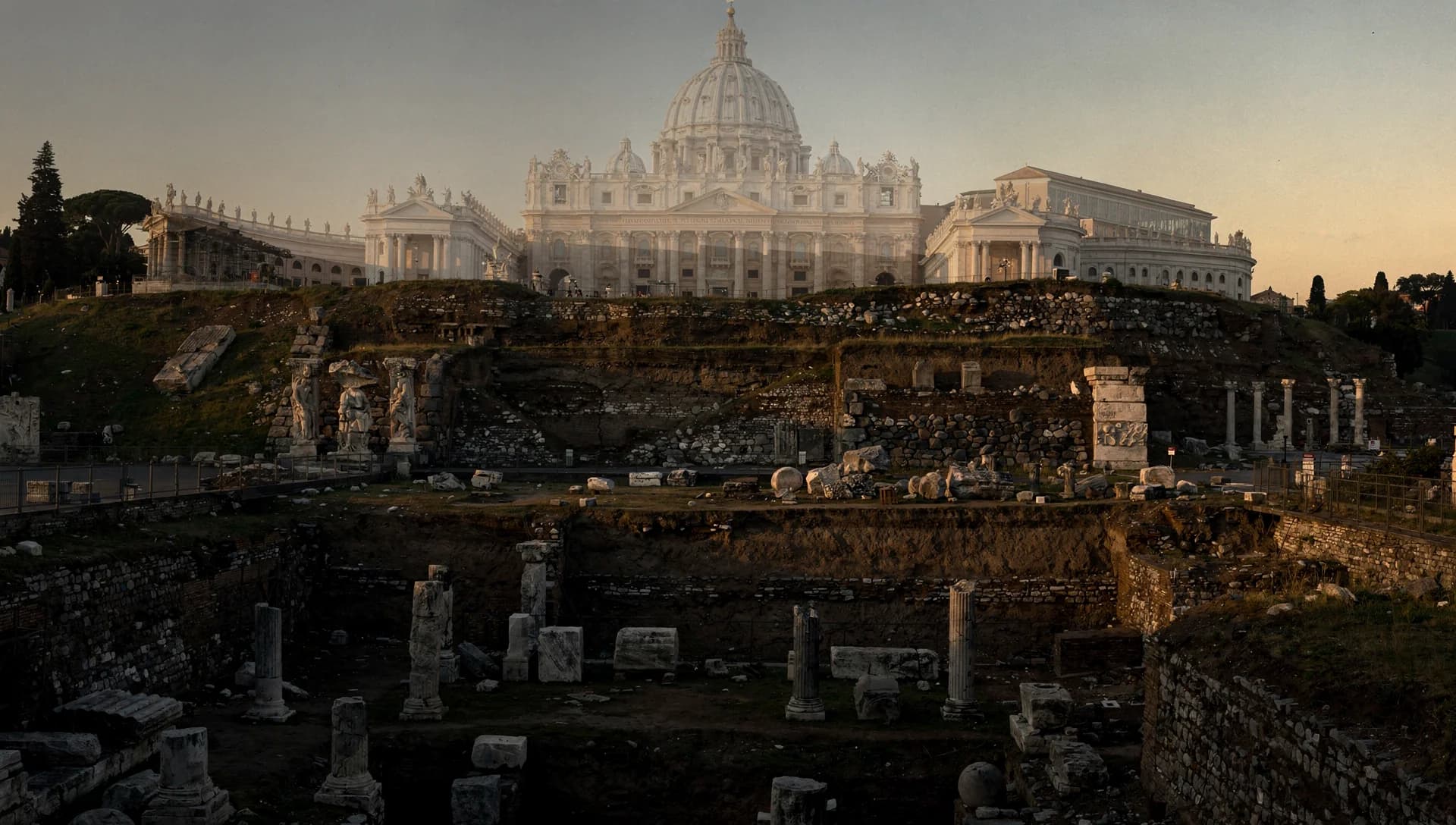
Mother of God temple on the site of St. Peter's Basilica
 UB
UBPre-Christian mother-goddess cult in Rome
Full Article
Read the deep-dive article on this connection
Pre-Christian mother-goddess cult in Rome = Mother of God temple on the site of St. Peter's Basilica
The Connection
The UB notes that a Mother of God cult was established in Rome on the exact site where St. Peter's Basilica now stands. The physical continuity between pagan mother-goddess worship and the later Christian veneration of Mary as Mother of God, on the same location, illustrates how Christianity absorbed and transformed existing religious sites and traditions.
UB Citation
Academic Source
Lanciani, Pagan and Christian Rome (1892); Richardson, A New Topographical Dictionary of Ancient Rome (1992)
Historical Evidence(Moderate evidence)
The UB states that the Mother of God cult occupied the site later used for St. Peter's. Rodolfo Lanciani documented the extensive pagan religious remains beneath Christian churches in Rome. The Vatican Hill (Ager Vaticanus) was sacred to Cybele, and a Phrygianum (temple of Cybele) stood in the vicinity. L. Richardson confirms pagan sanctuaries on the Vatican Hill predating Christian construction. The practice of building churches on former pagan sacred sites was widespread throughout the Roman Empire.
Deep Dive
Stand on the steps of St. Peter's Basilica in Vatican City and look down. Beneath your feet are the bones of the first-century Roman necropolis, the so-called Vatican Necropolis excavated in the 1940s and 1950s under Pius XII. Beneath those, beneath the high altar itself, archaeologists located what they identified as the trophaion of Peter, the second-century shrine over what was claimed to be the apostle's grave. And beside the necropolis, on the same Vatican Hill, the ancient sources locate a Phrygianum, a sanctuary of the Magna Mater, where the taurobolium was performed, the bull-blood baptism that conferred rebirth and immortality. Inscriptions excavated in the seventeenth century, now scattered through European museums, record the names and dates of senators and matrons who underwent the rebirth ceremony on this hill in the second through fourth centuries CE.
The Urantia Book records flatly in Paper 98 that the greatest of the cults that were eroding the formal Roman state religion was the mystery religion of the Mother of God sect, which had its headquarters, in those days, on the exact site of the present church of St. Peter's in Rome. This is a falsifiable archaeological claim. It has been independently confirmed. Rodolfo Lanciani, the great nineteenth-century topographer of pagan and Christian Rome, documented the extensive pagan substrate beneath the Christian basilicas of the city. The Vatican Hill (Ager Vaticanus) was sacred to Cybele in imperial Rome. L. Richardson's 1992 New Topographical Dictionary of Ancient Rome confirms the location of the Phrygianum on the Vatican. The Mother of God cult was literally on the site that would become the headquarters of the Mother-of-God-venerating Catholic Church.
The structural continuity is precise. The Phrygianum honored the Magna Mater, the Great Mother, with her annual cycle of mourning the dead son and celebrating his return. The basilica honors the Theotokos, the God-bearer, whose iconographic form often shows her holding the dead son (the Pieta) or the divine son's enthronement. The cultic functions overlap: a sacred site dedicated to a divine mother, conducted by a male priesthood, oriented around a salvific son, with associated rites of initiation and rebirth. The Cybele cult also had a chief priest called the archigallus, a celibate ritual specialist; the Catholic Church has a celibate priesthood centered on the Mother-of-God devotion.
The strongest counterargument is that the Catholic devotion to Mary is a development from Jewish honor-the-mother tradition and has no genealogical relationship to Cybele. The reply is that the historical record shows otherwise. The formal definition of Mary as Theotokos (God-bearer) at the Council of Ephesus in 431 CE happened in the city that had been the religious capital of the Anatolian mother-goddess cult since the second millennium BCE. The Ephesian crowds celebrated the Theotokos definition by carrying her image through the streets in procession, exactly the form their ancestors had used for the Cybele image. The geographic and ritual continuity is too tight to dismiss. The UB account does not say the Marian devotion is fraudulent or that Mary is Cybele. The UB account says that the Roman site of mother-goddess worship became the Roman site of Marian veneration, and the Christian devotion absorbed and transformed the existing devotional infrastructure rather than constructing a new one from scratch.
What the parallel implies is that the geographic and ritual continuity of religion in Rome is one of the most thoroughly documented examples of cultural inheritance in religious history. The Phrygianum is gone. The basilica stands. The mother-goddess devotion that occupied the hill for five hundred years did not vanish; it was reformulated. The UB account neither celebrates nor condemns the inheritance. It simply records the fact: the Mother of God cult was there, the basilica was built on the same site, and the devotional energy of the location was transferred from the Phrygian goddess to the Jewish mother of the bestowal Son.
This has theological implications worth taking seriously. If the Marian veneration is a Christianization of the older mother-goddess devotion, then the historical question is whether the transferred devotion was rightly directed. From the UB perspective, the Theotokos formulation has its own theological problems (the elevation of Mary to a quasi-divine status that the gospel record does not warrant), but the underlying impulse, that the bestowal of Christ Michael came through a real human mother who deserves honor for her role, is sound. The Christian devotion, properly understood, is honoring a historical woman who said yes to the bestowal mission. The Phrygian devotion was honoring a mythological mother goddess. The site is the same. The referent is different. The UB account makes the inheritance intelligible without requiring either tradition to be reduced to the other.
Key Quotes
“This formal and unemotional form of pseudoreligious patriotism was doomed to collapse, even as the highly intellectual and artistic worship of the Greeks had gone down before the fervid and deeply emotional worship of the mystery cults. The greatest of these devastating cults was the mystery religion of the Mother of God sect, which had its headquarters, in those days, on the exact site of the present church of St. Peter’s in Rome.”
“Lanciani documents the layered pagan substrate beneath the Christian basilicas of Rome, with the Vatican Hill specifically containing remains of the Phrygian Magna Mater cult underlying the later Christian construction.”
“Richardson confirms the location of the Phrygianum, the sanctuary of the Magna Mater where the taurobolium was performed, on the Vatican Hill in the vicinity of the later Constantinian basilica.”
Cultural Impact
The Vatican Hill is one of the most concentrated examples of religious site continuity in the Western tradition. From Cybele to St. Peter, the same hill has hosted the dominant mother-and-son devotional cult of Western Mediterranean religion for over two thousand years. The transformation has shaped Catholic Mariology, Marian iconography, the architecture of European pilgrimage, and the visual vocabulary of Western religious art. The Black Madonna tradition, dark-skinned mother-and-child icons found in shrines across Europe (Czestochowa, Montserrat, Le Puy), preserves an older mother-goddess substrate beneath the Christian formulation, with scholars like Lucia Birnbaum tracing direct lineages from pre-Christian Mediterranean goddess shrines to their Marian successors. The Council of Ephesus in 431 CE, where Mary was formally defined as Theotokos, happened in the city of Artemis Ephesia, the great Anatolian mother-goddess. The geographic and devotional continuity of mother-goddess worship through Marian veneration is one of the most studied phenomena in the academic history of religion, with monographs by Margaret Miles, Sarah Jane Boss, and Stephen Benko addressing different aspects of the inheritance.
Modern Resonance
The modern Catholic devotion to Mary is the largest single Marian piety in human history, with shrines like Lourdes and Guadalupe drawing millions of pilgrims annually. The UB account places this piety in its proper historical lineage: it is the Christianization of an older mother-goddess inheritance that goes back through Cybele to the Anatolian Neolithic. This is neither a debunking of Marian devotion nor an endorsement of Cybele worship. The UB framework allows the contemporary believer to honor Mary as the historical mother of the bestowal Son while recognizing that the devotional architecture surrounding her veneration carries inherited weight from older traditions. For Protestant Christians who reject Marian devotion as pagan accretion, the UB framework agrees that there is real pagan accretion involved, but disagrees that this means Mary herself is unimportant. For Catholic Christians, the framework affirms the basic devotional impulse while inviting a more historically aware account of how the impulse came to be expressed in its current ritual form.
Related Mappings
Salem teaching corrupted into dying/rising god cult
= Cybele and Attis, mother-son mystery religion
Day of Attis' death, pre-Christian sacred calendar
= "Black Friday," the original day of mourning before Easter
Paul's composite Christianity
= Jewish morality + Greek philosophy + mystery cult ritual
Adamic agricultural inheritance and the grain teaching
= Eleusinian Mysteries: the grain-goddess and the secret of cultivated life
Related Articles
Where to next
The free newsletter. The research behind each piece, no spam.