
 Mythic
"Black Friday," the original day of mourning before Easter
 UB
UBDay of Attis' death, pre-Christian sacred calendar
Full Article
Read the deep-dive article on this connection
Day of Attis' death, pre-Christian sacred calendar = "Black Friday," the original day of mourning before Easter
The Connection
The day of Attis' death in the Cybele cult was celebrated as a day of mourning and fasting, falling on what would later become Good Friday in the Christian calendar. The UB connects this pre-Christian "Black Friday" to the later Christian observance, showing how the existing ritual calendar was absorbed rather than invented from scratch.
UB Citation
Academic Source
Vermaseren, Cybele and Attis (1977); Alvar, Romanising Oriental Gods (2008)
Historical Evidence(Strong evidence)
The UB explicitly connects the Attis mourning day with the Christian Good Friday observance. Jaime Alvar documents the March festival of Cybele/Attis: March 22 (tree-bearing), March 24 (dies sanguinis/day of blood, when Attis dies), March 25 (hilaria/day of joy, when Attis rises). This three-day death-and-resurrection sequence, celebrated in Rome centuries before Christianity, provided a ready-made ritual template. The calendrical correspondence is well-documented in Roman religious scholarship.
Deep Dive
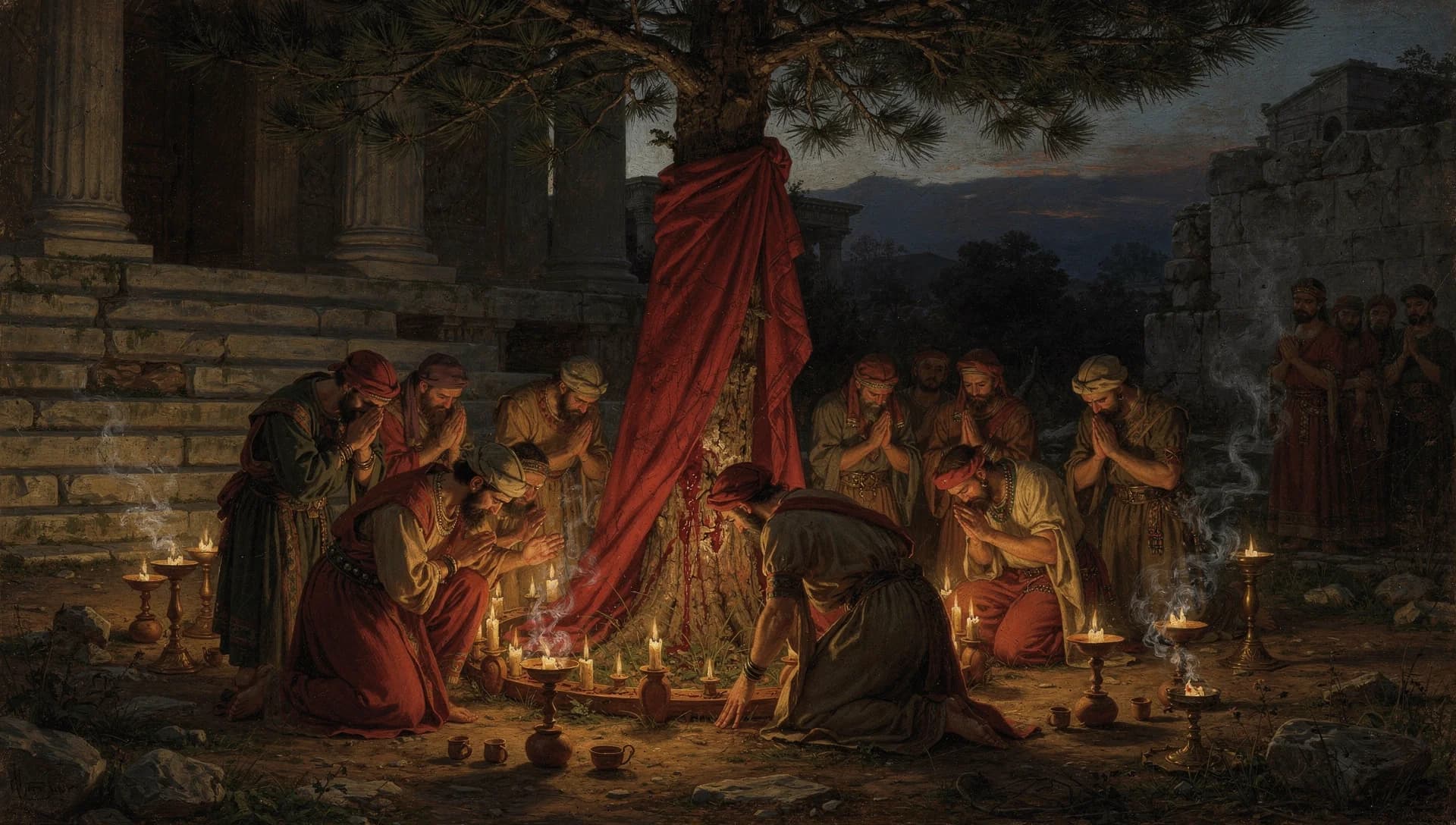
The Roman calendar of Philocalus, compiled in 354 CE and preserved in a luxury manuscript that survives only in copies, gives the day-by-day liturgy of the Cybele cult as it was being practiced in the imperial capital at the moment Christianity was about to displace it. March 15 was the day the reed-bearers (cannophori) brought the sacred reeds. March 22 was the day the tree-bearers (dendrophori) felled the pine and carried it into the temple, the trunk wrapped like the body of Attis. March 24 was the dies sanguinis, the day of blood, when the priests gashed themselves and Attis was mourned as dead. March 25 was the dies hilaria, the day of joy, when Attis was proclaimed risen. March 26 was a day of rest, March 27 the lavatio when the cult statue was washed in the Almo. The death and resurrection of the divine son was the formal Roman state liturgy of the spring equinox.
The Urantia Book's account of the Phrygian mystery in Paper 98 places this calendar at the center of how Christianity inherited and absorbed pre-Christian Mediterranean religion. The phrase "anniversary of the god's death and resurrection" in Paper 98:4.6 is doing real historical work: it names the existing pattern that Christian liturgy would later occupy. The Christian paschal triduum, Good Friday through Easter Sunday, occupies the same calendrical neighborhood (the spring equinox cycle), runs the same three-day arc (death, mourning, resurrection), and serves the same religious function (initiate participation in the saving work of the dying-and-rising son). The structural identity is not coincidence and is not, in the UB account, fraud. It is what happens when a Salem-derived teaching is preached into a culture that already has a ritual calendar built around the same pattern from an earlier corruption of the same source.
Jaime Alvar's 2008 study Romanising Oriental Gods documented the festival in detail, with the dies sanguinis and dies hilaria as the climactic days of the spring liturgy. The taurobolium (bull-blood baptism) was performed on initiates during this period, with inscriptions in the Phrygianum on the Vatican Hill recording the names and dates of the rebirth-by-blood ceremonies. The Christian spring triduum is structurally homologous: a death day (Good Friday), a vigil/silent day (Holy Saturday), a resurrection day (Easter Sunday). The Christian baptismal liturgy historically occurred at the Easter Vigil. The Phrygian cult had been doing functionally the same thing on the same calendar for at least four centuries before Christianity arrived in Rome.
The strongest counterargument is that the spring equinox is a natural focal point for any vegetation-related religion, and the calendrical convergence does not require Salem mediation. The reply is that the structural specifics, divine son, atoning death, third-day resurrection, conferred immortality through initiation, are not generic spring-festival features. They cluster around the Salem-derived theological framework. Where they appear in concentrated form, the historical evidence consistently points back to the eastern Mediterranean basin where Salem missionary activity was densest.
The UB position is not that Christianity copied Cybele. The UB position is that both the Cybele cult and Christianity are descendants of the original Salem teaching, with Cybele having been in the field for several centuries longer and having attached itself to an older Anatolian mother-goddess substrate. When the Christian gospel arrived in Rome, it found a congregation already trained, by the Phrygian liturgy, in the structural categories it needed. The calendrical absorption was not a hostile takeover but a reuse: the existing public ritual rhythm, the spring death-and-resurrection sequence, was repurposed to commemorate a real historical event (the bestowal of Christ Michael) rather than a mythological vegetation drama.
What the parallel implies for contemporary believers is that Easter is older than Christianity in its calendrical bones. The Friday-Sunday triduum is part of the inheritance the Mediterranean basin handed to the early church, an inheritance that the UB traces back through Cybele to corrupted Salem teaching to the original gospel of Machiventa Melchizedek. The Christian observance does not lose anything by being placed in that lineage. It is recognized as the historical fulfillment of a structure that humanity had been rehearsing, in fragmentary ritual form, for two thousand years before the resurrection actually happened.
Key Quotes
“The Phrygian and Egyptian mysteries taught that the divine son (respectively Attis and Osiris) had experienced death and had been resurrected by divine power, and further that all who were properly initiated into the mystery, and who reverently celebrated the anniversary of the god’s death and resurrection, would thereby become partakers of his divine nature and his immortality.”
“The Roman state calendar lists the Phrygian rites as: March 22 Arbor intrat (the tree enters), March 24 Dies sanguinis (day of blood), March 25 Hilaria (day of joy when Attis is proclaimed risen). (Paraphrased from the Codex-Calendar of 354.)”
“Alvar documents the spring festival of Cybele and Attis as the central ritual cycle of the Magna Mater cult in Rome, with the three-day death-and-resurrection sequence forming the calendrical template later occupied by the Christian paschal triduum.”
Cultural Impact
The pre-Christian three-day spring death-and-resurrection cycle is one of the deepest layers in Western liturgical inheritance. Through the absorption of the Phrygian calendar into the Christian paschal triduum, the structure has been re-performed every year for nearly two millennia in churches from Constantinople to Lima. The Friday-of-grief, Saturday-of-silence, Sunday-of-joy arc is the architectural backbone of the entire Christian liturgical year and of much of Western literary and artistic imagination of redemption. Bach's St. Matthew Passion, Mel Gibson's The Passion of the Christ, the medieval mystery play tradition, Handel's Messiah, Eliot's Four Quartets, all are working within the calendrical inheritance the Roman state had already routinized through Cybele's spring festival. Beyond Christianity, the spring equinox dying-and-rising-god pattern entered comparative mythology through Frazer, depth psychology through Jung's archetype of the dying god, and the modern academic study of religion through the Cambridge Ritualists. The festival's emphasis on bodily participation in the god's suffering through self-mortification has continuing echoes in Holy Week processions in Spanish-speaking Catholicism, in the Shia mourning practices of Ashura which run a structurally similar liturgy for Imam Hussein, and in monastic ascetic practices throughout the Christian East.
Modern Resonance
Internet skeptics regularly cite the Cybele/Attis calendar as proof that Christianity is a fraud. This is the wrong inference from the right data. The data are real: the Roman state was running a death-and-resurrection liturgy on the spring equinox before Christianity arrived. The UB account explains the data without requiring fraud: both traditions inherit from the same Salem source, and Christianity is the historical fulfillment of a structure that humanity had been rehearsing in fragmentary form for centuries. The contemporary "pagan origins of Easter" critique cuts both ways: yes, the calendrical structure is pre-Christian, but the pre-Christian structure was itself a corruption of an earlier Salem-derived teaching, and the Christian observance restored the connection to the underlying historical truth. The structural similarity is evidence of common ancestry, not of borrowing. For contemporary readers who have lost their faith over the "Easter is pagan" claim, the UB framework offers a way back: the calendrical inheritance is real, the historical bestowal is also real, and the two facts are not in conflict.
Related Mappings
Salem teaching corrupted into dying/rising god cult
= Cybele and Attis, mother-son mystery religion
Pre-Christian mother-goddess cult in Rome
= Mother of God temple on the site of St. Peter's Basilica
Paul's composite Christianity
= Jewish morality + Greek philosophy + mystery cult ritual
Adamic agricultural inheritance and the grain teaching
= Eleusinian Mysteries: the grain-goddess and the secret of cultivated life
Related Articles
Where to next
The free newsletter. The research behind each piece, no spam.