
 Mythic
Cybele and Attis, mother-son mystery religion
 UB
UBSalem teaching corrupted into dying/rising god cult
Full Article
Read the deep-dive article on this connection
Salem teaching corrupted into dying/rising god cult = Cybele and Attis, mother-son mystery religion
The Connection
The UB traces the Cybele/Attis mystery cult back to corrupted Salem teaching. The original message of salvation through faith was transformed into a dramatic death-and-resurrection ritual. Attis (the divine son) dies and is reborn annually, with initiates participating in his death and resurrection through ritual. This became one of the major mystery cults competing with early Christianity.
UB Citation
UB 98:4.1-2, 98:4.6
Academic Source
Vermaseren, Cybele and Attis (1977); Roller, In Search of God the Mother (1999)
Historical Evidence(Moderate evidence)
The UB identifies the Cybele/Attis cult as a corrupted Salem derivative. Maarten Vermaseren documents the cult's spread from Phrygia (modern Turkey) throughout the Roman Empire. Lynn Roller traces its origins to Neolithic Anatolian goddess worship, but notes the dying/rising god element was a later development. The transformation from simple faith-teaching to elaborate ritual drama follows the UB pattern for Salem corruption worldwide.
Deep Dive
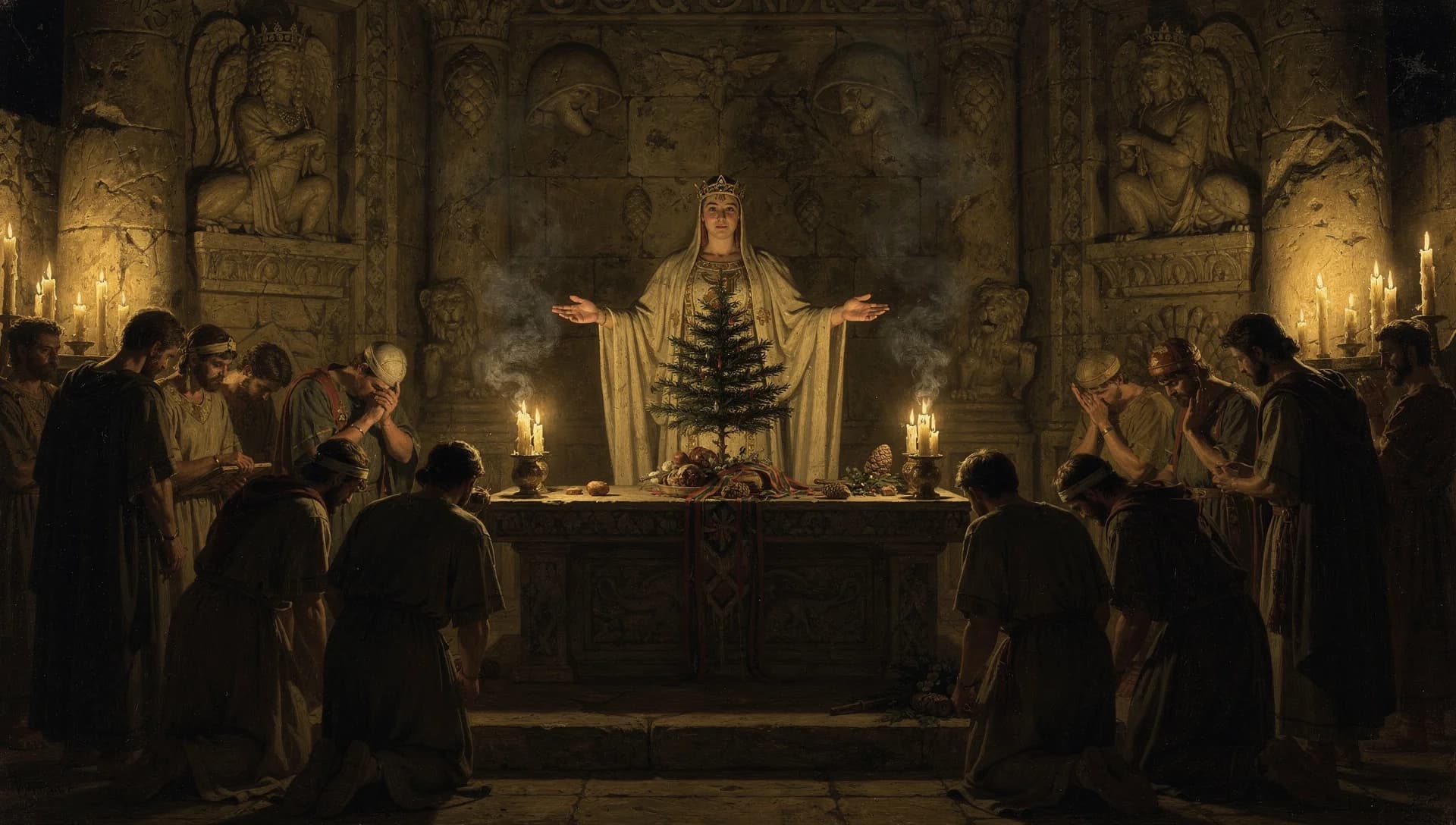
In the spring of every year, on the slopes of the Palatine in Rome, a procession would assemble around a felled pine tree. The trunk was wrapped in wool like a corpse, garlanded with violets, and carried into the temple of the Magna Mater. For three days the priests of Cybele wailed and gashed themselves with potsherds, pouring blood onto the altar in mourning for Attis, the divine son who had died beneath the pine. Then on the third day, the dies hilaria, the temple erupted in joy. Attis had risen. Initiates who had passed through the taurobolium, the bath in bull's blood, were said to be reborn for eternity. This was the spring festival of the Phrygian mother and her dying son, transplanted to the heart of the Roman Empire by senatorial decree in 204 BCE during the Second Punic War, and it was running at full ritual strength when Paul of Tarsus was preaching in the same city about another dying and rising son.
The Urantia Book identifies the Phrygian mystery as one of three cults that became dominant in the Greco-Roman world as the older state religions collapsed. Paper 98 records that the Phrygian mysteries taught that the divine son, in this case Attis, had experienced death and had been resurrected by divine power, and further that all who were properly initiated into the mystery, and who reverently celebrated the anniversary of the god's death and resurrection, would thereby become partakers of his divine nature and his immortality. The structural elements are listed plainly: dying god, annual ritual reenactment, initiate participation, conferred immortality. Paper 98 traces the rise of these mysteries to a specific historical moment, the collapse of the old Greek philosophical religion under the weight of common-people demand for salvation rituals and personal deities. The Salem missionary teaching, which had been preserved in attenuated form within Greek philosophical religion, was now being absorbed into the rising mystery framework along with the older Anatolian goddess cults.
Lynn Roller, in her 1999 study In Search of God the Mother, traced the Cybele cult back to its Anatolian origins as a mountain mother goddess, attested at Catalhoyuk and the Phrygian highland sanctuaries from at least the second millennium BCE. The dying-and-rising son element, however, is a later development, surfacing clearly in the Hellenistic period after the Salem missionary streams had been mixing into Anatolian religious culture for centuries. Maarten Vermaseren, in his 1977 monograph Cybele and Attis, mapped the cult's spread from Phrygia through Pergamon and Smyrna into Rome and from there throughout the empire, with mithraea and metroac sanctuaries jointly serving the imperial soldiery. The dying-son theology that Paul would later wrestle with was already running in the streets where he preached.
The structural match with the UB account is precise. The Salem teaching, as Paper 93 describes it, was the gospel of belief and faith in God, with no elaborate ritual machinery. By the time the teaching had been carried into Phrygia and absorbed into the Cybele cult, it had been transformed into a death-and-resurrection drama of a divine son with sacramental initiation conferring immortality. That is exactly the Salem-corruption pattern the UB describes for the Mediterranean basin: simple faith teaching gets dressed up in the dying-god mythology of the local mother-goddess religion, then exported as a mystery cult. The narrative components originally belonged to the agricultural year, the dying-and-rising vegetation god of Anatolian peasant religion, and the Salem-derived language of salvation by faith was grafted onto that pre-existing ritual frame.
The strongest counterargument is that dying-and-rising vegetation gods are independent everywhere, and no Salem influence is needed to explain Attis. The reply is that the structural details that match the Salem-Christian pattern are not the dying-rising element by itself, which is universal, but the specific overlay of personal salvation through initiation, partaking of the divine nature, and conferred immortality. Those features are not part of pure agricultural cycle religion. They appear in the eastern Mediterranean precisely in the centuries following Salem missionary penetration, and they are absent from the older Phrygian mountain-mother strata.
What the parallel implies is that the Christian Easter narrative was preached into a religious environment already saturated with the structural template of dying-and-rising-god salvation. The Pauline communities in the Greek east did not have to invent the framework. They had to argue that Jesus, not Attis, was the real one. The UB account makes the parallel intelligible by showing that the underlying Salem-derived faith teaching was the same in both cases, but the Christian formulation was anchored to a real historical bestowal of a real Creator Son, while the Cybele cult was anchored to a mythological vegetation god. Same theological vocabulary, different historical referent.
Key Quotes
“The Phrygian and Egyptian mysteries taught that the divine son (respectively Attis and Osiris) had experienced death and had been resurrected by divine power, and further that all who were properly initiated into the mystery, and who reverently celebrated the anniversary of the god’s death and resurrection, would thereby become partakers of his divine nature and his immortality.”
“The majority of people in the Greco-Roman world, having lost their primitive family and state religions and being unable or unwilling to grasp the meaning of Greek philosophy, turned their attention to the spectacular and emotional mystery cults from Egypt and the Levant.”
“Vermaseren documents the Phrygian cult of Cybele and Attis as one of the most widespread mystery religions of the Roman Empire, with sanctuaries from Anatolia to Britain and a fully articulated death-and-resurrection ritual cycle in the spring festival.”
Cultural Impact
The Cybele/Attis cult's most enduring inheritance is the architecture of Christian Eastertide itself. The three-day mourning-then-rejoicing structure, the spring timing, the language of partaking in the god's death and resurrection through initiation, the bloody atonement framework, all of these were running in Roman public religion centuries before Christianity codified its own paschal triduum. The Magna Mater procession on the Vatican Hill, where the Phrygianum stood, fed directly into the Marian devotional tradition: Mary as Theotokos, the God-bearer, occupies the structural slot that Cybele had filled for half a millennium before her. Through the iconography of the Pieta, the mother holding the dead son, the Phrygian inheritance crosses into Renaissance art and into the contemporary Catholic devotional imagination. The taurobolium, the bull's-blood baptism, has structural parallels in later Christian baptismal theology of dying and rising with Christ that Paul develops in Romans 6. Beyond the Christian channel, the Cybele cult fed into the mother-goddess revival in modern Western paganism, with Marija Gimbutas and second-wave feminist theology drawing extensively on the Anatolian mother-goddess substrate. The dying-and-rising son archetype, refracted through Frazer's Golden Bough, became one of the foundational categories of twentieth-century comparative religion and depth psychology, with Jung treating Attis as a primary anima-mediator alongside Osiris and Christ.
Modern Resonance
The contemporary scholarly conversation about whether Christianity copied the mystery cults, or the mystery cults copied Christianity, or both drew on shared Near Eastern substrate, has been running since the nineteenth century without resolution. The UB account cuts the knot by providing the missing common ancestor: a Salem missionary teaching of salvation through faith, transmitted into Anatolia and Greece centuries before either the mystery cults or Christianity reached their classical forms. Both inherit from the same source. The mystery cults dressed the teaching in vegetation-god mythology and dramatized it ritually. Pauline Christianity dressed it in Jewish-prophetic-Greek synthesis and anchored it to a historical bestowal. Neither is a copy of the other. Both are descendants of the same Salem teaching, evolving independently in different cultural channels for five centuries before they came back into contact in first-century Rome. For contemporary readers wrestling with the apparent paganism of Easter or the apparent Christianity of Attis, this is the frame that makes both intelligible without requiring either to be a fraud.
Related Mappings
Day of Attis' death, pre-Christian sacred calendar
= "Black Friday," the original day of mourning before Easter
Pre-Christian mother-goddess cult in Rome
= Mother of God temple on the site of St. Peter's Basilica
Paul's composite Christianity
= Jewish morality + Greek philosophy + mystery cult ritual
Adamic agricultural inheritance and the grain teaching
= Eleusinian Mysteries: the grain-goddess and the secret of cultivated life
Related Articles
Where to next
The free newsletter. The research behind each piece, no spam.