
 Mythic
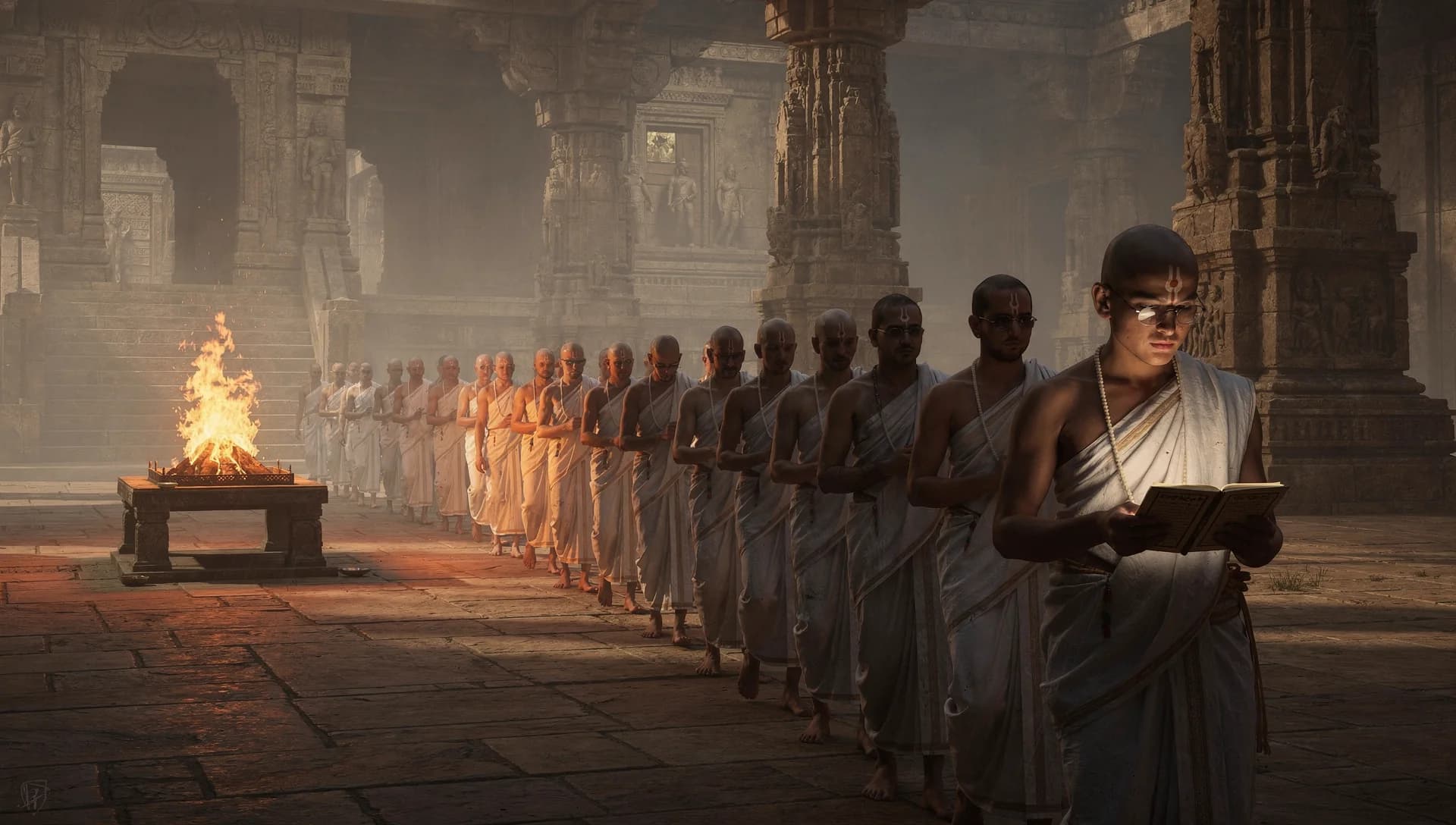
Brahman priestly caste of India
 UB
UBSethite priests, Adamite-descended teachers
Full Article
Read the deep-dive article on this connection
Sethite priests, Adamite-descended teachers = Brahman priestly caste of India
The Connection
The UB identifies the Brahman caste as descendants of the Sethite priests, the Adamite priestly line that carried forward the knowledge of the Adamic civilization. The hereditary nature of the Brahman caste, their role as keepers of sacred knowledge, and their claim to divine origin all trace back to the actual biological and cultural heritage of the Sethite priesthood.
UB Citation
Academic Source
Basham, The Wonder That Was India (1954); Doniger, The Hindus: An Alternative History (2009)
Historical Evidence(Moderate evidence)
The UB states that the Sethite priests became the Brahman caste upon entering India. A.L. Basham documents the Brahman claim to divine origin and hereditary priestly status as the oldest continuous priesthood tradition in history. The strict endogamy (marrying within caste) practiced by Brahmans is consistent with the UB description of Sethite/Adamite lineage preservation. Genetic studies have confirmed significant West-Central Asian admixture in Indian Brahman populations.
Deep Dive
The Brahman caste of India is the oldest continuous hereditary priesthood in human history. For at least three thousand years, and probably considerably longer, Brahmans have transmitted the Vedic ritual tradition through father-to-son succession, with strict marriage rules that have preserved the lineage genetically as well as culturally. Brahman families today can often trace their gotra (clan lineage) back through dozens of generations, claiming descent from one of the seven primordial rishis (sages) of the early Vedic tradition. The cultural inheritance includes not only ritual knowledge but also Sanskrit textual learning, philosophical training, and a particular set of dharmic obligations that govern daily life. No other priestly tradition in any culture has maintained comparable continuity over comparable time spans.
The Urantia Book, in a single dense passage, identifies the Brahman caste as the cultural and biological descendants of the Sethite priesthood that emerged after the Adamic default. UB 79:4.6 records: "Of the four great castes, all but the first were established in the futile effort to prevent racial amalgamation of the Aryan conquerors with their inferior subjects. But the premier caste, the teacher-priests, stems from the Sethites; the Brahmans of the twentieth century after Christ are the lineal cultural descendants of the priests of the second garden, albeit their teachings differ greatly from those of their illustrious predecessors."
The Sethite priesthood was, in UB tradition, the priestly line that descended from Seth, son of Adam and Eve, after the move from the first to the second garden. The Sethites carried forward the religious knowledge of the Adamic tradition. They were not the only priestly line in the post-Adamic world, but they were the most direct biological and cultural inheritors of Adamic religious tradition. Through the Andite migrations across Asia, Sethite lineages spread widely, and one branch of these migrations, carrying Sethite priestly tradition with them, settled in India as part of the Aryan invasions of the second millennium BCE. There they became the priestly caste that subsequent Indian history would know as the Brahmans.
UB 79:4.7 notes the partial preservation and partial corruption of the original tradition: "When the Aryans entered India, they brought with them their concepts of Deity as they had been preserved in the lingering traditions of the religion of the second garden. But the Brahman priests were never able to withstand the pagan momentum built up by the sudden contact with the inferior religions of the Deccan after the racial obliteration of the Aryans. Thus the vast majority of the population fell into the bondage of the enslaving superstitions of inferior religions; and so it was that India failed to produce the high civilization which had been foreshadowed in earlier times."
The historical scenario is detailed and falsifiable. Aryan-Sethite migration into northern India in the second millennium BCE brings monotheistic-trinitarian religious tradition. The encounter with pre-existing Dravidian religious traditions (the Deccan religions, with their reincarnation doctrines, polytheism, and elaborate ritualism) results in a syncretic mixture in which the Aryan tradition is gradually absorbed into the Dravidian. The Brahman priests, descendants of the original Sethite line, retain the institutional position of supreme religious authority but progressively lose the substantive content of the Sethite teaching. By the time the Upanishads are composed in the early-to-mid first millennium BCE, the Brahmans are working with a heavily corrupted version of the original tradition, and their philosophical achievements (the Atman doctrine, the Brahman doctrine, the karma doctrine) are partial recoveries from this corrupted starting point rather than direct inheritances of the original Adamic-Sethite tradition.
Modern population genetics has provided some confirmation of the basic UB scenario. Studies of Y-chromosome and autosomal DNA in Indian populations have identified a significant West-Central Asian (Steppe-derived, Yamnaya-related) genetic component that entered the Indian subcontinent during the second millennium BCE, consistent with the conventional Aryan migration hypothesis. This component is overrepresented in upper-caste, particularly Brahman, populations relative to lower castes and Dravidian-speaking southern populations. The genetic signature is consistent with the UB's account of Aryan-Sethite migration introducing a distinct biological and cultural component into the Indian gene pool, with the priestly caste preserving that component most strongly through endogamous marriage practices over millennia. Recent papers by Reich, Patterson, Narasimhan, and others have refined the picture significantly. The UB's claim that the Brahman caste preserves Sethite lineage is consistent with the genetic evidence, though the genetics alone cannot confirm the specific identification of the West-Central Asian component as "Sethite" rather than simply "Yamnaya-related Steppe pastoralist."
The strongest counterargument is that the UB's identification of the Brahman caste with the Sethite priesthood depends on a specific UB-internal historical claim (the Adamic-Sethite priestly line) that cannot be independently verified. The reply is that the structural features the UB identifies (an Aryan-derived priestly caste, hereditary, endogamous, carrying religious tradition from a Western source, encountering and partially absorbing native Dravidian traditions) are consistent with the mainstream archaeological and linguistic reconstruction of the Aryan migration and its aftermath. The UB adds detail (the Sethite ancestry of the Aryan priesthood) that mainstream history cannot independently confirm but that fits cleanly into the established framework. The UB account is not contradicted by what we know; it adds historical depth to what we know.
Key Quotes
“Of the four great castes, all but the first were established in the futile effort to prevent racial amalgamation of the Aryan conquerors with their inferior subjects. But the premier caste, the teacher-priests, stems from the Sethites; the Brahmans of the twentieth century after Christ are the lineal cultural descendants of the priests of the second garden, albeit their teachings differ greatly from those of their illustrious predecessors.”
“When the Aryans entered India, they brought with them their concepts of Deity as they had been preserved in the lingering traditions of the religion of the second garden. But the Brahman priests were never able to withstand the pagan momentum built up by the sudden contact with the inferior religions of the Deccan after the racial obliteration of the Aryans.”
“The spiritual awakening of the sixth century before Christ did not persist in India, having died out even before the Mohammedan invasion. But someday a greater Gautama may arise to lead all India in the search for the living God, and then the world will observe the fruition of the cultural potentialities of a versatile people so long comatose under the benumbing influence of an unprogressing spiritual vision.”
Cultural Impact
The Brahman caste's role in shaping Indian civilization cannot be overstated. As the custodians of Sanskrit, the Vedas, the dharma sastras, the philosophical schools, and the entire textual heritage of classical Indian culture, Brahmans have been the primary cultural transmitters for three millennia. Indian science, mathematics, astronomy, linguistics, and philosophy developed largely within Brahman intellectual circles. The Hindu temple tradition, the legal code system, the educational tradition that culminated in the medieval university at Nalanda and similar institutions: all of these developed under Brahman intellectual leadership. Through Indian influence, Brahman scholarship has shaped Southeast Asian, Tibetan, and Central Asian cultures. In the modern era, Brahman intellectuals have led the Indian renaissance from Ram Mohan Roy through Vivekananda to contemporary academic and political leadership. The cultural inheritance is one of the most consequential intellectual lineages in human history. The UB's identification of this lineage with the Sethite priesthood, descendants of Adam through Seth, places it in the broader sweep of post-Adamic cultural transmission as one of the most successful preservations of the Adamic priestly tradition anywhere in the world.
Modern Resonance
The caste system has come under sustained moral critique in modern India and globally, particularly because of its association with hereditary discrimination against the lower castes and Dalits. Modern Indian reform movements from B.R. Ambedkar to contemporary anti-caste activism have argued for the abolition of caste-based hierarchies. The UB account does not endorse the caste system as a whole. UB 79:4.6 explicitly notes that "all but the first" of the four great castes "were established in the futile effort to prevent racial amalgamation," and characterizes this as a failure rather than an achievement. The Brahman caste is identified as having a genuinely ancient priestly lineage descending from the Sethites, but this is not a moral endorsement of caste hierarchy or an argument against caste reform. What the UB account preserves is the historical claim that one specific lineage (the priestly caste) does have ancient roots in the Adamic-Sethite tradition, while the broader social system of caste-based hierarchy is identified as a failed strategy of racial preservation. Contemporary Indian Brahmans who recover the UB framework will find themselves in an interesting position: heirs of an ancient and significant priestly tradition, with a particular religious heritage to preserve and transmit, but also called to the abolition of the broader hierarchical system that grew up around their hereditary status.
Related Mappings
Related Articles
Where to next
The free newsletter. The research behind each piece, no spam.