
 Mythic
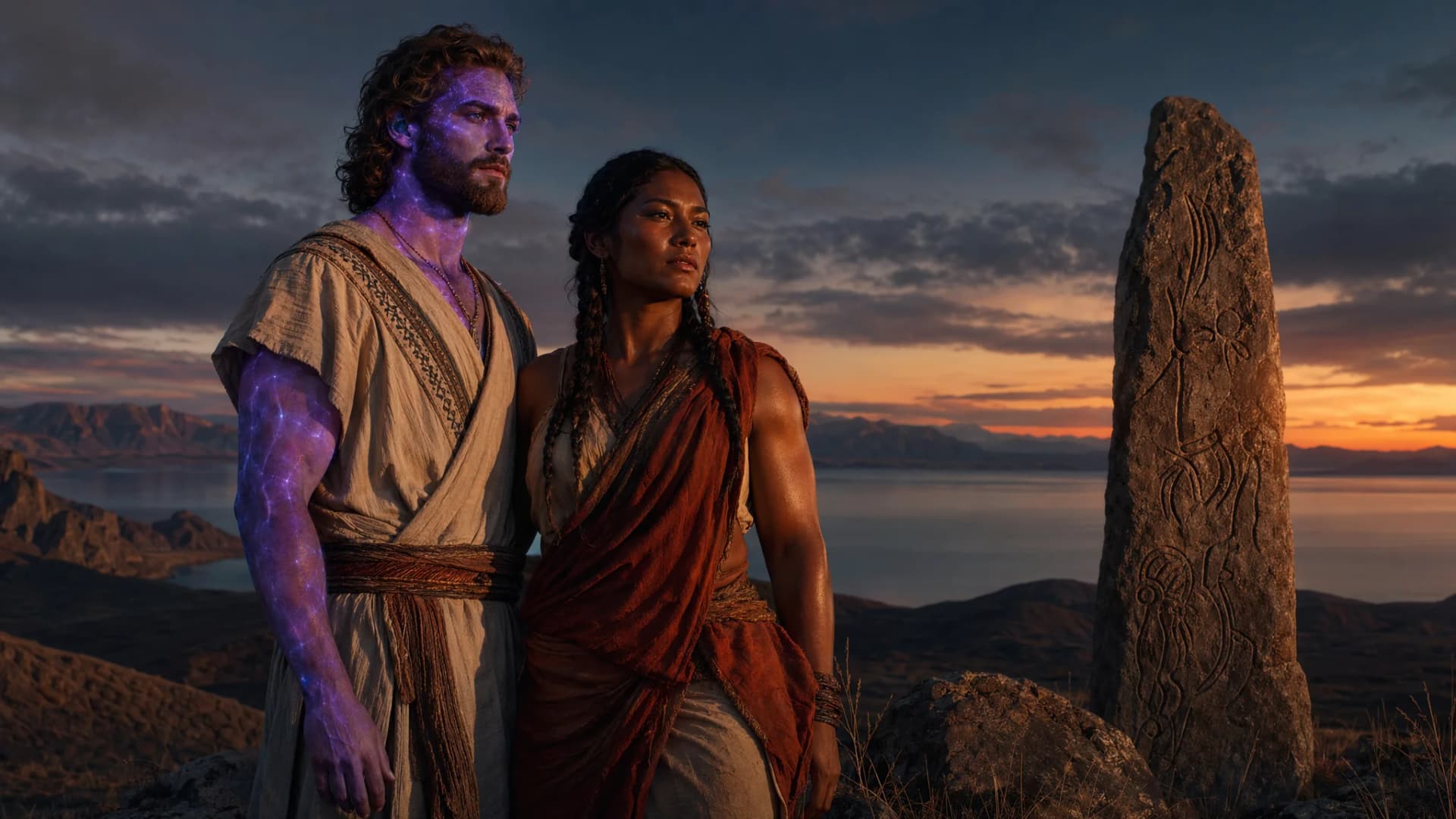
Krishna + Radha
 UB
UBAdamson + Ratta
Full Article
Read the deep-dive article on this connection
Adamson + Ratta = Krishna + Radha
The Connection
Krishna's blue/violet skin maps to Adamson's fading Adamite violet glow, not blue in nature, but a violet tinge remembered and amplified as "blue skin" over millennia. Radha as "most beautiful woman" maps to Ratta, described as the most beautiful woman of her era, last of a pure superhuman lineage.
UB Citation
UB 76:4.1, 77:5
Academic Source
Bhagavata Purana; Doniger, Hindu Myths (1975)
Historical Evidence(Suggestive evidence)
Smarthistory discusses the theological significance of blue/dark skin in Hindu iconography. Brahma Samhita describes Krishna's complexion as "beautiful like a dark rain cloud." Hindu theological tradition shows Vishnu/Krishna in different complexions during different yugas: white, yellow, red, and black/blue. The blue/violet skin represents divine otherness. The divine couple motif is universal enough that the parallel is suggestive rather than specific.
Deep Dive
Walk into any Hindu temple, especially in the Vaishnavite tradition, and the most prominent image will likely be Krishna with his consort Radha. He is blue or dark, often with a peacock feather in his hair, holding a flute. She stands beside him, fair-skinned, beautiful, the most exalted of the gopis (cowherd women) of Vrindavan, the village of Krishna's youth. Their love is the central theme of the Bhagavata Purana and the entire bhakti tradition. Krishna's blue skin is iconographically distinctive. Hindu theology offers various explanations: the color is the cosmic dark of pre-creation, or the color of clouds heavy with rain, or simply the color of the infinite. The Brahma Samhita describes Krishna's complexion as "beautiful like a dark rain cloud." The Bhagavata Purana presents him as so dark that his name itself, Krishna, means "the dark one" or "the black one."
The Urantia Book presents a figure whose biographical structure matches the Krishna-Radha image with surprising specificity. Adamson, the eldest son of Adam and Eve, did not remain in the second garden after his parents settled there. UB 77:5.2 records that Adamson "had often heard from Van and Amadon the story of their highland home in the north, and sometime after the establishment of the second garden he determined to go in search of this land of his youthful dreams." He traveled north with twenty-seven companions and found the people Van and Amadon had told him about. Among them was Ratta, who according to UB 77:5.5 was "a wonderful and beautiful woman, twenty years old, who claimed to be the last pure-line descendant of the Prince's staff." Ratta said her ancestors "were all descendants of two of the fallen staff of the Prince. She was the last of her race, having no living brothers or sisters." Adamson and Ratta married within three months of meeting and produced sixty-seven children. Every fourth child was an unusual being: a secondary midwayer, a corps of permanent invisible planetary ministers.
The Adamson-Ratta narrative includes the key elements of the Krishna-Radha tradition. A male figure of unique heritage (Adamson, son of the violet race; Krishna, descendant of the divine line). A female figure of rare beauty and unique pure-line ancestry (Ratta, last of her race; Radha, supreme among the gopis). A relationship that becomes the foundation of a continuing spiritual lineage (the Adamsonites, who maintained a high culture for almost seven thousand years; the Krishna-Radha tradition, which became the central devotional focus of Vaishnavism). A geographic setting that was a center of civilization (the Adamsonite headquarters in the Kopet Dagh region of Turkmenistan; Vrindavan as the legendary site of Krishna's youth).
The "blue skin" puzzle is where the parallel becomes specific. Adam and Eve, the violet race progenitors, had a faint violet luminescence in their physical bodies, an artifact of the dual nutrition (food and light) that sustained their material form. Their immediate descendants retained traces of this luminescence, fading with each generation. UB 76:4.1 records: "Adam and his offspring had blue eyes, and the violet peoples were characterized by fair complexions and light hair color, yellow, red, and brown." The phrase "blue eyes" plus "violet peoples" plus "fair complexions" is suggestive: a population with notable visual distinctiveness, including an unusual color quality that did not exactly match other races. To outside observers in the surrounding evolutionary populations, the Adamic line would have looked subtly different in coloration, particularly in the early generations. The "violet" tinge, remembered and amplified by surrounding populations who had no equivalent color in their own bodies, could plausibly have been preserved in mythological memory as "blue."
The geographic match is also striking. UB 77:5.10 records that the Adamsonite headquarters was "in the region east of the southern end of the Caspian Sea, near the Kopet Dagh." It then notes that "the residue of Adamson's descendants migrated north and west to enter Europe with the blended stock of the last Andite wave coming out of Mesopotamia, and they were also numbered among the Andite-Aryan invaders of India." So the Adamsonites included among their migrating populations the Andite-Aryan invaders of India. The Aryan migration into India brought with it cultural memory of the Adamsonite tradition, which over the subsequent millennia was integrated into the developing Hindu pantheon. The Krishna figure, with his blue skin and his consort Radha, took shape in the Indian theological imagination as the refracted memory of Adamson and Ratta.
The strongest counterargument is that divine couples are universal in mythology, and the specific match between Adamson-Ratta and Krishna-Radha could be coincidence. The reply is twofold. First, the chronological match holds. Adamsonite migration into India through the Aryan waves places the cultural memory at the right place at the right time. Second, the Indian tradition's preservation of multiple structural elements together (blue-skinned hero, beautiful consort, divine pure-line ancestry, foundation of a continuing devotional lineage) is more specific than what generic divine-couple archetypes would predict. The combination of features fits the Adamson-Ratta historical situation in detail rather than fitting generic mythological structure in approximation.
There is one further detail worth noting. The Bhagavad-Gita, in chapter 11, depicts Krishna revealing his cosmic form to Arjuna, including the claim that he has incarnated repeatedly across the ages whenever righteousness declines. The avatar doctrine is one of the distinctive contributions of Vaishnavism to Indian religious thought. On the UB reading, this doctrine preserves cultural memory of multiple superhuman descents into the human realm: the Prince's staff, Adam and Eve, Adamson, Machiventa Melchizedek (who incarnated at Salem), and ultimately Michael (as Jesus). The avatar doctrine is, in this reading, a generalization from cultural memory of multiple actual divine descents into a doctrinal claim that such descents recur. Krishna himself, on the UB reading, is the cultural memory of one of the earliest of these descents: Adamson, the violet-race scion who carried the residual divine luminescence into the populations from which the Aryan migrations would later carry the memory into India.
Key Quotes
“A company of twenty-seven followed Adamson northward in quest of these people of his childhood fantasies. In a little over three years Adamson's party actually found the object of their adventure, and among these people he discovered a wonderful and beautiful woman, twenty years old, who claimed to be the last pure-line descendant of the Prince's staff.”
“Adam and his offspring had blue eyes, and the violet peoples were characterized by fair complexions and light hair color, yellow, red, and brown.”
“The residue of Adamson's descendants migrated north and west to enter Europe with the blended stock of the last Andite wave coming out of Mesopotamia, and they were also numbered among the Andite-Aryan invaders of India.”
Cultural Impact
The Krishna-Radha tradition is the devotional heart of Vaishnavism, the largest of the major Hindu sectarian traditions. Through the Bhagavata Purana, the Gita Govinda of Jayadeva, the poetry of Mirabai and the Sant tradition, and the philosophical theology of Chaitanya and the Gaudiya Vaishnavas, Krishna-Radha has shaped Indian religious culture for more than a millennium. The bhakti movement that swept northern India from the twelfth century onward took Krishna-Radha as its central theological focus, producing some of the greatest devotional poetry in any language. Through Indian diaspora movements in the modern era, particularly through the International Society for Krishna Consciousness (ISKCON) founded by Bhaktivedanta Swami Prabhupada in 1966, Krishna devotion has spread globally and become a recognizable feature of contemporary religious life worldwide. The figure of Krishna playing his flute beside Radha is one of the most reproduced religious images in world art, comparable in cultural reach to the Madonna-and-child of Western Christian art.
Modern Resonance
Western converts to Krishna devotion through ISKCON and similar movements often report a sense of recognition rather than discovery, a feeling that Krishna is somehow already familiar even to people who grew up in Christian or Jewish or secular contexts. On the UB reading, this familiarity has a historical basis: Krishna preserves cultural memory of an actual figure (Adamson) whose biological descendants are widely distributed across the modern human population. The cultural memory of Adamson, refracted through Indian religious imagination as Krishna, is a heritage that contemporary humans share more broadly than the geographic distribution of the Hindu tradition would suggest. Western practitioners of Vaishnava bhakti are, on this reading, recovering an aspect of their own heritage that their immediate cultural traditions did not preserve as clearly. The blue-skinned cowherd with his flute beside the most beautiful of the gopis is, in the UB framework, the ancestral figure whose violet luminescence and pure-line consort gave rise to the highland civilization in the Kopet Dagh that contributed to the gene pool of the modern world.
Related Mappings
Adamson riding Fandor
= Krishna / Vishnu riding Garuda, giant divine bird
Thought Adjuster, indwelling divine fragment
= Atman, the inner self / divine spark in Hinduism
Salem monotheism, rejected and abstracted
= Brahman, the abstract absolute that replaced personal God
Sethite priests, Adamite-descended teachers
= Brahman priestly caste of India
Related Articles
Where to next
The free newsletter. The research behind each piece, no spam.