
 Mythic
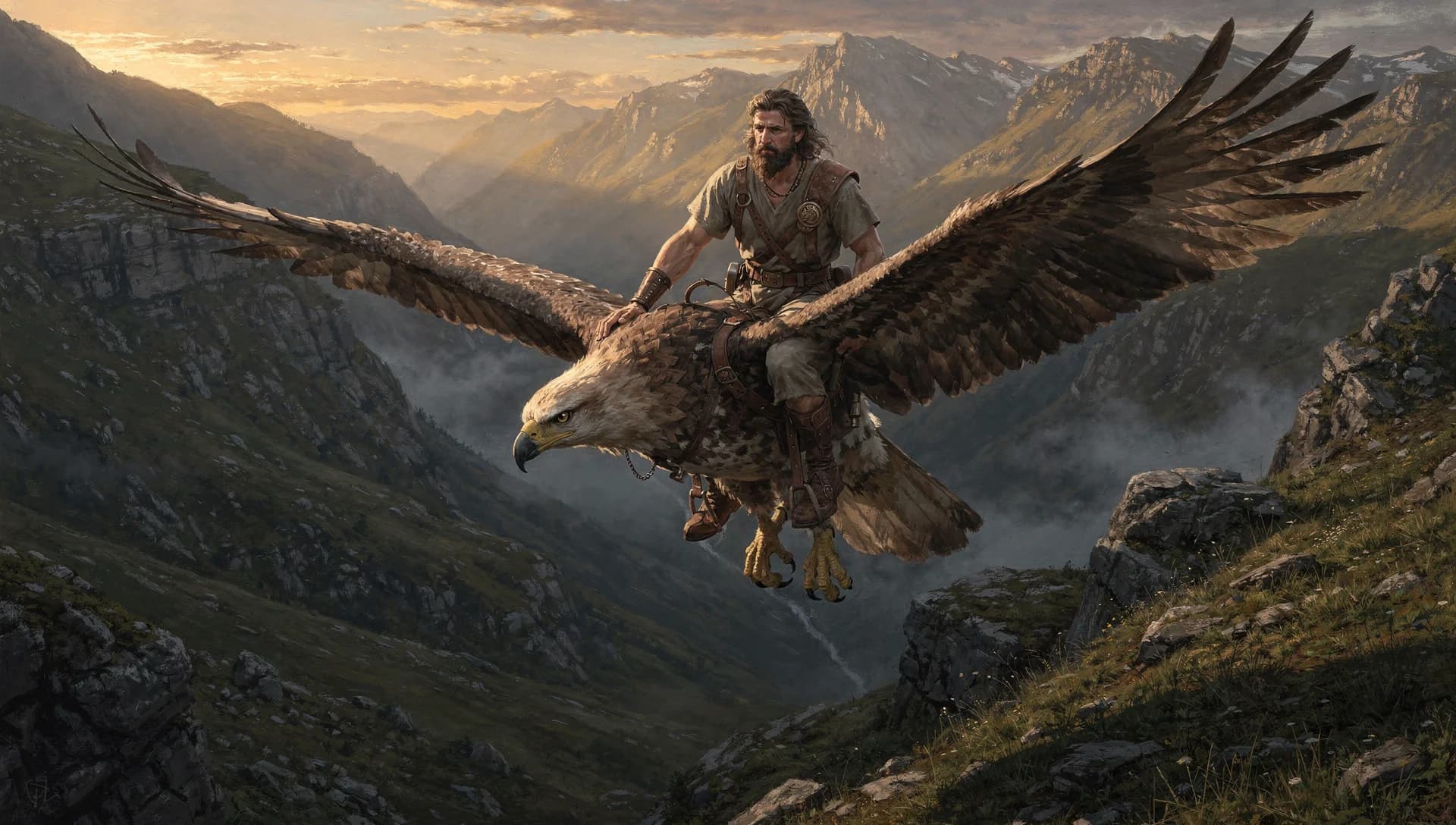
Krishna / Vishnu riding Garuda, giant divine bird
 UB
UBAdamson riding Fandor
Full Article
Read the deep-dive article on this connection
Adamson riding Fandor = Krishna / Vishnu riding Garuda, giant divine bird
The Connection
A violet/blue-skinned superhuman figure riding a giant bird. The UB provides a literal physical basis: Adamson (violet-skinned Adamic descendant) riding a fandor (giant passenger bird). The Hindu tradition preserves this as Krishna/Vishnu riding Garuda.
UB Citation
UB 77:5, 66:5.6
Academic Source
Mahabharata; Garuda Purana
Historical Evidence(Moderate evidence)
Britannica: Garuda is a Hindu deity depicted as "the king of the birds" and the mount (vahana) of Vishnu. The Mahabharata describes Garuda as so massive he can block out the sun. World History Encyclopedia: Garuda carries Vishnu through the skies. Combined with Anzu (Sumerian), Thunderbird (Indigenous), and teratorns (paleontology), the cross-cultural persistence of the "giant rideable bird" motif is remarkable.
Deep Dive
Garuda is one of the most thoroughly developed avian figures in any religious tradition. The Mahabharata devotes substantial passages to his birth and exploits. He is described as so vast that his outspread wings can block the sun. His usual posture in Hindu iconography is as the vahana (mount) of Vishnu, the divine vehicle on which the preserver god travels through the cosmos. He is depicted standing or in flight, with the body of a powerful man, the head and beak and wings of an eagle, and bearing Vishnu (often with Lakshmi) on his back or shoulders. He is the king of the birds. He is the eternal enemy of the nagas, the serpent beings of the underworld. The Garuda Purana, named for him, is one of the eighteen major Puranas of the Hindu canon. From India, the Garuda motif spread throughout Southeast Asia: he is the national symbol of Indonesia and Thailand, and his image dominates the iconography of Buddhist and Hindu temples from Cambodia to Bali.
The composite of "blue-skinned divine figure riding giant bird" is one of the most distinctive iconographic units of South and Southeast Asian religious art. Krishna or Vishnu, blue or dark, mounted on Garuda, eagle-headed and immense, flying through the sky. The combination has no obvious referent in nature. Indian eagles are not large enough to bear human riders. The image is excessive against any zoological reality the cultures could have observed. Yet it persisted and was elaborated for over two thousand years across an enormous geographic range.
The Urantia Book provides a literal explanation that we have already discussed in connection with the Sumerian Anzu. UB 66:5.6 records that "Bon's group were successful in training the great fandors as passenger birds, but they became extinct more than thirty thousand years ago." UB 74:3.4 describes Adam and Eve being carried over the Garden by fandors. The Adamic and Adamsonite traditions involved the use of these large birds for transport. The UB 77:5.10 migration trajectory of Adamson's descendants into India through the Aryan invasions provides the mechanism for the cultural memory to reach the Indian subcontinent.
What is distinctive about the Garuda case, compared to the Sumerian Anzu, is that the bird is paired specifically with the blue-skinned divine figure (Vishnu/Krishna), reproducing the Adamson-on-Fandor scene with extraordinary specificity. UB tradition records Adamson, son of the violet race, riding fandors as one of the heritage activities that he and his line continued from the original Adamic practice. The combination of "violet/blue luminous figure on giant bird" was a real visual scene in the highland Adamsonite culture and was carried as cultural memory by their migrating descendants into the regions that would eventually produce the Vishnu-Garuda iconography.
Two further details support the parallel. First, Garuda's enmity with the nagas (serpent beings) maps onto a feature of the UB account that we have not yet discussed in detail. The post-rebellion period saw the loss of the original civilizational achievements of the Prince's staff, and the descendants of the loyal staff (including Adamson's line) were in continuing tension with the descendants of the rebel staff and with the corrupted post-rebellion populations. Serpent symbolism is widely associated in Mesopotamian and Indian tradition with the rebel side: the serpent in Eden, the nagas of the underworld. Garuda's defining mythological characteristic, his perpetual war with the nagas, is structurally consistent with the cultural memory of the loyal Adamsonite line in continuing struggle with the rebel-derived populations and traditions of the post-Caligastian world.
Second, Garuda's traditional birthplace and homeland in Indian mythology is the northern mountains, not the central plains where most Hindu mythology is set. The Mahabharata locates Garuda's nest on a great mountain in the north. UB tradition places the Adamsonite headquarters in the Kopet Dagh range south of the Caspian Sea, the same general direction north of the Indian subcontinent. The geographic memory points the same way.
The strongest counterargument is the same one we addressed for Anzu: giant divine birds are universal in mythology (the simurgh, the roc, the thunderbird, the phoenix), and any specific match could be archetypal rather than historical. The reply is the same. Universality of the motif is exactly what we would expect if the underlying historical phenomenon (the use of fandors as transport during the Adamic and Adamsonite eras) was genuinely planetwide. The geographic specificity (giant birds always associated with mountainous origins, often paired with luminous heroic riders) and the chronological specificity (the bird is always remembered as something ancient and now lost rather than present in the cultures' current ecology) fit a real historical referent better than they fit a Jungian archetype.
Key Quotes
“Bon's group were successful in training the great fandors as passenger birds, but they became extinct more than thirty thousand years ago.”
“From the large passenger birds, the fandors, Adam and Eve looked down upon the vast stretches of the Garden while being carried through the air over this, the most beautiful spot on earth.”
“Garuda the king of birds was so vast that the spreading of his wings could obscure the sun, and his speed of flight could outpace the wind.”
Cultural Impact
Garuda's cultural reach extends from the Indian subcontinent throughout Southeast Asia and into the modern global imagination through Hindu and Buddhist diaspora and through pop-culture transmission. He is the national emblem of Indonesia, where Garuda Pancasila represents the unity of the nation. He is the symbol of Thailand's monarchy, appearing on the royal standard. He is depicted in stone reliefs at Angkor Wat, Borobudur, and dozens of other major Southeast Asian temple complexes. Through Buddhist transmission, Garuda spread to China, Japan, and Tibet, becoming part of the iconographic vocabulary of those traditions as well. In the modern era, Garuda has become one of the most globally recognizable Hindu mythological figures, appearing in films, video games (the Final Fantasy series, Smite), and contemporary fantasy literature. The combination of avian power and human intelligence, embodied in a being who serves as the divine mount, has been one of the most durable iconographic units in the history of religious art.
Modern Resonance
For contemporary readers familiar with both the Hindu tradition and the broader cross-cultural distribution of giant-bird mythology, the convergence is striking. Garuda in India, Anzu in Mesopotamia, Thunderbird in North America, simurgh in Persia, roc in Arabic tradition, phoenix in China and the Mediterranean: each tradition preserves a memory of a giant bird, often associated with carrying heroic figures, often associated with mountains, often associated with the ancient past rather than current ecology. Mainstream comparative religion has variously explained this convergence as Jungian archetype, as diffusion from a single ancient source, or as independent invention from common psychological substrates. The UB account offers a different explanation: there really were giant birds (fandors), used for transport during specific eras of planetary history, that went extinct in prehistory and survived only in mythological memory. The convergence is not psychological but historical. Modern readers encountering Garuda's image at a temple, or Vishnu mounted on his bird through the sky, are looking at a stylized memory of something that actually happened: a divine figure on a giant bird, traveling between the regions of the early world.
Related Mappings
Adamson + Ratta
= Krishna + Radha
Thought Adjuster, indwelling divine fragment
= Atman, the inner self / divine spark in Hinduism
Salem monotheism, rejected and abstracted
= Brahman, the abstract absolute that replaced personal God
Sethite priests, Adamite-descended teachers
= Brahman priestly caste of India
Related Articles
Where to next
The free newsletter. The research behind each piece, no spam.