
 Mythic
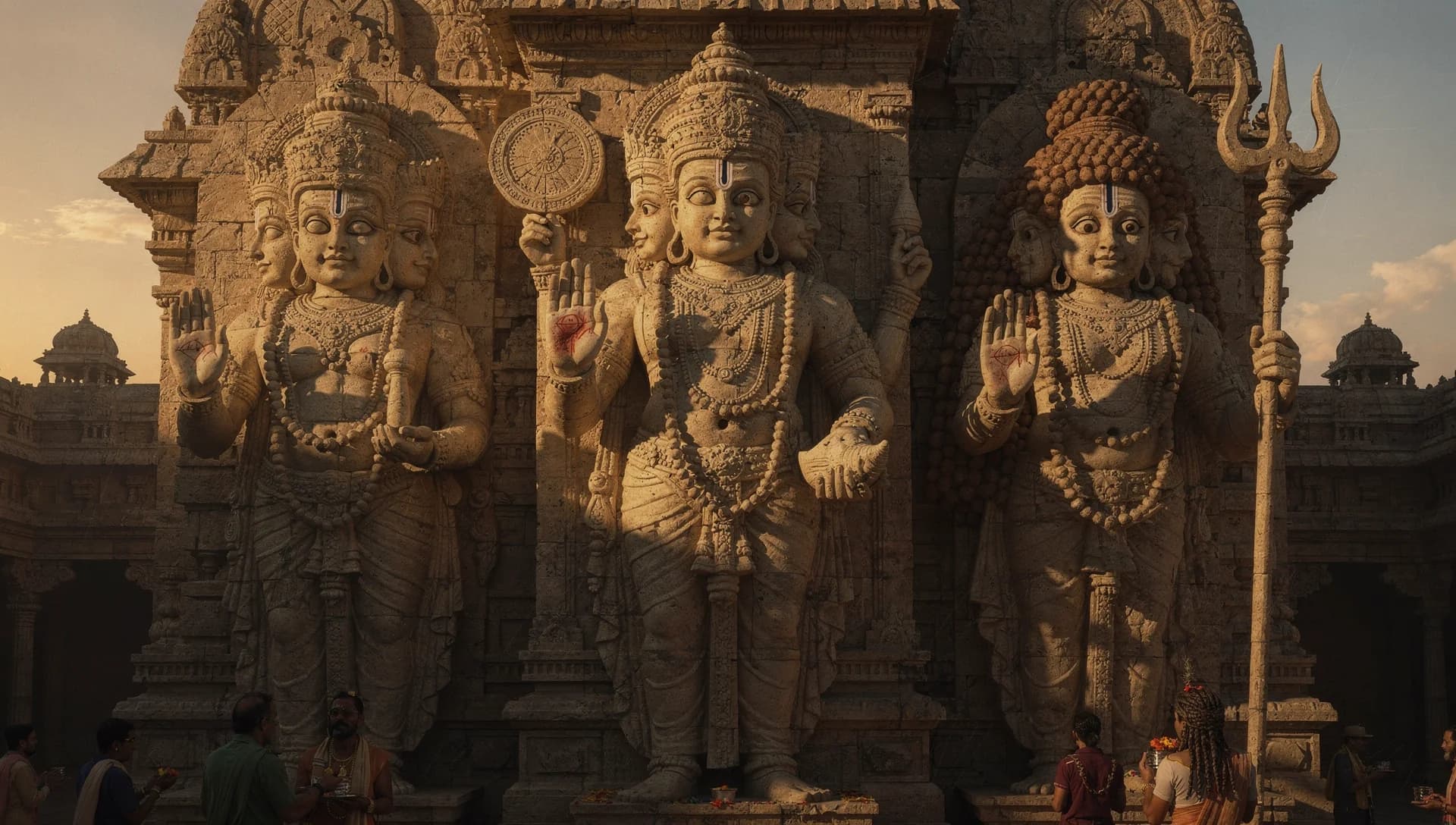
Hindu Trimurti (Brahma, Vishnu, Shiva)
 UB
UBSalem Trinity teaching, corrupted in India
Full Article
Read the deep-dive article on this connection
Salem Trinity teaching, corrupted in India = Hindu Trimurti (Brahma, Vishnu, Shiva)
The Connection
The UB identifies the Hindu Trinity as a corrupted form of the Salem Trinity teaching. Melchizedek taught a three-in-one concept of deity. In India, this was transformed into the Trimurti: Brahma (creator), Vishnu (preserver), Shiva (destroyer). The original Salem teaching of three persons in one God became three separate gods performing three functions.
UB Citation
Academic Source
Matchett, Three Forms of God in Hindu Iconography (2003); Klostermaier, A Survey of Hinduism (2007)
Historical Evidence(Moderate evidence)
The UB traces Trinity concepts across multiple cultures back to Melchizedek's Salem teaching. Freda Matchett documents the development of the Trimurti concept in Hindu theology, noting its relatively late systematization compared to the individual worship of Brahma, Vishnu, and Shiva. Klaus Klostermaier observes that the Trimurti never achieved the same integration as the Christian Trinity, remaining "more a theological construct than a living devotional reality," consistent with the UB description of a corrupted rather than faithfully transmitted teaching.
Deep Dive
The Trimurti, the threefold form of the divine in Hindu theology, presents the supreme reality through three deities with specialized cosmic functions. Brahma is the creator, who brings the universe into being. Vishnu is the preserver, who sustains the world through his ten avatars (with Krishna and Rama as the most prominent incarnations). Shiva is the destroyer, who dissolves the world at the end of each cosmic cycle in preparation for renewal. The three are sometimes depicted as three faces of a single god, sometimes as three separate but coordinated deities, sometimes as a unity-in-trinity comparable in form (though not in content) to the Christian Trinity. The Trimurti concept appears in mature form in the Puranic literature of the early to mid first millennium CE, though its component elements have older roots in the Vedic and Upanishadic periods.
The Urantia Book traces multiple Trinity concepts across the world's religions back to a common source: the Salem teaching of Melchizedek. UB 104:1.5 records: "Among the Hindus the trinitarian concept took root as Being, Intelligence, and Joy. (A later Indian conception was Brahma, Siva, and Vishnu.) While the earlier Trinity portrayals were brought to India by the Sethite priests, the later ideas of the Trinity were imported by the Salem missionaries and were developed by the native intellects of India through a compounding of these doctrines with the evolutionary triad conceptions."
The historical scenario is layered. First, the Sethite priests, descendants of Adam through Seth and carriers of the Adamic religious tradition, brought a Trinity concept (sat-chit-ananda, "being-consciousness-bliss") to India during the Aryan migrations. Second, the Salem missionaries, descendants of the Melchizedek teaching tradition, brought a more developed Trinity concept centered on the personal Universal Father, the Eternal Son, and the Infinite Spirit. Third, the native Indian intellectual traditions absorbed both inputs and combined them with the developing native polytheism, producing the eventual Trimurti concept of Brahma-Vishnu-Shiva.
The result, on the UB account, is a corrupted Trinity. The original Salem doctrine of three persons in one God became three separate gods performing three cosmic functions. The unity-in-multiplicity that is essential to the genuine Trinity doctrine was lost. Brahma, Vishnu, and Shiva are not three persons of one God in the Christian and UB sense; they are three deities with overlapping but partly competing cultic followings, only loosely integrated into a triadic theological structure. The Trimurti is a theological construct that exists in the philosophical literature but does not function as a living devotional reality in the way the Christian Trinity does in Christian devotion. Klaus Klostermaier in A Survey of Hinduism notes this exact point: "The Trimurti, while widely known as a theological concept, has never achieved the integration in devotional practice that the Christian Trinity has." Vaishnavites worship Vishnu, Shaivites worship Shiva, and Brahma is essentially without devotional following despite his theological position as creator. The three deities are doctrinally linked but devotionally separate.
UB 104:1.5 also identifies the earlier Hindu Trinity as sat-chit-ananda, "Being, Intelligence, and Joy." This formulation is older and philosophically more sophisticated than the Brahma-Vishnu-Shiva schema. It appears in the Upanishads and is central to Vedanta. As a description of the impersonal absolute, sat-chit-ananda articulates the inner structure of Brahman: pure being, pure consciousness, pure bliss. The UB identifies this earlier Hindu Trinity as the Sethite contribution, descended from the Adamic religious tradition's understanding of God's inner structure. The later Brahma-Vishnu-Shiva Trinity is identified as the Salem missionary contribution, refracted through Indian polytheistic syncretism into the popular three-deity formulation.
The strongest counterargument is that Hindu theology has its own internal logic for the development of the Trimurti, with no need for external influence from Salem missionaries. The reply is that the Hindu tradition's distinctive emphasis on threefold divine structures, paralleled in the Christian Trinity, the Buddhist trikaya doctrine, the Egyptian Atum-Shu-Tefnut and Osiris-Isis-Horus formulations, and several other Mediterranean and Near Eastern triads, suggests a common source rather than independent invention. The UB account names that common source: the Melchizedek Salem teaching of one God in three persons. Each receiving culture refracted the teaching through its own philosophical and religious vocabulary, producing locally distinctive Trinity formulations. The Hindu Trimurti is one such refraction. The Christian Trinity, though developed through different historical channels, descends ultimately from the same Salem source. The structural similarity across cultures, often noted by historians of religion as a puzzle, is on the UB account the natural consequence of common origin.
Key Quotes
“Among the Hindus the trinitarian concept took root as Being, Intelligence, and Joy. (A later Indian conception was Brahma, Siva, and Vishnu.) While the earlier Trinity portrayals were brought to India by the Sethite priests, the later ideas of the Trinity were imported by the Salem missionaries and were developed by the native intellects of India through a compounding of these doctrines with the evolutionary triad conceptions.”
“The Buddhist faith developed two doctrines of a trinitarian nature: The earlier was Teacher, Law, and Brotherhood; that was the presentation made by Gautama Siddhartha. The later idea, developing among the northern branch of the followers of Buddha, embraced Supreme Lord, Holy Spirit, and Incarnate Savior.”
“The Trimurti, while widely known as a theological concept, has never achieved the integration in devotional practice that the Christian Trinity has.”
Cultural Impact
The Trimurti concept has shaped Indian theological thought for nearly two millennia, providing a framework for integrating the major Hindu sectarian traditions into a coordinated theological vision. Through Hindu temple iconography, the Trimurti has been one of the most reproduced religious images in Indian art: the three deities depicted together, sometimes as three figures, sometimes as a single three-faced figure (Trimurti Sadashiva, particularly famous in the Elephanta Caves sculpture from the sixth or seventh century CE). The concept has been important in Hindu philosophical theology, in the integration of Vaishnavism and Shaivism within the broader Hindu tradition, and in the popular religious imagination as a way of organizing the multiplicity of Hindu deities into a coherent structure. The cultural inheritance has been substantial within India and within the broader Indo-Asian cultural sphere. Outside India, the Trimurti has been less directly influential than the Christian Trinity, but through nineteenth-century Western reception of Hindu thought (Schopenhauer, Emerson, the Theosophists), it has contributed to comparative-religion frameworks and to popular understanding of the structural similarities across major religious traditions.
Modern Resonance
Comparative religion has long noted the prevalence of trinitarian structures across major world religions: Christianity, Hinduism, Buddhism, Egyptian religion, late Roman religion, and others. Mainstream academic explanations of this convergence vary: Jungian archetypes of psychological completeness, structuralist accounts of triadic categorization in human cognition, historical diffusion from one or more common sources. The UB account is the diffusion account, with the specific identification of Melchizedek's Salem teaching as the historical source. For contemporary readers interested in the underlying unity of the world's major religions, the UB framework provides a historical mechanism that connects the Hindu Trimurti, the Christian Trinity, the Buddhist trikaya, and the Egyptian theological triads as distinct refractions of a single ancient revelation. The cultural-historical specificity of the UB account distinguishes it from purely archetypal or structuralist accounts. The Trinity concept, on the UB reading, is not a generic feature of religious thought; it is a specific theological insight transmitted through a specific historical movement (the Melchizedek Salem mission) and refracted through diverse cultural receptions across the literate world.
Related Mappings
Related Articles
Where to next
The free newsletter. The research behind each piece, no spam.