
 Mythic
Mithraic tauroctony: the bull-slaying as cosmic-order symbol
 UB
UBCorporate memory of the Lucifer rebellion and cosmic dualism
Full Article
Read the deep-dive article on this connection
Corporate memory of the Lucifer rebellion and cosmic dualism = Mithraic tauroctony: the bull-slaying as cosmic-order symbol
The Connection
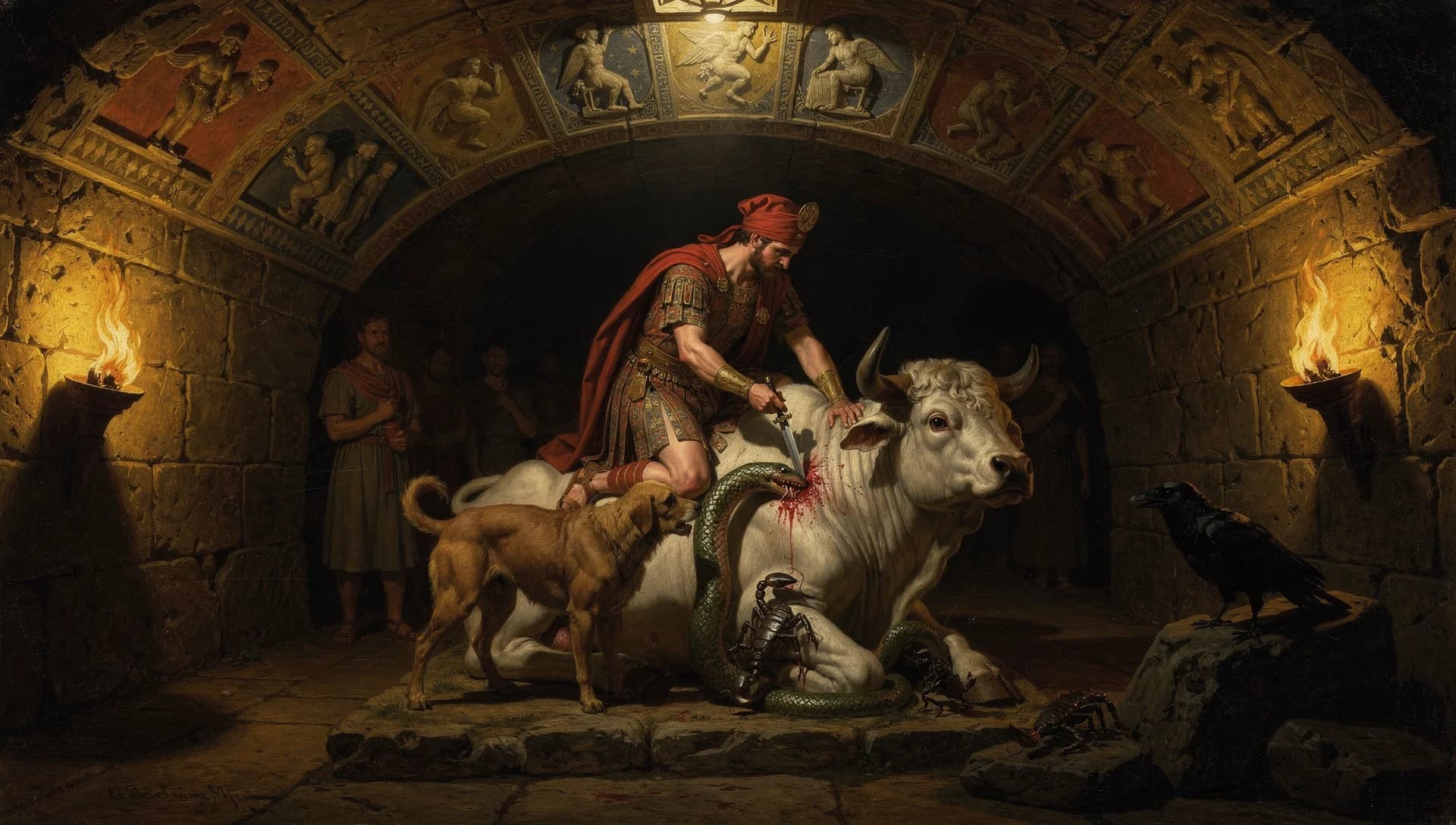
Mithraic iconography centers on the tauroctony, Mithras slaying a bull while a serpent, scorpion, dog, and raven attend the scene. Scholarly analysis (Ulansey, Beck) has demonstrated the astronomical encoding: Mithras represents the power that moves the equinoxes, overcoming the old cosmic order (Taurus age) and inaugurating a new one. The Zoroastrian roots of Mithraism preserve, in garbled form, memory of the Lucifer rebellion as a cosmic conflict between good and evil, and the tauroctony visualizes the renewal of cosmic order after that conflict.
Academic Source
Ulansey, The Origins of the Mithraic Mysteries (1989); Beck, The Religion of the Mithras Cult (2006)
Historical Evidence(Moderate evidence)
David Ulansey demonstrated that the tauroctony encodes the precession of the equinoxes, with Mithras as the cosmic power who moves the ages. Roger Beck extended the astronomical reading through the grade-hierarchy structure of the mysteries. The UB says of the Mithraic sun-god: "This sun-god, or Sol Invictus, was a degeneration of the Ahura-Mazda deity concept of Zoroastrianism" (98:5.3). Of Zoroastrian dualism it says: "Only in later times did the belief gain credence that good and evil contended on equal terms" (95:6.5). Tracing that dualism back to the rebellion and on to Roman Mithraic cosmology is our reading. The tauroctony reads naturally as a symbolic image of cosmic renewal after the rebellion rather than an abstract astronomical allegory alone.
Deep Dive
Walk into a Mithraeum, the rectangular subterranean cult chamber of the Roman Mithras religion, and at the head of the room you will find the same image, repeated with minor variations from Britain to Syria, from Germania to North Africa: a young man in Phrygian cap, kneeling on a great bull, holding the bull's nostrils with his left hand and plunging a short sword into its shoulder with his right. Around the central scene, a fixed iconographic vocabulary appears: a serpent and a dog drink the bull's blood, a scorpion attacks its testicles, a raven perches on the cape of the bull-slayer, the sun and moon look on from above, and twin torch-bearers (Cautes and Cautopates, one with torch up and one with torch down) flank the scene. This is the tauroctony, the bull-slaying, and it is the central icon of one of the most widespread mystery religions of the Roman Empire.
The Urantia Book at 98:5.3 describes the Mithraic cult as portraying a militant god taking origin in a great rock, engaging in valiant exploits, and causing water to gush forth from a rock struck with his arrows. The UB notes that this Sol Invictus was a degeneration of the Ahura-Mazda deity concept of Zoroastrianism, and that Mithras was conceived as the surviving champion of the sun-god in his struggle with the god of darkness. In recognition of his slaying the mythical sacred bull, Mithras was made immortal, being exalted to the station of intercessor for the human race among the gods on high. Two key elements appear in the UB description: the Zoroastrian inheritance, and the cosmic-conflict frame of struggle between light and darkness.
The UB at 95:6.5 traces Zoroastrian dualism itself to distorted memories of the actual Lucifer rebellion. The full lineage runs: real cosmic rebellion (Lucifer, c. 200,000 BCE) becomes Zoroastrian dualism (Iran, c. 1500 BCE) becomes Roman Mithraism (Mediterranean, c. 100 BCE through 400 CE). At each stage the underlying memory is preserved in increasingly mythological form. By the time of the Roman Mithraic cult, the original administrative event has become a cosmic-symbolic drama enacted by a young god slaying a bull.
David Ulansey, in his 1989 monograph The Origins of the Mithraic Mysteries, demonstrated that the tauroctony encodes the precession of the equinoxes. Mithras represents the cosmic power that moves the equinoxes from one zodiacal sign to another, with the bull-slaying iconographically marking the end of the Age of Taurus and the beginning of the Age of Aries (around 2000 BCE) as observed by Hipparchus's contemporaries. Roger Beck, in The Religion of the Mithras Cult in the Roman Empire (2006), extended the astronomical reading through the seven-grade hierarchy of initiation (Raven, Bridegroom, Soldier, Lion, Persian, Sun-Runner, Father) corresponding to the seven planets. The cult, on this reading, was a cosmological mystery whose ritual practice was the symbolic enactment of cosmic-order renewal.
The structural match with the UB account is clean if we read the tauroctony as a symbolic image of cosmic renewal after the Lucifer rebellion. The young god in Phrygian cap, slaying the bull of the old cosmic order to inaugurate a new one, with the heavenly bodies witnessing, is what you would expect to develop in the cultural memory of a system that had really experienced a cosmic rebellion and a real adjudication. The Zoroastrian framing, light versus darkness, good versus evil, would then naturally develop into a cosmic-symbolic icon in the Mithraic Roman context. The astronomical encoding (Ulansey, Beck) and the cosmic-rebellion-memory reading are complementary rather than competing: the same imagery can carry both readings simultaneously, with the astronomical layer serving as the visible vehicle for the underlying mythological-historical content.
The strongest counterargument is that Mithraism is a Roman invention with little real Iranian content, the so-called "Roman Mithraism" thesis advanced by Cumont's critics. The reply is that even the strong-Roman-invention reading agrees that the cult drew on Iranian theological vocabulary and that the cosmic-dualism frame is non-Roman in origin. The UB account does not require that Mithraism be a direct lineal descendant of Iranian Zoroastrianism; it requires only that the cosmic-dualism memory survived in attenuated form into the Mithraic synthesis. That is a weaker claim and is well-supported by the surviving evidence.
What the parallel implies is that the cosmic-symbolic content of the Mithraic mysteries, the bull-slaying, the cosmic conflict, the renewal of cosmic order, was not invented from whole cloth in the Roman period. It was the cultural inheritance of older Iranian dualism, which itself was the cultural inheritance of older Zoroastrian engagement with rebellion-memory traditions, which themselves were degraded memories of the actual Lucifer rebellion. The contemporary historian of religion has access to the surviving iconography. The UB has access to the underlying historical referent. Bringing the two together yields an unusually full account of one of the most ritually elaborate Roman mystery religions.
Key Quotes
“The Mithraic cult portrayed a militant god taking origin in a great rock, engaging in valiant exploits, and causing water to gush forth from a rock struck with his arrows. There was a flood from which one man escaped in a specially built boat and a last supper which Mithras celebrated with the sun-god before he ascended into the heavens. This sun-god, or Sol Invictus, was a degeneration of the Ahura-Mazda deity concept of Zoroastrianism. Mithras was conceived as the surviving champion of the sun-god in his struggle with the god of darkness. And in recognition of his slaying the mythical sacred bull, Mithras was made immortal, being exalted to the station of intercessor for the human race among the gods on high.”
“Zoroastrianism is the only Urantian creed that perpetuates the Dalamatian and Edenic teachings about the Seven Master Spirits. While failing to evolve the Trinity concept, it did in a certain way approach that of God the Sevenfold. Original Zoroastrianism was not a pure dualism; though the early teachings did picture evil as a time co-ordinate of goodness, it was definitely eternity-submerged in the ultimate reality of the good. Only in later times did the belief gain credence that good and evil contended on equal terms.”
“Ulansey demonstrates that the tauroctony encodes the precession of the equinoxes, with Mithras as the cosmic power that moves the ages and the bull-slaying marking the cosmological transition from one age to the next.”
Cultural Impact
The Mithraic cult was Christianity's primary competitor in the Roman Empire of the second through fourth centuries CE. The two religions ran in parallel, with Mithraea and house-churches sometimes located within blocks of each other in cities like Rome, Ostia, Carnuntum, and Doura-Europos. Mithraic ritual elements that fed into Christian practice include the December 25 birthday of the Sun (adopted as Christmas), the Sunday weekly worship day (Mithraic, then Christian), the sacred meal of bread and wine, the seven-grade hierarchy of initiation (loosely paralleled in the Christian threefold orders of deacon, priest, bishop, plus minor orders), and the cosmic-redeemer iconography. The tauroctony itself did not enter Christianity, but its underlying cosmic-conflict frame did, with Christ as the slayer of cosmic evil in Christus Victor atonement theology, the cosmic-Christ imagery of Colossians and Ephesians, and the apocalyptic warrior-Christ of Revelation. Beyond the Christian channel, the tauroctony has had a long afterlife in Western esoteric tradition, with seventeenth-century Rosicrucianism, eighteenth-century Freemasonry (whose initiation grade structure resembles the Mithraic), and twentieth-century Theosophy all drawing on the bull-slaying imagery. Carl Jung treated the tauroctony as a primary archetype of the hero's victory over the unconscious bull-of-instinct.
Modern Resonance
Contemporary scholarship on Mithraism is divided between the strong-Iranian-continuity school (Cumont, Beck, Boyce-influenced) and the strong-Roman-invention school (Gordon, Beck's later work in part), with most scholars now occupying middle positions that allow for partial Iranian inheritance combined with substantial Roman elaboration. The UB framework participates in this conversation by providing a longer historical lineage than either pole considers: the cosmic-dualism content goes back not to Zoroaster's sixth-century BCE moment but through Zoroaster to the original Lucifer rebellion of two hundred millennia ago. This is a stronger claim than academic scholarship can verify, but it offers a coherent explanation for why the cosmic-conflict imagery of Mithraism feels so much older and deeper than its second-century BCE Roman emergence: the imagery is older and deeper, with a real referent in the actual cosmic history of the system. For contemporary readers drawn to the Mithraic mysteries through Western esoteric tradition, the UB framework offers a way to take the cosmic-conflict imagery seriously without requiring belief in either the astronomical encoding or the literal bull-slaying mythology. The underlying memory of cosmic rebellion is real. The Mithraic iconography is one of its most elaborate cultural preservations.
Related Mappings
Salem teaching corrupted into dying/rising god cult
= Cybele and Attis, mother-son mystery religion
Day of Attis' death, pre-Christian sacred calendar
= "Black Friday," the original day of mourning before Easter
Pre-Christian mother-goddess cult in Rome
= Mother of God temple on the site of St. Peter's Basilica
Paul's composite Christianity
= Jewish morality + Greek philosophy + mystery cult ritual
Related Articles
Where to next
The free newsletter. The research behind each piece, no spam.