
 Mythic
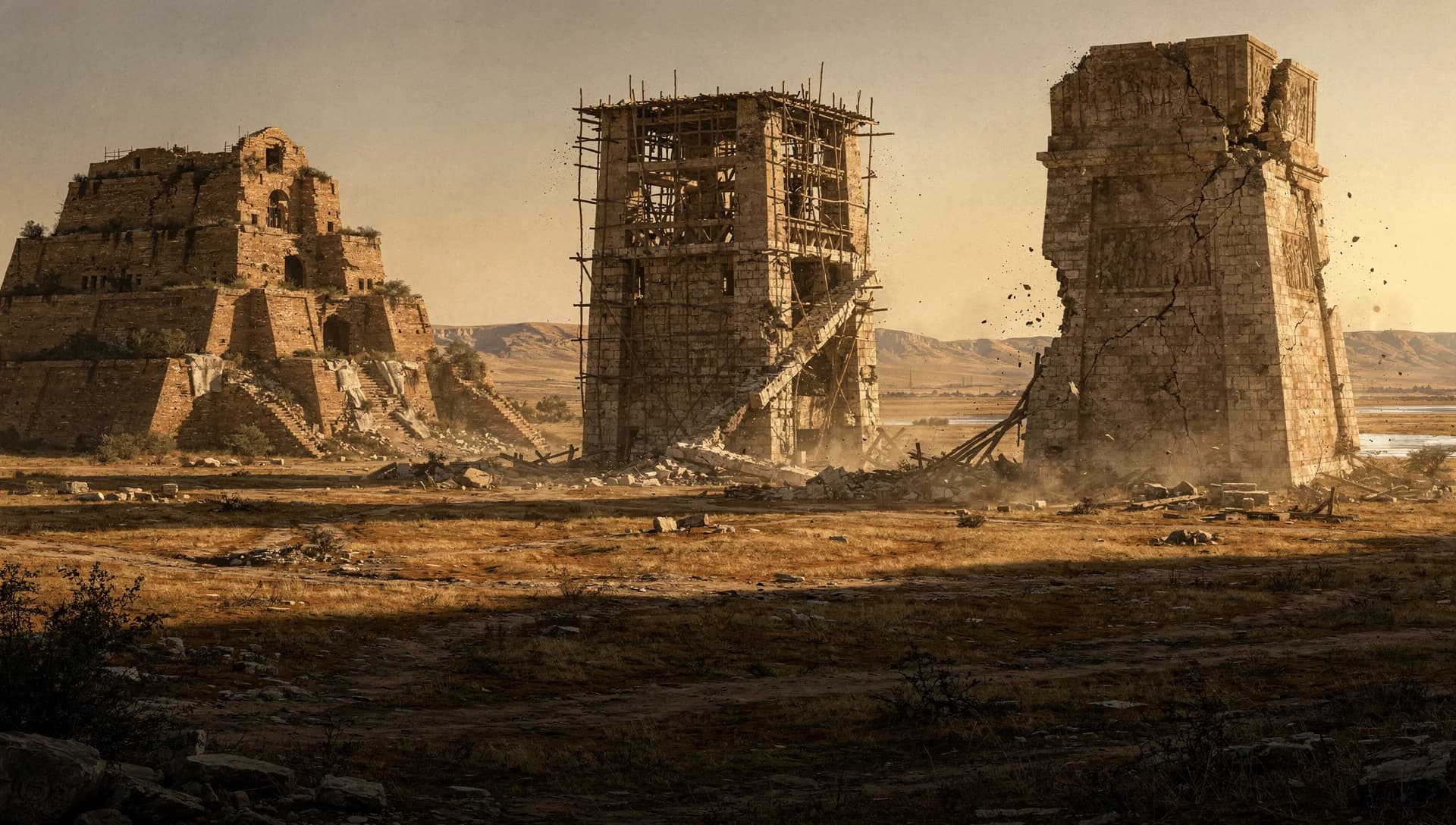
Tower of Babel / Babylon: three towers, not one
 UB
UBBablot → Bablod → Babel → Babylon
Full Article
Read the deep-dive article on this connection
Bablot → Bablod → Babel → Babylon = Tower of Babel / Babylon: three towers, not one
The Connection
Genesis describes one Tower of Babel. The UB describes THREE attempts over 150,000+ years. Tower 1: Bablot's tower (~150,000 years ago), destroyed by civil war between three factions (77:3.1-8). Tower 2: Andite attempt on the ruins (~10,000 BCE), collapsed under its own weight (77:3.9). Tower 3: Barbarian cavalrymen in Babylon adopted the name and tried again (78:8.4). The "confusion of tongues" is the degraded memory of the three-faction dispute.
UB Citation
UB 77:3.1-9, 78:8.4
Academic Source
Genesis 11:1-9; Kramer (1956), History Begins at Sumer; George (2007), Tower of Babel archaeology
Historical Evidence(Moderate evidence)
The original Bablot was near the first Dilmun (Persian Gulf coast, likely southern Iran). The name migrated: Bablot → Bablod → Babel. The third attempt was in historical Babylon on the Euphrates (modern Iraq). The Genesis narrative compressed all three into one event with divine language confusion replacing the actual cause: a civil war over purpose.
Deep Dive
Genesis 11:1-9 tells the story of the Tower of Babel: the whole earth had one language, the people gathered in the plain of Shinar, they began to build a tower whose top would reach heaven, the Lord came down and confused their language so they could not understand one another, and the building was abandoned. The narrative is brief, evocative, and theologically loaded. It explains the diversity of human languages as divine punishment for hubris. It locates the event in Babylon (Babel = Babili = Babylon, "gate of god"). It treats the construction as a single failed project.
The UB account is significantly more complex. UB 77:3.1-9 describes not one but three towers, separated by enormous spans of time. Tower 1 was Bablot's tower, built roughly 200,000 years ago by the Nodite descendants of the Prince's defaulted staff. The motivation was racial preservation: as the Nodites had multiplied and intermarried with surrounding Andonite and Sangik populations, their distinctive racial identity was at risk, and the tower was proposed as a unifying monument to their collective heritage. The project failed not through divine intervention but through internal civil war between three factions: those who wanted a memorial of Nodite history, those who wanted a temple of worship, and those who wanted a fortified retreat from foreign attack. The factions could not agree, and the conflict over purpose dispersed the population.
Tower 2 came roughly 10,000 BCE, an Andite-era attempt to build on the ruins of Bablot, which collapsed under its own weight (UB 77:3.9). Tower 3 was a much later attempt at historical Babylon by "barbarian cavalrymen" (UB 78:8.5), of whom the book says: "These conquerors of Mesopotamia carried in their ranks many of the better Andite strains of the mixed northern races of Turkestan, including some of the Adamson stock" (UB 78:8.4). These conquerors of Mesopotamia "quickly and willingly assimilated the residue of the civilization of Mesopotamia" and adopted the older tower-name, attempting their own version on the Euphrates plain.
The Genesis narrative compressed all three attempts into a single mythologized event, with the historical cause (civil war over purpose, structural collapse, and political-cultural assimilation) replaced by a theologically convenient cause (divine punishment of human hubris). The "confusion of tongues" replaces the actual confusion of factions in Bablot's civil war.
The etymological chain Bablot → Bablod → Babel → Babylon traces the name across these transitions. The Sumerian-Akkadian Bab-ili / Bab-ilim ("gate of god") is the historical Bronze Age form of the name, attached to the city on the Euphrates that is the location of the third tower attempt. The Hebrew Bavel (Babel) preserves the same root through Aramaic-Hebrew transmission. The original Bablot, by the UB account, is the proto-form from which the later names descended through 200,000 years of linguistic transmission.
The mainstream archaeological consensus on the Tower of Babel is that the historical kernel, if any, is the Etemenanki ziggurat in Babylon, which was a real seven-tiered stepped pyramid dedicated to Marduk. The ziggurat was rebuilt repeatedly in the second and first millennia BCE. Andrew George's 2007 work on the architectural history of Etemenanki provides the standard scholarly treatment. The ziggurat is, in the UB framing, the historical residue of the third tower attempt.
The strongest counterargument to the UB three-tower framework is the absence of textual or archaeological evidence for towers earlier than the Babylonian ziggurat tradition. The Sumerian textual record does not mention multi-millennial earlier tower attempts. The archaeological record at the relevant Persian Gulf coastal sites is largely submerged and inaccessible. The UB account stands on its own authority in proposing the deeper history.
The counter-defense is that the Genesis narrative, with its language of "tower whose top reaches heaven" and its theological compression, is exactly what we would expect if multiple historical events had been conflated in scribal redaction. The plurality of original events leaves traces in the multiplicity of associated motifs (a memorial, a temple, a fortified retreat) that the Genesis narrative would not naturally generate from a single original event. The UB account treats these motif-multiplicities as historical residue rather than narrative ornament.
What the chain Bablot → Babel illustrates is the general UB approach to ancient mythology: complex historical realities get compressed and simplified in tradition, and the residue of the compression is visible in motif-multiplicities that the simplified tradition cannot fully integrate. Reading the Genesis Babel narrative through the UB framework reveals more historical content than the text itself preserves, while honoring rather than dismissing the surface tradition.
Key Quotes
“After the submergence of Dalamatia the Nodites moved north and east, presently founding the new city of Dilmun as their racial and cultural headquarters. And about fifty thousand years after the death of Nod, when the offspring of the Prince's staff had become too numerous to find subsistence in the lands immediately surrounding their new city of Dilmun, and after they had reached out to intermarry with the Andonite and Sangik tribes adjoining their borders, it occurred to their leaders that something should be done to preserve their racial unity.”
“These conquerors of Mesopotamia carried in their ranks many of the better Andite strains of the mixed northern races of Turkestan, including some of the Adamson stock. These less advanced but more vigorous tribes from the north quickly and willingly assimilated the residue of the civilization of Mesopotamia.”
Cultural Impact
The Tower of Babel is one of the most enduring images in Western literature, art, and theology. From Pieter Bruegel's Tower of Babel paintings (1563 and later) to contemporary literary references, the image of a failed monumental project struck down by divine punishment has shaped Western thinking about hubris, technology, and the relationship between human ambition and divine sovereignty. The UB plural-tower framework reframes this entire tradition. The Babel narrative is not a fable about hubris but a compressed memory of a real political-architectural-civic crisis that occurred multiple times across hundreds of thousands of years. The lesson is not that humanity's ambitions are inherently displeasing to God but that political projects without unified purpose tend to collapse under their own internal contradictions. This reframing has practical implications for contemporary political and architectural thinking. The Bablot civil war was not a punishment from on high but a structural failure in the political design of a project that combined incompatible objectives (memorial, temple, refuge) under a single architectural program. Modern attempts to build civic monuments that serve multiple incompatible purposes face the same structural risk. The UB framework offers a sober, internally-coherent reading of why monumental projects fail rather than the theologically convenient external-punishment account.
Modern Resonance
In an era of large-scale infrastructure projects, megacity construction, and ambitious technological initiatives, the question of how to align competing purposes within a single project remains live. The UB framing of Bablot's tower as a civil war between memorial-builders, temple-builders, and refuge-builders is recognizable as the standard pathology of contemporary large-scale projects: stakeholders cannot agree on the primary purpose, and the project either fails outright or produces a compromised result that satisfies no constituency. The contemporary parallel that often comes to mind is the World Trade Center reconstruction after September 11. The project had to satisfy commercial, memorial, and civic-symbolic functions, and the resulting compromise (One World Trade Center plus the Memorial pools plus the Oculus transportation hub) reflects exactly the kind of multi-purpose accommodation that often produces unsatisfying results. The UB framing of Bablot suggests this is a recurring human pattern rather than a uniquely modern challenge. For readers in 2026, the UB Tower of Babel framework offers a practical lens for evaluating contemporary monumental projects. When a project tries to be a memorial, a temple, and a fortress at once, it is courting Bablot's fate. When the purpose is unified, the project can succeed. This is not a theological lesson but a structural one, and the UB framework recovers it from the theological framing that Genesis imposed.
Related Mappings
UR-AN-TIA, the planet's name
= "Land of An (the Prince)"
DALA-MA-TIA, headquarters city
= "Land/Place of Daligastia"
The UR root, oldest identifiable root in human language
= Ur, Uruk, Urartu, Armenia, Iran, Iraq, Ararat, Aram, Eridu
Van's highland headquarters
= Lake Van (Turkey), name preservation, NOT the HQ location
Related Articles
Where to next
The free newsletter. The research behind each piece, no spam.