
The Hat, the Hammer, and the Million Light Years
Gary Tonge warned that we may be trading our mind for a fancy mechanical hat. I went back to the sources, from Hubble's own papers to what the Urantia Book says about machines, and found his concern holds up better than some allowed.

A response to Gary Tonge's "Trading our Mind for a Fancy Mechanical Hat" (urantiabook.org, October 22, 2026).
A word before we start
Gary asked a fair question, and it deserves a straight answer. I am one of the people his article is talking about.
I use AI tools nearly every day. They help me research, organize, build the Urantia Book Network website, and produce films. In May I published "Kantor's Map: The Urantia Outreach Problem in the Age of AI" here on the Urantia Book Network, a written companion to David Kantor's talk at the Urantia Foundation Leadership Roundtable. It describes the AI layer that now stands between every seeker and the revelation, and how our community can write for it with integrity. So when a respected voice in our community warns that we may be "trading our mind for a fancy mechanical hat," I am not reading from the bleachers. I am wearing the hat, and I want to know whether it fits.
So I went back to the sources. I checked every UB passage Gary quoted against the text. I followed his Andromeda story back to Hubble's own papers. I looked up Sam Altman's own words. And I read more of the Urantia Book on machines, mind, and tools than either of us quoted the first time.
What I found surprised me. Gary's central concern holds up better than some readers allowed. A few of his facts do not, and one of them turns out to be the best evidence for his own point. Here is all of it.
Where we agree, more than you might think
The heart of Gary's article is true, so that is where I want to start.
Every passage he quotes is accurate, and each one is used in its proper sense. The psychic circles demand "the harmonious functioning of the entire personality, not merely of some one phase thereof" (110:6.3). "Effort does not always produce joy, but there is no happiness without intelligent effort" (48:7.10). And his strongest point comes straight from the midwayers: "If this were merely a material universe and man only a machine, such a man would be wholly unable to recognize himself as such a machine" (195:7.3).
The same paper says even more. "A machine cannot know, much less know truth, hunger for righteousness, and cherish goodness" (195:6.11). And again: "Machines do not think, create, dream, aspire, idealize, hunger for truth, or thirst for righteousness" (195:7.14). The midwayers wrote those lines about the philosophy of mechanism, not about software. But they apply cleanly. Whatever a language model is doing when it strings words together, it is not knowing truth, and it is not hungry for righteousness. The unease Gary feels when people talk as if it were is well placed.
The revelation also puts the creative center of life exactly where Gary does: "The advances of true civilization are all born in this inner world of mankind. It is only the inner life that is truly creative" (111:4.3).
And there is research that should give every one of us pause. In 2023, researchers from Harvard Business School and Boston Consulting Group ran a field experiment with 758 consultants doing realistic work. On tasks the AI handled well, consultants using it finished 12.2 percent more tasks, worked 25.1 percent faster, and produced work rated about 40 percent higher in quality. But on a task chosen to sit just outside what the AI could do reliably, the consultants using it got the right answer far less often. The share of correct answers fell from 84 percent without AI to roughly 60 to 70 percent with it. The machine gave confident answers that were not correct, and capable professionals believed it.
That is Gary's warning, measured in the field. So before I say a word about where his article and I part ways, I want to be clear: on the danger of surrendering our judgment to a confident machine, we are on the same side.
Following the Andromeda trail
The centerpiece of Gary's article is a story. While making his 2023 video "What Is Revelation," he researched the changing estimates of the distance to Andromeda. His slide lists Hubble at 930,000 light years in 1923 and 1,500,000 in 1925. When a friend asked for the citations in 2026, he spent well over an hour with Google, which finally offered "about 900,000." He calls that a "huge rounding error" and says the Universal Censor used Hubble's first figure "because Hubble's first estimate was the closest to the truth by far."
I went looking for the same citations, starting with the primary sources. Here is the record.
| When | Who | Distance to Andromeda |
|---|---|---|
| Today | Several teams, several methods | About 2.5 million light years (about 780,000 parsecs) |
| 1950s | Walter Baade's recalibration of the Cepheid scale | Hubble's distances roughly doubled |
| 1934 | W. F. G. Swann, The Architecture of the Universe | Light "takes nearly a million years to reach us" |
| 1929 | Hubble, Astrophysical Journal 69:103 | 275,000 parsecs, which Hubble himself writes as 900,000 light years |
| January 1, 1925 | Hubble's Cepheid result, read at the American Astronomical Society | At least 930,000 light years (285,000 parsecs) |
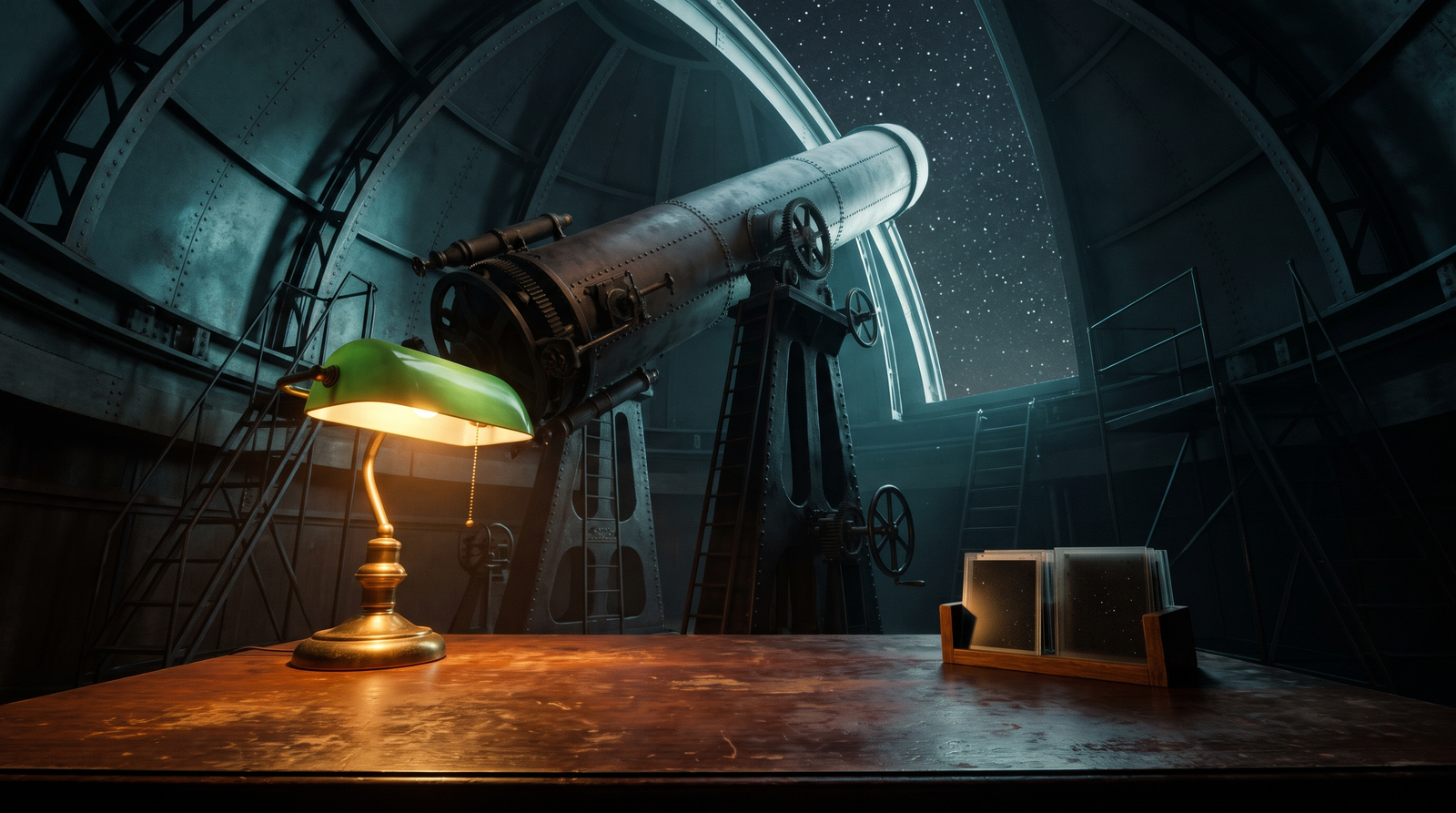
Hubble first spotted his famous Cepheid on a photographic plate in October 1923, which is likely why the slide gives that year. The distance itself was announced at the start of 1925.
Three things stand out.
The first estimate was not the closest. At 930,000 light years, Hubble placed Andromeda at about 37 percent of its real distance. The 1.5 million figure on Gary's slide would have been closer, and every estimate after Baade's work was closer still. Hubble's own 1929 figure moved slightly nearer, not farther. The Urantia Book's "almost one million years" (15:4.7) is short of today's value by a factor of about two and a half.
The "rounding error" is a number Hubble used himself. Google's "about 900,000" is a fair rounding of 930,000, within about 3 percent, and it is the very figure Hubble printed in his 1929 paper.
The 1.5 million figure has a human trail. I could not find it anywhere in Hubble's own work. So I searched for where it shows up, and I found the same figure, in nearly the same list, in a Universe Today article on the distance to Andromeda. That article says that in 1925 Hubble "calculated that the galaxy was actually 1.5 million light-years away," and it lists Heber Curtis at 500,000 and modern measurements of 2.57, 2.51, 2.52, and 2.56 million. Gary's slide carries nearly the same list, with Hubble's 930,000 added. And the Google summary in Gary's own screenshot cites Universe Today.
I have done exactly this myself. It looks like Gary did honest research in 2023 and trusted a popular science site, which is what most of us would do. Years later, the search engine leaned on the same site. As far as I can tell, the machine did not invent the error. It repeated what it found.
And that, I think, is the most useful thing in this whole story. The danger Gary is pointing to is real, but it is older than AI. It is the danger of trusting a summary instead of a source. The summary can come from a website, a teacher, a beloved slide, or a chatbot. The cure is the same every time: go back to the original.
What the revelators said about their own science
The good news is that our faith never depended on the Andromeda number being ahead of its time. The revelators told us so themselves, in a Melchizedek paper on the limitations of revelation.
"We are not at liberty to anticipate the scientific discoveries of a thousand years." They knew that "within a few short years many of our statements regarding the physical sciences will stand in need of revision." And then the line every student should know by heart: "The cosmology of these revelations is not inspired. It is limited by our permission for the co-ordination and sorting of present-day knowledge" (101:4.2).
That fits Andromeda exactly. When the papers were being prepared, the best science said its light took nearly a million years to reach us. Matthew Block noted in the comments that he is "sure the source for the UB passage about the distance to Andromeda is Swann's 1934 book, The Architecture of the Universe," and Swann's wording is a close match. The Universal Censor sorted present day knowledge, just as the mandate required. We do not have to picture the author choosing one of Hubble's numbers over another for its hidden accuracy, and in this case the hidden accuracy was not there anyway.
The same section says what revealed cosmology is still good for. Such statements, it says, "at least transiently" clarify knowledge (101:4.5), including through "the reduction of confusion by the authoritative elimination of error" (101:4.6) and "the supplying of information which will fill in vital missing gaps in otherwise earned knowledge" (101:4.9). They were never meant to be a prophecy we test against the Hubble Space Telescope.
The revelators even warned about the trap. Students "are tempted to discard any element of genuine religious truth it may contain because they discover errors on the face of the associated cosmologies" (101:4.1). The mirror image carries its own risk. If we stake the revelation on its science being prescient, we hand every skeptic an easy win the moment the numbers move. Block put the Andromeda case plainly: "The Andromeda case is one where the UB has not proved to be prescient." Our footing is the spiritual truth, which, the same Melchizedek tells us, "will stand on the records of the ages to come" (101:4.2).
What the machine reads is what we write
There is one more piece of this story, and it is an encouraging one. It comes from David Kantor's talk at the Urantia Foundation Leadership Roundtable in Chicago this April, which I wrote up for this site in May as "Kantor's Map."
Kantor's point is that AI search no longer works like a card catalog. An old search engine handed you a ranked list of pages. An AI agent does something different. As I summarized his argument in that article, "It surveys the sky and recognizes constellations." It looks for clusters of sources that agree with each other, and it answers from what the cluster says.
That is what seems to have happened with Andromeda. A popular article said 1.5 million. A sincere researcher, it appears, carried it onto a slide. When Gary asked Google in 2026, the summary repeated what the constellation was saying. No machine decided to bevel off history. It read the record we humans built, mistakes and all.
Which means the remedy is in our hands. If careful, sourced work anchored in primary documents goes into the constellation, that is what the machine will repeat. Gary worries that genuine human knowledge will be buried under careless aggregation. I share the worry. The answer is for people who care about truth to keep putting truth where the machines can find it.
Kantor also named what erodes trust in this new layer, and he warned that a single untrustworthy piece "lowers the trust score of every other node in the constellation." The same logic applies to any claim that the Urantia Book foresaw a measurement it did not. When a careful reader checks it, human or machine, and it does not hold, it costs all of us a little credibility. The revelators never asked us to make that claim (101:4.2), and we are free to let it go.
And here Kantor and Gary land in the same place. In Kantor's view, as I summarized it, AI agents "are increasingly sensitive to content that lacks the texture of having been thought through by a person." Gary is making the same point from the other direction: human thought, human effort, human review. The best answer to a flood of careless content is not to walk away from the tools. It is to keep producing work that carries the unmistakable texture of a mind, and a soul, behind it.
What the Urantia Book says about machines
Gary is careful to say, "This is not an attack on the future of technology," and the book backs him up. It is more hopeful about machines than we sometimes remember, honest about their dangers, and very clear about who must stay in charge.
The hopeful side. An Archangel tells us that "the growth of culture is predicated upon the development of the tools of civilization," and that those tools were effective "just to the extent that they released man power for the accomplishment of higher tasks" (81:2.1). He goes further: "Regardless of the transient trouble produced by the prolific invention of machinery, the ultimate benefits to be derived from such mechanical inventions are inestimable. Civilization can never flourish, much less be established, until man has leisure to think, to plan, to imagine new and better ways of doing things" (81:2.14).
He even speaks directly to the fear of losing work. "Latterly, machines have begun to displace men, and every such advance is directly contributory to the progress of society because it liberates man power for the accomplishment of more valuable tasks" (81:6.21). A Melchizedek lists "the elimination of toiling slavery by machine invention and the subsequent mastery of the machine age" as one of the levels in the evolution of statehood (71:8.11).
The honest side. None of this is naive. "Science, guided by wisdom, may become man's great social liberator. A mechanical age can prove disastrous only to a nation whose intellectual level is too low to discover those wise methods and sound techniques for successfully adjusting to the transition difficulties" (81:6.22). Notice the condition. Science must be guided by wisdom, and the danger lies in a people too unthinking to adjust. That is Gary's concern, and the Archangel shares it.
The midwayers add that "the violent swing from an age of miracles to an age of machines has proved altogether upsetting to man" (195:6.6). And a Melchizedek warns that leisure is not an end in itself: "Leisure must produce as well as consume" (71:3.7). If the time a machine saves us goes only to scrolling and consuming, the worry is well founded.
The neighboring planet. This is the setting of the passage Gary quotes from Paper 72. A Melchizedek describes "the most advanced human race living on a not far-distant planet" (72:0.1). They work six hours a day, four days out of every five (72:5.9). The richest man on their continent "works six hours a day in the office of his machine shop" before heading off to study statesmanship (72:5.10). And then the line Gary quoted, in full context: "Slowly but certainly they are conquering their machines." They are "beginning to appreciate their well-earned leisure, which can be devoted to increased self-realization" (72:5.12). Conquering here means mastering. Their disgust is for idleness and unearned wealth, and so is mine, and I think Gary would agree that mastery is the goal.
The passage that ties it together. If I could point to one passage on all of this, it would be this one from a Mighty Messenger:
"As man shakes off the shackles of fear, as he bridges continents and oceans with his machines, generations and centuries with his records, he must substitute for each transcended restraint a new and voluntarily assumed restraint in accordance with the moral dictates of expanding human wisdom" (118:8.10).
That is the whole answer in one sentence. Every new power, every machine that lifts an old limit off our backs, calls for a new discipline that we choose for ourselves. The tool removes a restraint. Our character has to supply a better one. And as a Melchizedek puts it elsewhere, "Man may manufacture a machine, but its real value must be derived from human culture and personal appreciation" (100:3.7).
A machine, and much more than a machine
In the comments, Gary and Mark Turrin took up "mechanical mind" from different sides. I think they are both partly right, and the text lets us hold their points together.
Gary makes a sound point: the UB's mechanical mind is a real ministry. It is "the nonteachable intellect of the most primitive forms of material life," ministered by the Master Physical Controllers (42:10.3), and the spirit of intuition is "the only one to make extensive functional contact with the nonteachable levels of mechanical mind" (36:5.6). Software that imitates thinking has no part in that ministry. A language model is not a mind in the UB's sense, and it has no Adjuster.
Mark makes a sound point too: the revelators are not embarrassed by our machines. When a Universal Censor tries to describe the frandalanks, he reaches for our inventions as the comparison: "your own mechanical contrivances which perform with almost intelligentlike precision and accuracy" (29:4.38). And a Mighty Messenger treats building machines as a sign of mind, not a surrender of it: "The ability of the mortal intellect to conceive, design, and create automatic mechanisms demonstrates the superior, creative, and purposive qualities of man's mind as the dominant influence on the planet" (42:12.1). The first thing mind reaches toward, on his list, is the "creation of material mechanisms" (42:12.2).
Then there is a passage that I think surprises most readers. "Mortal man is a machine, a living mechanism; his roots are truly in the physical world of energy. Many human reactions are mechanical in nature; much of life is machinelike. But man, a mechanism, is much more than a machine; he is mind endowed and spirit indwelt" (118:8.2).
So the revelation does not say we are not machines. It says we are not merely machines. We already live inside a mechanism, the body that "material evolution has provided you" as a "life machine" (111:1.4). The question has never been whether mind will work alongside machinery. It always has. The question is who is in command.
Paper 111 gives us the picture: "Mind is your ship, the Adjuster is your pilot, the human will is captain" (111:1.9). I love that image for this conversation. A captain uses instruments. He reads the charts, the compass, the depth sounder. A good captain trusts them, checks them against each other, and never hands them the wheel. The trouble Gary describes is not a captain using instruments. It is a captain who has fallen asleep at the helm and let the instruments steer. Put that way, I do not think Gary and I disagree at all.

Even Paradise keeps reference librarians
Here is a small delight I found while digging. The idea of help in finding knowledge is not foreign to the universe. It is built into it.
On Paradise, a Perfector of Wisdom tells us, the custodians of knowledge have one chief function: "that of reference and verification." A pilgrim who wants to know something simply asks, and "forthwith will appear the brilliant beings who are the very thing you wish to know. No longer must you seek enlightenment from engrossed pages; you now commune with living intelligence face to face" (27:5.2).
And on the long road there, the tertiary seconaphim serve as "the timesavers, space abridgers, error detectors, faithful teachers, and everlasting guideposts" placed "at the crossroads of time, there to guide the feet of anxious pilgrims in moments of great perplexity" (28:7.3).
To be clear, a search engine is not a seconaphim, and a chatbot is not a custodian of knowledge. Those are living, loyal personalities who are "reflective of the sure knowledge and certain wisdom" of those who went before (28:7.3). Our tools are neither living nor sure.
But look at what the universe values in a helper of knowledge: reference, verification, error detection, saving time for higher things. Those are the right standards for any tool we use. The search Gary ran repeated the 1.5 million figure without flagging that it has no source in Hubble's work, and it is fair to say so. The answer is not to stop asking for help. It is to ask of our helpers what Paradise asks of its own, and to do the verifying ourselves when the helper cannot.
The boatbuilder who refused the short cuts
Whenever we talk about the Master, we start where he started. His earthly life "was devoted to one great purpose" (196:0.14), and that purpose was doing the will of his Father. Everything else in his life, including his work with tools, flowed from that.
There are some short cuts a son of God must refuse, as Gary says. In the wilderness after his baptism, Jesus "was fully aware of the short cuts open to one of his powers" (136:8.5). He could have dazzled the crowds and skipped the slow work of winning hearts. He refused, because spiritual results cannot be bought with spectacle. No tool, ancient or modern, can do our growing for us. On that, Gary and I agree completely.
But the same Jesus spent a year in Zebedee's boat shop at Capernaum. There "he created a new style of boat and established entirely new methods of boatmaking" (129:1.3). With "greatly improved methods of steaming the boards," he and Zebedee built craft that were "far more safe for sailing the lake." Within five years, nearly every boat on the lake came out of that shop (129:1.3).

Think about that. The Creator of our universe, living as a man, did not refuse better tools. He made them. He made the fishermen's work safer and their boats better, and he did it with joy. The midwayers tell us he "mastered a technique of acceptably doing the Father's will while in the flesh" (196:2.9), and I believe that included the workbench.
So here is the line his life draws. No short cuts for the soul. Better boats for the fishermen. If we can hold both of those at once, we will use our tools the way he used his.
Altman, secularism, and fear
Gary closes with two statements from Sam Altman, the head of OpenAI. If we ask the world to check its sources, we have to check ours, so I did.
The first is accurate. At GITEX Global in October 2025, Altman said, "I have a kid who was born in 2025, and I don't think he'll be smarter than AI." In fairness to him, his very next sentence was "But I don't think that will get in the way of his happiness or fulfillment at all."
The second reads like a paraphrase. Gary puts this in quotation marks: "Training AI models is often more energy-efficient than training a human, noting that raising a human takes 20 years of food and energy consumption." I can find no record of Altman saying that sentence. The words "noting that" suggest a news summary. What he told The Indian Express in February 2026 was this: "It also takes a lot of energy to train a human. It takes like 20 years of life and all of the food you eat during that time before you get smart."
The substance is close, and I share Gary's discomfort with a worldview that weighs a child against a data center. But a paraphrase in quotation marks is the same quiet slippage as the 1.5 million figure. It is an honest mistake, the kind any of us make on deadline. It is also one more reminder that the danger is not the machine. It is the unchecked claim, wherever it comes from.
Gary also speaks of "borderline secular totalitarianism," and he points us to Paper 195, sections 6 to 8, himself. Section 8 carries the title "Secular Totalitarianism," and it does not mince words: "Twentieth-century secularism tends to affirm that man does not need God. But beware! this godless philosophy of human society will lead only to unrest, animosity, unhappiness, war, and world-wide disaster" (195:8.5). When a powerful man talks as if a human being were just an expensive way to produce intelligence, the echo of that warning is hard to miss.
But the same section adds a caution we tend to skip: "But mark you well! do not be quick to surrender the beneficent gains of the secular revolt from ecclesiastical totalitarianism" (195:8.6). The midwayers want us to reject godlessness without throwing away the real goods that came with the modern world. Science, medicine, and yes, our machines, are among those goods. Whether Altman is a man of faith does not settle whether a tool helps or harms the person using it. We can reject his philosophy and still judge the tool by its fruits.
Holding ourselves to the same standard
Jesus "did not attack the teachings of the Hebrew prophets or the Greek moralists. The Master recognized the many good things which these great teachers stood for" (140:8.20). He was "even respectful of the faulty worship of his fellows," yet "this did not deter him from making attacks on religious traditions or assaulting errors of human belief" (100:7.16). Respect for the person and honesty about the error, both at once. That is a high bar for anyone writing a response to someone else's article, and I know I have not cleared it perfectly. It is still the right bar.
That standard runs in every direction. In the comments, Thomas O'Keefe questioned the line in Gary's video that the revelators used "human sources" rather than "human concepts." The Foreword does speak of "human concepts" (0:12.12), and Thomas carefully distinguished it from the Jesus papers. It is worth adding that the midwayer who prepared those papers writes, "As far as possible I have derived my information from purely human sources" (121:8.12). The phrase is the book's own, at least for Part IV, so I would not fault the narrator too hard.
Thomas also wrote something in that same comment that I want to hear as much as anyone: "Critical thinking must be a principle, not a convenience we invoke only when challenging those with whom we disagree." If I check Gary's sources, I have to check mine. That is why every quote in this article has been compared word for word against the text, and why I have tried to show my work.
One last thing. An Archangel tells us, "Humor is the divine antidote for exaltation of ego" (48:4.15). That goes for anyone who sets out to correct the record, very much including me.
Why I care about getting this right
I have been around this revelation for a long time, and in a lot of places: offices and study groups, conference rooms and living rooms, behind a camera and in front of one. Along the way I have been blessed with personality associations through this beautiful revelation, people who taught me, corrected me, and trusted me with things that mattered to them. Whatever discernment I have, I owe a great deal of it to them. That is why I do this work.
When I started building with these new tools, I brought the same standards with me. The tools do not know this revelation. They were never formed by it the way a lifelong reader is, and left to themselves they will happily produce a quote that sounds right and is not. So I bring the book to them: the source text, the exact citations, checks that compare every quotation word for word, and long hours explaining concepts no machine understands on its own. That is why I built UB Tools, so that any quotation can be checked against the text itself before it goes out. That is how a revelation finds its way into film, into games, into technology. It is slow work, and it is not easy. I have made my own mistakes along the way, and when I have, I have owned them and corrected them.
I share this not to claim anything for myself, only to say that I know what this kind of work costs. Nearly everyone in this conversation, Gary included, has spent years carrying something precious through a world that mostly does not notice. We are all on the ground, getting scars fighting for truth. The last thing we should do is chop each other down.
A better hat
Gary wrote one line I would hang on the wall: "Automation is not the problem, it never has been." I agree with him completely. So let me end with what I think the problem really is, and what we can do about it.
The danger was never the hat. The danger is wearing any hat, whether it is a search engine, a famous scholar, a popular science website, our own old notes, or a beloved slide from a past video, and forgetting to check what it tells us. This whole Andromeda tangle was largely settled by going back to Hubble's own papers, which anyone can read online in a few minutes. The same tools that can mislead us can also take us straight to the source, if we ask them to and then go look.
Here is the discipline I try to keep in my own work at UBN, offered for whatever it is worth.
- Go to the primary source. Hubble's paper, not a summary of it. The UB text, not our memory of it. When a tool hands you a fact, ask it where the fact came from, then go read that.
- Check every quotation word for word. If it is in quotation marks, it should be exactly what was said or written. Paraphrase is fine; paraphrase dressed as a quotation is not.
- Learn where the tool falls short. In the Harvard and BCG experiment, capable people were led astray when the task sat just past the tool's real ability. Know where that edge runs in your own work.
- Keep the revelation's own boundaries. Its spiritual truth is the gift. Its cosmology was never meant to be inspired (101:4.2), so we are free from defending every number as prescient.
- Let the tool fetch and sort. Keep the judging, the meaning, and the worship. Those belong to the mind and spirit God gave us. The will stays captain (111:1.9).
- Spend the saved time on growth. "Leisure must produce as well as consume" (71:3.7). If a tool saves us an hour, the question is what that hour becomes.
- When we make a mistake, say so quickly. Failure is "an educational episode" (160:4.15). That goes for Gary's slide, for my articles, and for every machine we use.
The midwayers wrote that "a new and fuller revelation of the religion of Jesus is destined to conquer an empire of materialistic secularism and to overthrow a world sway of mechanistic naturalism. Urantia is now quivering on the very brink of one of its most amazing and enthralling epochs of social readjustment, moral quickening, and spiritual enlightenment" (195:9.2). I believe Gary and I share that hope, and we are each working toward it in our own way.
"Things are time conditioned, but truth is timeless" (118:3.2). Hubble's numbers changed. Our tools will keep changing. The Father's love, the Master's example of doing the Father's will, and the Spirit's leading do not. If we keep mind in command and our facts honest, we can use every tool this age hands us and still walk out of the hat store with our minds, and our souls, our own.
Gary, thank you for raising the question.
Verification ledger
Every UB passage below was pulled from the full text (Urantiapedia JSON of the standard edition) and compared word for word. All quotations in Gary's article, the comments cited, and this response match the text. An independent review pass confirmed every quote and sponsor.
| Ref | Sponsor | Used by | Point |
|---|---|---|---|
| 0:12.12 | Divine Counselor | Thomas O'Keefe, this response | "human concepts" |
| 15:4.7 | Universal Censor | Gary | "almost one million years" |
| 27:5.2 | Perfector of Wisdom | This response | Custodians of knowledge: "reference and verification" |
| 28:7.3 | Mighty Messenger | This response | Tertiary seconaphim as "error detectors" |
| 29:4.38 | Universal Censor | Mark Turrin, this response | Frandalanks compared to our machines |
| 36:5.6 | Vorondadek Son | Gary (comment), this response | Intuition and mechanical mind |
| 42:10.3 | Mighty Messenger | Gary (comment), this response | Mechanical mind |
| 42:12.1, 42:12.2 | Mighty Messenger | Mark Turrin, this response | Building mechanisms shows mind dominance |
| 48:4.15 | Archangel | This response | Humor and ego |
| 48:7.10 | Archangel | Gary, this response | Intelligent effort |
| 71:3.7, 71:8.11 | Melchizedek | This response | Leisure must produce; mastery of the machine age |
| 72:0.1, 72:5.9, 72:5.10, 72:5.12 | Melchizedek | Gary, this response | Neighboring planet conquering its machines |
| 81:2.1, 81:2.14, 81:6.21, 81:6.22 | Archangel | This response | Tools of civilization; science guided by wisdom |
| 100:3.7, 100:7.16 | Melchizedek | This response | Value of a machine; the Master's reverence and honesty |
| 101:4.1, 101:4.2, 101:4.5, 101:4.6, 101:4.9 | Melchizedek | This response | Cosmology "not inspired" |
| 110:6.3 | Solitary Messenger | Gary, this response | Whole personality |
| 111:1.4, 111:1.9, 111:4.3 | Solitary Messenger | This response | Life machine; ship, pilot, captain; inner life |
| 118:3.2 | Mighty Messenger | Gary, this response | Truth is timeless |
| 118:8.2, 118:8.10 | Mighty Messenger | This response | Man a machine and more; voluntarily assumed restraint |
| 121:8.12 | Midwayer Commission | This response | "purely human sources" (Part IV) |
| 129:1.3 | Midwayer Commission | This response | The new style of boat |
| 136:8.5 | Midwayer Commission | This response | Short cuts refused |
| 140:8.20 | Midwayer Commission | This response | Jesus did not attack other teachers |
| 160:4.15 | Midwayer Commission | Gary, this response | Failure as educational episode |
| 195:6.6, 195:6.11, 195:7.3, 195:7.14 | Midwayer Commission | Gary, this response | Machines cannot know |
| 195:8.5, 195:8.6 | Midwayer Commission | This response | Secular totalitarianism, with balance |
| 195:9.2 | Midwayer Commission | This response | Quivering on the brink |
| 196:0.14, 196:2.9 | Midwayer Commission | This response | Doing the Father's will |
| Factual claim | Status | Basis |
|---|---|---|
| Hubble 1925: at least 930,000 ly (285,000 pc) | Confirmed | Cambridge University Press blog; UT Austin course notes |
| Hubble 1929: 275,000 pc written as 900,000 ly | Confirmed | Hubble, ApJ 69:103, main text (abstract gives 273,000 pc) |
| Hubble 1925: 1.5 million ly | Not in Hubble's papers | Appears in Universe Today's "Distance to Andromeda"; not in Hubble 1929, AIP, Linda Hall, or Cambridge accounts |
| Gary's slide list matches Universe Today | Close match, checked against the slide image | Curtis 500,000; Hubble 1.5 million; 2.57, 2.51, 2.52 million (slide 2.55, article 2.56) |
| Google summary cites Universe Today | Confirmed | Gary's screenshot image |
| Baade roughly doubled the distances in the 1950s | Confirmed | AIP; Cambridge blog; Linda Hall |
| Modern distance about 2.5 million ly | Confirmed | Cambridge blog; UT Austin (780 kpc); Universe Today (2.54 million) |
| Swann 1934: "nearly a million years" | Confirmed, secondhand | Quoted from Swann p. 232 in a parallels document and in Block's comment; book not opened directly |
| Harvard and BCG study figures | Confirmed | Harvard Crimson; Ethan Mollick, One Useful Thing (84 percent to 60 to 70 percent) |
| Altman, son born 2025 | Confirmed | TechRadar, GITEX Global, October 2025 |
| Altman, energy to train a human | Confirmed, wording varies | Decrypt prints "before you get smart"; TechRadar prints "before you get started" |
| Kantor's Map quotations | Confirmed | Read on urantiabooknetwork.com (published May 12, 2026) |
Sources
- Gary Tonge, "Trading our Mind for a Fancy Mechanical Hat" (urantiabook.org, October 22, 2026)
- Derek Samaras, "Kantor's Map: The Urantia Outreach Problem in the Age of AI" (Urantia Book Network, May 12, 2026)
- The Urantia Book full text, Urantiapedia JSON
- Hubble, "A Spiral Nebula as a Stellar System: Messier 31," ApJ 69:103 (1929)
- Universe Today, "Distance to Andromeda"
- Cambridge University Press blog, "Andromeda Galaxy at 100"
- NASA Cosmic Times, 1929 edition, Andromeda
- Linda Hall Library, Scientist of the Day: Edwin Hubble
- AIP, Hubble's distances doubled
- UT Austin AST358 course notes on Andromeda
- Swann parallels document (Architecture of the Universe, p. 232)
- Harvard Crimson on the BCG jagged frontier study
- Ethan Mollick, "Centaurs and Cyborgs on the Jagged Frontier"
- TechRadar on Altman at GITEX Global 2025
- Decrypt on Altman's Indian Express interview
- TechRadar, Altman quote of the day
Connecting Articles



The Newsletter
Get the research behind each piece
Free. New Urantia Book explorations, the sources behind the videos, and early looks. No spam, unsubscribe anytime.
Prefer video? Follow on YouTube and Facebook.
Delivered through Substack. You can also read past issues.