
Kantor's Map: The Urantia Outreach Problem in the Age of AI
At the April 2026 Urantia Foundation Leadership Roundtable in Chicago, David Kantor presented the most coherent diagnosis of the Urantia outreach problem we have heard in a decade. Between 85 and 94 percent of all Urantia themed content on YouTube is made for people who already read the book. The AI mediated discovery layer now standing between every seeker and the revelation rewards trust and consistency, and bypasses everything that smells like recruitment. This article is a written companion to the visual essay Kantor's Map, produced by the Urantia Book Network, and a working manual for any reader who creates content.

Kantor's Map: The Urantia Outreach Problem in the Age of AI
Derek Samaras
Urantia Book Network, urantiabooknetwork.com
May 2026
Keywords: David Kantor, Urantia Foundation, Leadership Roundtable, Urantia Book outreach, dissemination, AI search, large language models, content strategy, trust architecture, small groups, Paper 102, Paper 170, Urantia Book Network
Abstract
This article is a written companion to the visual essay Kantor's Map, produced by the Urantia Book Network in May 2026. Both works derive from a talk given by David Kantor at the Urantia Foundation Leadership Roundtable in Chicago, April 25 to 26, 2026. The framework belongs entirely to him. The purpose of the written version is to give the AI mediated discovery layer a text it can quote, to give content creators a working manual they can audit their own output against, and to put the argument on permanent record at urantiabooknetwork.com. The article reports five findings from the talk in turn: the five layer structure of Urantia content on YouTube, the ninety five percent problem of internal diffusion, the shift from keyword search to AI mediated constellation reading, the trust architecture that governs what AI agents are willing to surface, and the unchanged centrality of small groups as the real nursery of spiritual renewal. The article closes with a practical audit checklist that any Urantia content creator can apply to their own work this week.
1. The Talk and Why It Matters
On April 25 and 26, 2026, the Urantia Foundation hosted a Leadership Roundtable in Chicago. Thirteen people attended in person. Roughly thirty five additional content providers joined via Zoom from the Netherlands, Dubai, Australia, Nigeria, Canada, Spain, Uruguay, and Israel. The Sunday morning session, titled Expanding Outreach via Multi-Media, was led by David Kantor. The first fifty minutes of that session were given to a talk by Kantor titled AI and Urantia Content. The video record of that talk, produced as a PowerPoint presentation with voice over, is available on YouTube and is linked at the close of this article.
What follows is not a transcript and is not a paraphrase. It is an analytic restatement of Kantor's argument, organized to be useful to a working content creator and to be quotable by an AI agent that may surface it in answer to a seeker's question. The original recording is the primary source. Readers are encouraged to watch it. The framework, the data, and the metaphors are Kantor's. The errors, if any, are mine.
The argument is short enough to state in one paragraph and large enough to take the rest of this article to unfold. The Urantia community has, over the last twenty years, built a substantial presence on the world's largest media platform. That presence is doing real work for the readers who already know the book. It is not doing the work that most of us think it is doing for the public outside. The discovery layer that mediates between seekers and the revelation has changed beneath us in the last eighteen months. The new layer is governed by signals our existing content was not built to satisfy. The pressing question for every content creator now is whether their own output is participating in the constellation that AI agents will read, or fragmenting it.
2. The Five Layer Map
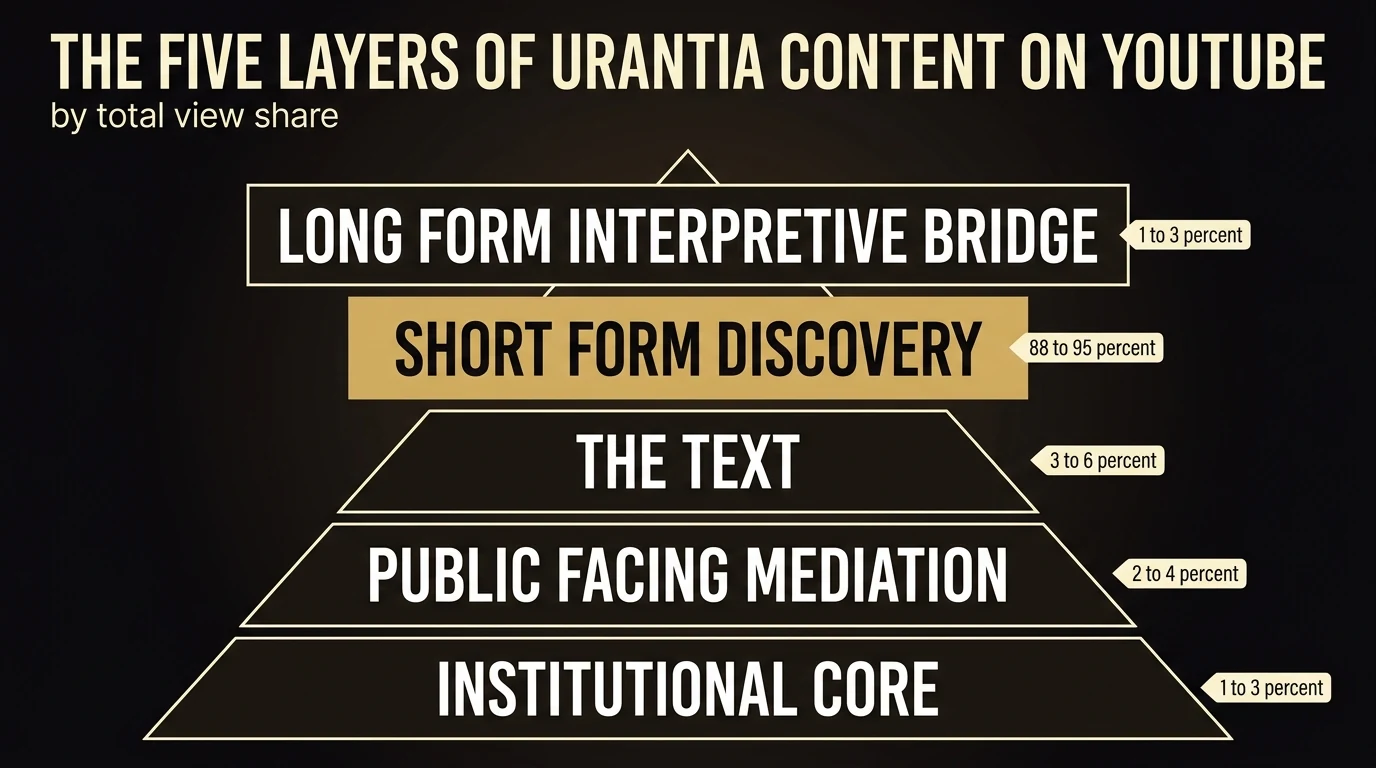
Kantor's first move is structural. He proposes that the totality of Urantia themed video content on YouTube can be sorted into five functional layers.
The first layer is the institutional and organizational core. This includes the Urantia Foundation, the Urantia Book Fellowship, the Urantia Association International, the Urantia University Institute, and the comparable national bodies. These organizations provide legal structure, nonprofit status, brand stability, and an anchoring presence that the rest of the ecosystem orbits.
The second layer is the public facing mediation layer. This is content designed to introduce a person to the existence of the Urantia Book, to help a newcomer discover it, and to provide a first contact surface for the curious or the searching. Examples include welcome videos posted by organizations, short biographical pieces on the book's origin, and introductions framed for the non reader.
The third layer is the text itself. Audio book renditions of all 196 papers, online reading platforms, downloadable PDFs, ePub versions, and audio engagement formats. This layer is what allows a seeker to encounter the actual content of the revelation in whatever medium suits them.
The fourth layer is short form discovery. Channels like Urantia Book Gems, short Jesus story channels, three minute teachings, devotional snippets, and the rapidly growing universe of social media first formats. This is the doorway content. It captures attention. It introduces ideas. It pulls viewers into the larger ecosystem.
The fifth layer is the long form interpretive bridge. These are the more substantial productions that connect the teachings of the Urantia Book to outside categories like history, science, theology, and philosophy. They include scholarly lectures, mini documentaries, and extended interviews. This is where the revelation is contextualized within the broader human inquiry.
Each layer is doing real work. Each is necessary. The map is descriptive, not prescriptive. The question Kantor then asks is what happens when we look at how much of the actual viewing attention each layer receives.
3. The Ninety Five Percent Problem
If one adds up the lifetime views of every Urantia themed video on YouTube, the total is approximately one hundred and twenty million views. Kantor presents this figure as a generally reliable estimate rather than as a precisely audited number. It is large enough that the patterns inside it carry analytic weight.
Distributing those one hundred and twenty million views across the five layers produces a striking distribution. The institutional and organizational core captures somewhere between one and three percent of total views. The public facing mediation layer captures between two and four percent. The online text in its various formats captures between three and six percent. The long form interpretive bridge captures between one and three percent. Short form discovery captures between eighty eight and ninety five percent of all views.
This is a notable finding on its own. Roughly nineteen out of every twenty views in the Urantia themed video ecosystem are happening in the short form layer. That is where the audience actually lives.
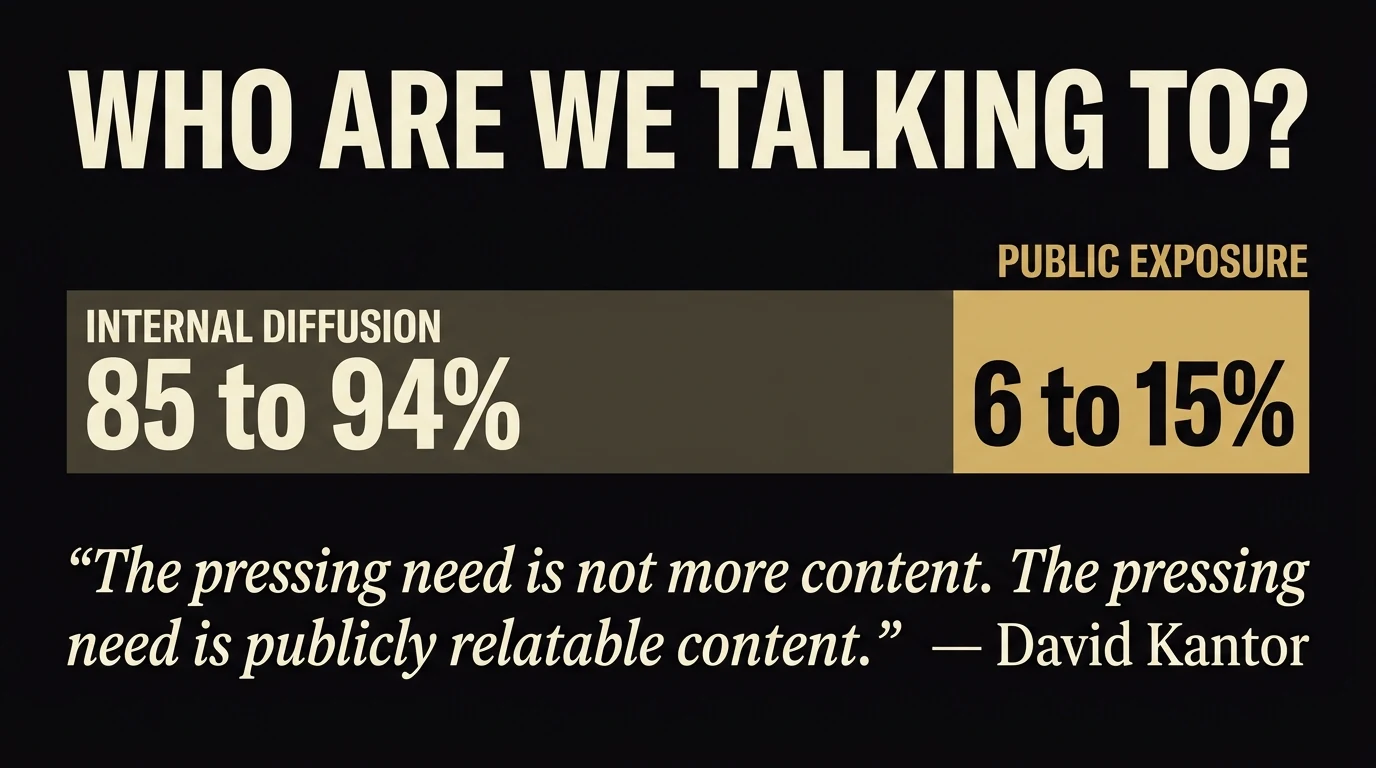
Kantor then makes a second cut that is more consequential. He sorts the same body of content not by length or producer type but by vocabulary and conceptual framing. He distinguishes two propagation zones. The first is internal diffusion. This is content that serves the existing readership community with education, devotional reinforcement, and aesthetic pleasure. It uses insider vocabulary. It assumes prior familiarity with the book. It advances claims that only make sense to someone who already accepts the revelation as authentic. The second is public exposure. This is content built to reach a person outside the readership, in their own language, on their own terms, beginning where their actual life is.
Sorted into these two zones, the same one hundred and twenty million views distribute as follows. Eighty five to ninety four percent of all Urantia themed content lives in the internal diffusion zone. Six to fifteen percent lives in the public exposure zone.
The Urantia community is, in other words, talking overwhelmingly to itself. This is not a moral failure. We like our music. We like our deep dives. We like hearing our vocabulary spoken back to us. But it means that the actual public outreach footprint of the community is somewhere between six and fifteen percent of what it appears to be from the outside.
Kantor's conclusion is a single sentence and worth memorizing.
The pressing need is not more content. The pressing need is more publicly relatable content.
Publicly relatable means content that speaks to a person on the basis of their existing ideas, their existing spiritual experience, their existing vocabulary, and their existing philosophical background. It means stories and concepts that excite the imagination of an outsider rather than producing cognitive resistance or overload. Kantor offers a useful analogy. Imagine asking an iPhone salesman to tell you why you might need one of these devices, and the salesman responds by unrolling a schematic and describing packetized data exchange and low latency response. Your eyes glaze over. Now imagine a different salesman, who tells you about a device that lets you connect with your family anywhere, anytime, that lets you carry your life with you, that will make you feel safer and less alone. Suddenly you can imagine yourself holding one. People respond to stories in which they can imagine themselves playing a role. They do not respond well to high levels of abstraction. The Urantia content ecosystem currently runs heavily to the first salesman.
4. From Star Catalogs to Constellation Reading
Kantor's second major move is to describe what has changed in the discovery layer that stands between a seeker and any source of information. The change is large enough that it reshapes what good Urantia outreach has to look like.
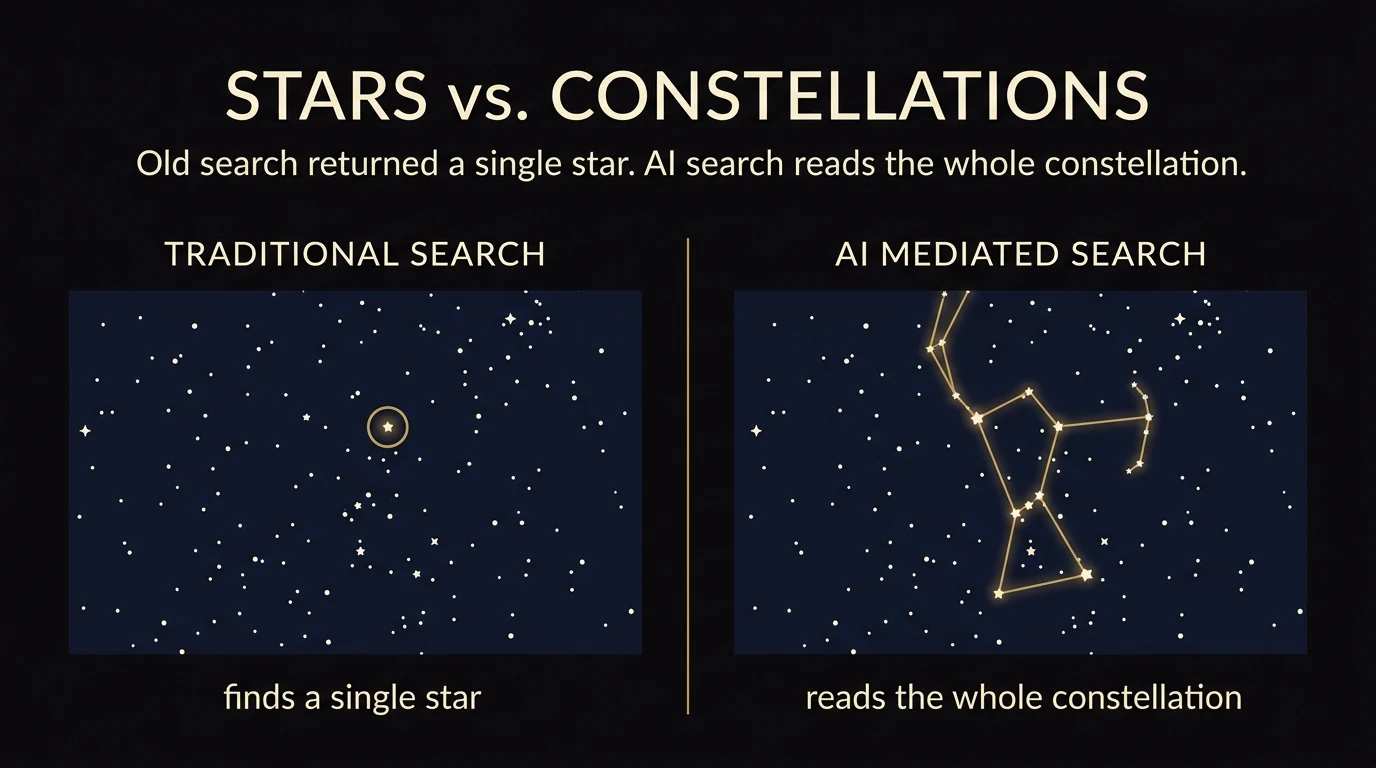
Traditional internet search behaved like a star catalog. A user typed a query. The engine returned a ranked list of individual results. Pages were stars. The user picked one. The ranking algorithm rewarded keywords, inbound links, payment, and a handful of other signals that any sufficiently informed content producer could optimize against. Search engine optimization for Urantia content under this regime was a tractable problem. You wrote good metadata, you used the right keywords, you got linked to by trusted sites, and your page rose.
AI mediated search does not work that way. When a user, particularly a user who is asking a personal, spiritual, or philosophical question, addresses that question to a large language model agent, the agent does not return a ranked list of individual stars. It surveys the sky and recognizes constellations. It looks for clusters of sources that agree with each other, that reference each other, and that collectively establish a topic as having a coherent and trustworthy substrate. The agent's answer is a synthesis drawn from that constellation rather than a click through to any one node within it.
The Urantia ecosystem on the internet is, whether anyone planned it that way, one of those constellations. Every site, every video, every book, every blog post, every metadata field that contains the word Urantia is part of the same constellation in the eye of an AI agent. The agent reads the constellation as a whole. The internal coherence of that constellation determines whether the agent treats Urantia as a trustworthy substrate for its answers, or whether it bypasses Urantia content as unreliable, fringe, or self contradictory.
This shifts the locus of action for every Urantia content creator. Optimizing one's own node is no longer the entire game. Tending the substrate that one's node is part of is now equally important. Three signals dominate.
The first signal is provenance. The AI agent wants to know where a piece of content came from. Is there a real organization behind it. Is there a real human author. Is there a track record. Is there a citation chain back to a stable source.
The second signal is authenticity. The AI agent wants to know whether the content is the product of human thought, human authorship, human review. Is there a real biography behind the byline. Is there a photograph. Is there a history of work that this piece is continuous with. AI agents are themselves trained on the residue of human writing and are increasingly sensitive to content that lacks the texture of having been thought through by a person.
The third signal is consistency. This is the one most Urantia content creators have the least practiced eye for, and it may be the most important of the three. The AI agent wants the constellation to cohere. It wants every node that references the same thing to use the same name for it, the same description of it, the same authorship attribution. If one site calls the text The Urantia Book, another calls it The Urantia Papers, and a third calls it The Fifth Epochal Revelation, the AI agent begins to wonder whether these are even references to the same object. The constellation only works as a constellation if the stars agree on what they are. Inconsistency at the metadata level fragments the substrate and the AI agent bypasses what it cannot reconcile.
The implication for every content creator is direct. The metadata fields of every piece of work, the descriptions, the keywords, the author bios, the canonical naming, all of these are now load bearing. They are not promotional copy. They are structural elements of the constellation that the AI mediated discovery layer is reading. Treat them accordingly.
5. Trust Architecture
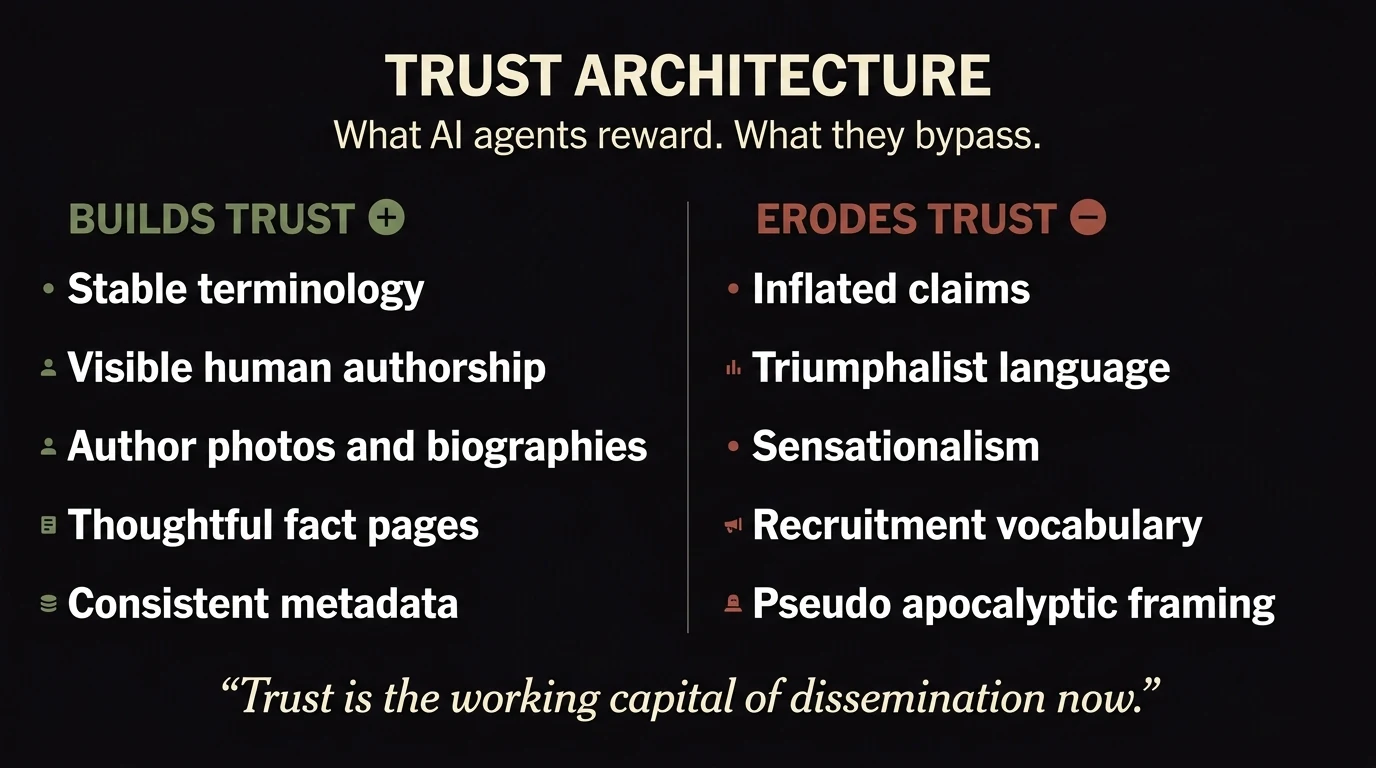
If consistency is the structural property of the constellation, trust is the working capital. Kantor's third major move is to specify what builds trust and what erodes it in the AI mediated environment.
The seeker for whom this matters is not at a desk in an office researching a topic for a paper. The seeker for whom this matters is sitting alone in a bedroom late at night, typing a personal question into a chat window. Why am I here. Is the universe friendly. What happens when I die. Why did my friend get sick. The AI agent that answers them is going to draw from somewhere. The constellation that gets quoted is the constellation that has registered as trustworthy. The constellation that gets bypassed is the one that registers as a sales pitch, a movement, a recruitment funnel, or a system of inflated claims.
Kantor enumerates the patterns that build trust. Stable terminology used consistently across platforms. Visible human authorship including real names, real photographs, and real biographies. Thoughtful fact pages that anchor the work in verifiable history and provenance. High quality metadata that is internally consistent and that links the work into the broader scholarly and historical conversation rather than isolating it inside a Urantia bubble. Acknowledgment of sources. A willingness to engage outside categories of thought without translating everything into insider language.
He also enumerates the patterns that erode trust. Inflated claims that promise the reader special access, hidden knowledge, or a unique cosmic position. Triumphalist language that frames the Urantia Book as having superseded every other revelation or every other tradition. Sensationalism that reduces the book's contents to clickbait. Recruitment vocabulary that conveys the goal is to bring the reader inside a movement. The promise of belonging to a select group of insiders. Pseudo apocalyptic framing. Anything that, taken as a whole, smells like a cult.
The function of these signals is not aesthetic. Kantor's point is sharper than that. The signals are the working physics of the new discovery layer. Content that displays the eroding patterns is being bypassed by AI agents that have been trained, both by design and by liability concern, to route seekers away from anything that reads as manipulative or as evangelistically aggressive. A piece of Urantia content that radiates these signals, however inspired its underlying content, is functionally invisible in the AI mediated environment. Worse, its presence in the constellation lowers the trust score of every other node in the constellation, including the ones that have done the work to read as trustworthy.
This is the part of the argument that asks the most of the community. It asks readers who love the book and feel a personal sense of urgency about sharing it to write, speak, and produce in a register that strips the urgency out of the surface text and lets the content carry the weight on its own. A seeker who is ready will recognize the depth without being told that they are reading something of cosmic importance. A seeker who is not yet ready will not be pushed away by hyperbole that they cannot yet hear in any other register than as a warning sign.
6. The Outrigger
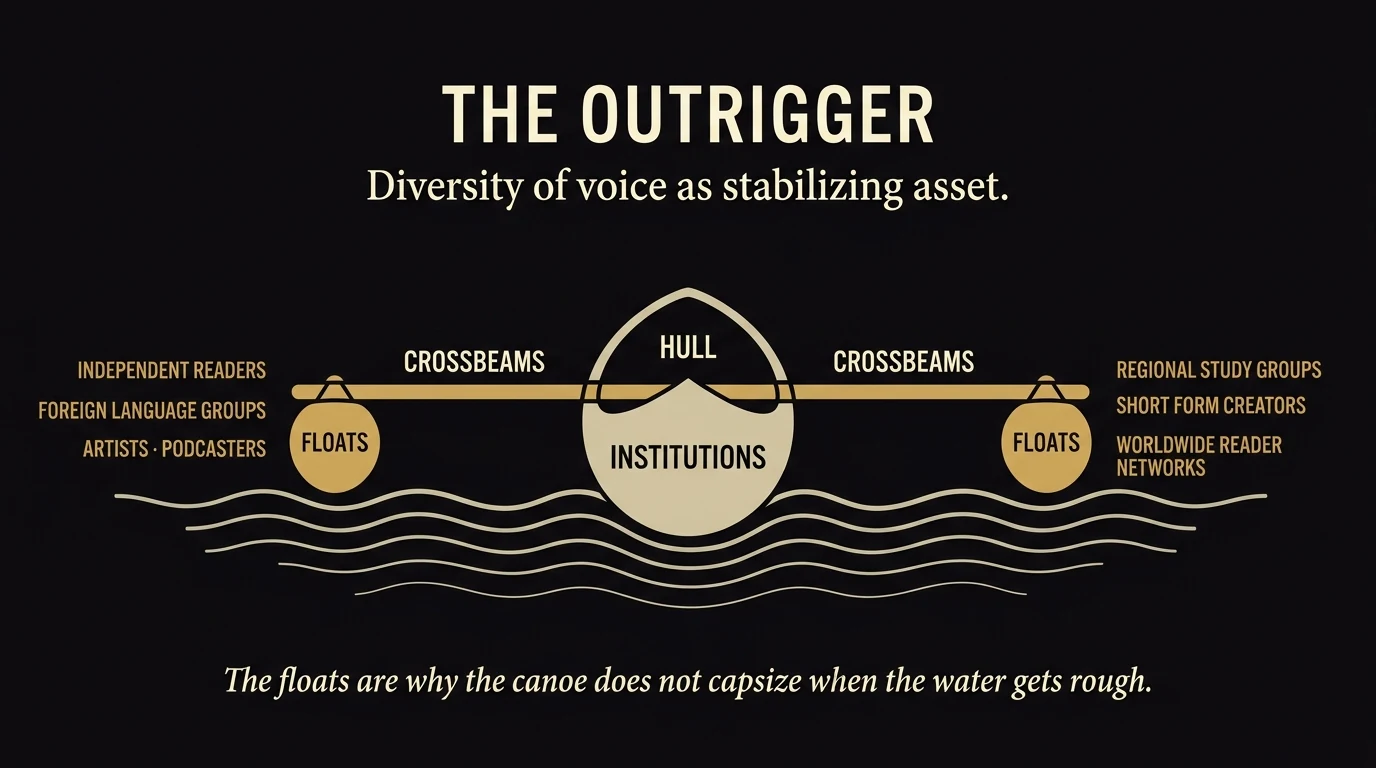
Kantor's fourth move addresses a tension that has run through the Urantia community for decades. As the dissemination project has expanded into the internet era, the number of independent reader content creators has grown faster than the institutional structure can absorb or coordinate. The traditional approach of every spiritual movement to this kind of growth has been some version of an enclosing institutional umbrella that asserts central authority over what counts as legitimate dissemination. That approach is not available to the Urantia community in any practical sense, and Kantor argues it is also not desirable.
His metaphor is the traditional outrigger canoe. A long central hull, and two floats extending outward to the sides. The floats look optional. They look like extras. They are not. The floats are the reason the canoe does not capsize when the water gets rough.
The institutions of the Urantia community are the central hull. The Foundation. The Fellowship. UAI. UUI. These provide legal stability, brand stewardship, the canonical text, the historical archive, the official conferences, the international coordinating function. They are stable. They are valuable. They are necessary.
The independent readers and content creators, the foreign language groups, the artists, the podcasters, the regional study groups, the people doing this work in Nigeria and Dubai and Uruguay and the Netherlands and Australia, are the floats. They extend the stability of the vessel out into the water. They are the reason the project remains upright when the water of civilizational change gets rough. They are also, taken together, the producers of approximately ninety five percent of all the dissemination content on the internet, and the carriers of approximately the same percentage of all the discovery attention.
Kantor's claim is that the diversity of voice across this independent layer is a strategic asset rather than a problem to be solved. The AI mediated constellation only forms if there are many stars. The outrigger canoe only sails if the floats extend. The expansion of the community into many independent points of light is the dissemination strategy, not a deviation from it.
This reframing matters. It releases the community from a category of internal anxiety that has historically slowed its work, and it asks instead for stewardship of the substrate. The institutions tend the hull. The independent creators tend the floats. The shared responsibility is the seaworthiness of the whole vessel.
7. The Garden
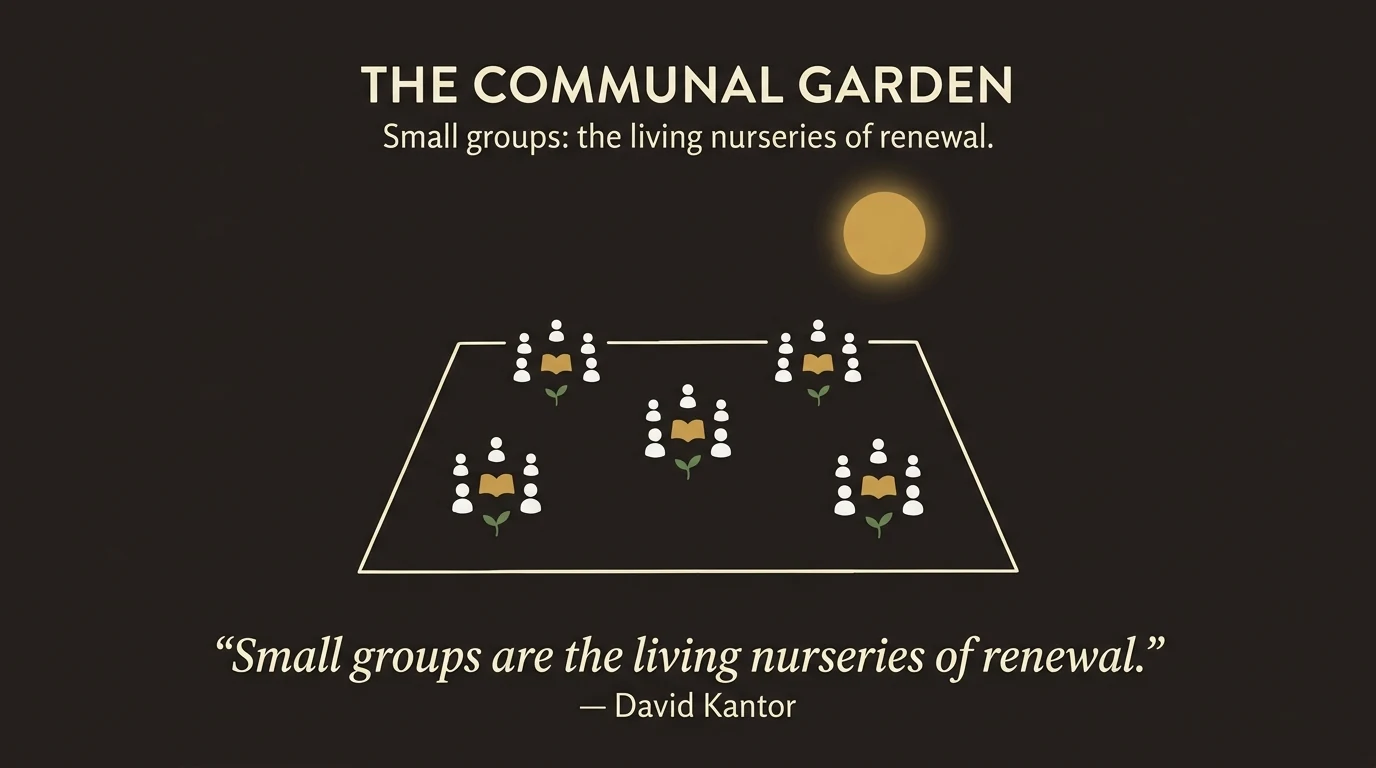
Behind everything in the talk, Kantor lays a thesis that is older than the internet and older than the printing press. The thesis is about how spiritual movements actually grow. They do not grow because someone built a bigger institution. They do not grow because someone bought better advertising. They grow because somebody, somewhere, sat down with two or three other people, and shared what was actually happening inside them.
The Urantia Book itself says this. In Paper 102, on the foundations of religious faith, the Melchizedek author records the following.
"While personal religion precedes the evolution of human morals, it is regretfully recorded that institutional religion has invariably lagged behind the slowly changing mores of the human races. Organized religion has proved to be conservatively tardy. The prophets have usually led the people in religious development; the theologians have usually held them back. Religion, being a matter of inner or personal experience, can never develop very far in advance of the intellectual evolution of the races." (102:8.6)
And in Paper 170, on the kingdom of heaven, the Midwayer Commission reports of the apostles' eventual understanding of their teacher.
"They looked upon the coming of the kingdom in the hearts of men as a gradual development, like the leaven in the dough or like the growing of the mustard seed. They believed that the coming of the kingdom in the racial or world sense would be both sudden and spectacular. Jesus never tired of telling them that the kingdom of heaven was their personal experience of realizing the higher qualities of spiritual living; that these realities of the spirit experience are progressively translated to new and higher levels of divine certainty and eternal grandeur." (170:2.16)
The same pattern Kantor names in 2026 is the pattern the revelation describes Jesus teaching in the first century. Personal religious experience is the upstream cause. Group experience small enough to be honest is where personal experience finds its first articulation. Institutional structure, in its best forms, is downstream of both and exists to preserve and transmit what the small groups generated. In its worst forms, institutional structure precedes and substitutes for the small group, and when that happens the spirit experience that should have been the seed is replaced by doctrine cast into religious molds.
The implication for the Urantia content creator is sober and clarifying. Every piece of content produced by the community, the videos, the books, the websites, the metadata, the AI discoverability work, the trust architecture, every part of it is upstream of one specific event. That event is the moment a real person, alone with two or three other real people, opens the Urantia Book and begins to read it together. If the entire ecosystem of Urantia content is doing its work well, it is preparing the conditions for that moment. If the ecosystem is producing content that does not eventually feed that moment, the ecosystem is decoupled from its purpose.
The metaphor Kantor closes on is gardening. The work of the content creator is not to grow the plant. The work is to prepare the conditions in which a plant can grow. Tend the soil. Protect what is fragile. Remove what blocks the light. And then get out of the way.
8. An Audit for Content Creators
The remainder of this article is practical. Any Urantia content creator, in any medium, can run their own work against the following checklist this week. The questions are derived directly from Kantor's framework and from the considerations laid out above.
Layer placement. On the five layer map, where does this piece live. Institutional core, public facing mediation, the text itself, short form discovery, or long form interpretive bridge. Each layer is legitimate. The question is whether you know which one you are producing for, and whether the audience you imagine matches the layer you are working in.
Zone of propagation. Read your piece as if you had never heard of the Urantia Book. Does the language open or close. Does the framing welcome or assume. Does the first thirty seconds presuppose belief in a fifth epochal revelation. Does it use insider vocabulary that you have not earned with the reader yet. If the answer is closer to the closed pole, the piece is internal diffusion. That is a legitimate product. It is not a public outreach product. Be clear with yourself about which one you are making.
Metadata consistency. Does this piece use the canonical name for the book that the rest of the ecosystem uses. Does the metadata cite the book in the same form on every platform where the piece appears. Are the author byline, the description, the keywords, and the canonical URL identical across YouTube, the website, the social repost, and the AI ingestible feed. Inconsistency at this level fragments the constellation.
Author surface. Is there a real person attached to the piece. Photograph. Biography. Track record. Other work to which this piece can be related. AI agents weight content with a visible human author more highly than anonymous content.
Trust signals built. Does the piece use stable terminology. Does it cite sources where it claims facts. Does it acknowledge the limits of what it is claiming. Does it engage outside categories of thought without forcing everything through insider categories.
Trust signals avoided. Does the piece contain inflated claims, triumphalist language, sensationalism, or recruitment vocabulary. Read the opening paragraph again with that filter on. Anything that promises hidden knowledge, special access, or membership in a cosmic elect is doing damage to the constellation regardless of the value of what follows.
Downstream destination. When a real person watches this piece or reads this piece, what is the next step in their journey. Is there one. Does the piece point toward the actual book, toward a study group, toward a small fellowship, toward a real conversation with a real reader. If the answer is that the piece is its own destination, the piece is decoupled from the larger purpose.
If most of the answers go in the constructive direction, keep going. The community needs the work.
9. An Invitation
David Kantor's talk does not ask the Urantia community to do something it has never done before. It asks for clarity about what the community is already doing, an audit of where the work is succeeding and where it is talking to itself, and a renewed attention to the substrate that all of the work depends on.
The talk also makes clear something the community already knew but has not always been able to act on. The center of the dissemination project is not on a YouTube channel and not in a metadata field. The center is the small group of two or three or five readers who gather around the book and around each other, and who carry what they discover into the next encounter. Every layer of the content ecosystem exists to feed that center.
The Urantia Book Network publishes this article in that spirit. We urge readers to watch the original talk at the link below. We urge content creators to apply the audit checklist to their own work this week. And we urge anyone who has not yet found a small group of fellow readers to begin one, with whatever neighbors and friends and online acquaintances are within reach. The constellation is wide. The garden is communal. The work is real.
A Conversation with David Kantor
The following interview is the producer's conversation with David Kantor, recorded in 2022, several years before the April 2026 talk summarized above. It develops the same framework in a longer form, with extended context, examples, and questions from the field.
Note on Sources
The primary source for this article is the video record of David Kantor's talk titled AI and Urantia Content, delivered at the Urantia Foundation Leadership Roundtable in Chicago on April 26, 2026. The recording is available at:
youtube.com/watch?v=uht7bZW1Fl0
A full transcript with timecodes was the working text from which this article was drafted. The transcript is included in the Urantia Book Network's production folder for the companion visual essay, also titled Kantor's Map, scheduled for release on the Urantia Book Network YouTube channel in May 2026.
All quotations from the Urantia Book in this article have been pulled verbatim from the canonical source text and verified against the cited paragraph. The two quoted paragraphs are 102:8.6, sponsored by a Melchizedek, and 170:2.16, sponsored by the Midwayer Commission. Readers are encouraged to confirm against their own copy of the canonical text.
All summaries of Kantor's argument are the present author's restatements of the recorded talk and do not constitute direct quotations of Kantor except where explicitly marked as such.
The framework is David Kantor's. The Urantia Book Network is responsible only for the present restatement, the editorial framing, and any errors of interpretation that may have crept in. Corrections and clarifications are welcome via the Urantia Book Network contact channels.
Serve prayerfully, friends.
Connecting Articles



The Newsletter
Get the research behind each piece
Free. New Urantia Book explorations, the sources behind the videos, and early looks. No spam, unsubscribe anytime.
Prefer video? Follow on YouTube and Facebook.
Delivered through Substack. You can also read past issues.