
The Breathing Universe, Act Two: Dark Energy Begins to Weaken
The Urantia Book describes a cosmos that alternately expands and contracts. For decades, accelerating expansion made that unthinkable. Then the DESI instrument started reporting that dark energy may be fading, and peer-reviewed cosmology is once again calculating a universe that turns around.
Where Act One Ended
Our earlier survey, The Record and the Science, laid out the record's boldest cosmological claim beside the observations of the last century. The record states it as observation, not speculation:
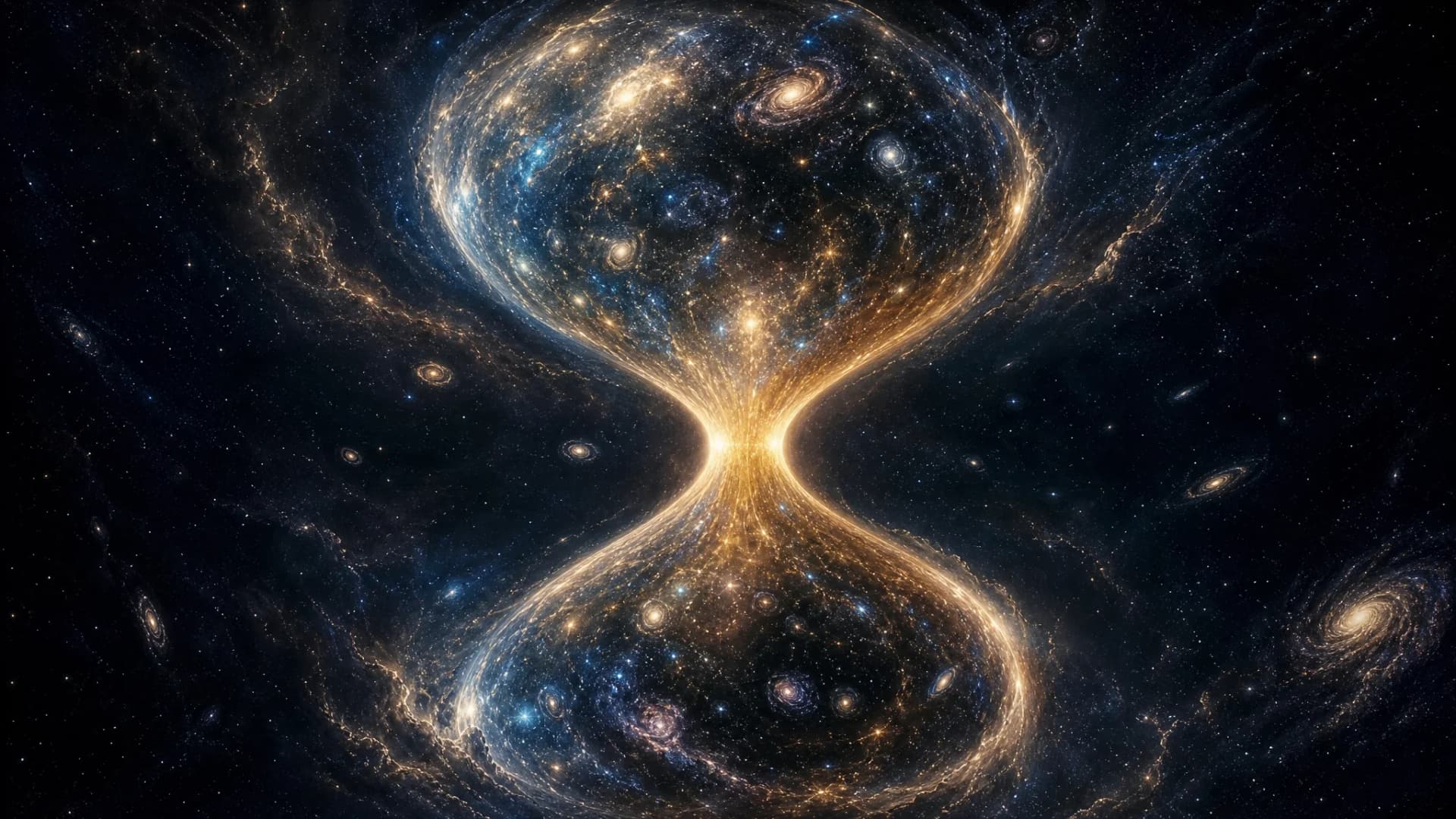
"We do not know the actual mechanism of space respiration; we merely observe that all space alternately contracts and expands. This respiration affects both the horizontal extension of pervaded space and the vertical extensions of unpervaded space which exist in the vast space reservoirs above and below Paradise. In attempting to imagine the volume outlines of these space reservoirs, you might think of an hourglass." (11:6.1)
"The cycles of space respiration extend in each phase for a little more than one billion Urantia years. During one phase the universes expand; during the next they contract. Pervaded space is now approaching the mid-point of the expanding phase, while unpervaded space nears the mid-point of the contracting phase, and we are informed that the outermost limits of both space extensions are, theoretically, now approximately equidistant from Paradise." (11:6.4)
A breathing cosmos: expansion now, contraction later, in alternating phases. When Act One was written, the standard model of cosmology said the opposite. Dark energy, treated as a cosmological constant, drives expansion that accelerates forever. No turnaround, no second phase, no breath drawn back in. The record's claim sat where it had always sat: outside the conversation.
The conversation has moved.
At a Glance
| Key figure | The record | Modern science |
|---|---|---|
| The claim | "all space alternately contracts and expands" (11:6.1) | Dark energy may be weakening: DESI at up to 4.2 sigma (2025), Lyman-alpha support (2026) |
| A future contraction | The next phase of the cycle (11:6.4) | Peer-reviewed big crunch calculation: total cosmic age about 33 billion years (JCAP, 2025) |
| Phase length | "a little more than one billion" years per phase (11:6.4) | Does not fit 13.8 billion years of observed expansion. A logged miss |
| The 1929 expansion rate | "one hundred miles a second for every million light-years" (12:4.14) | Era value about 530; today's value about 70 |
| Confidence | Below the 5 sigma discovery bar; systematics debate live; full survey results 2027 |
What DESI Found
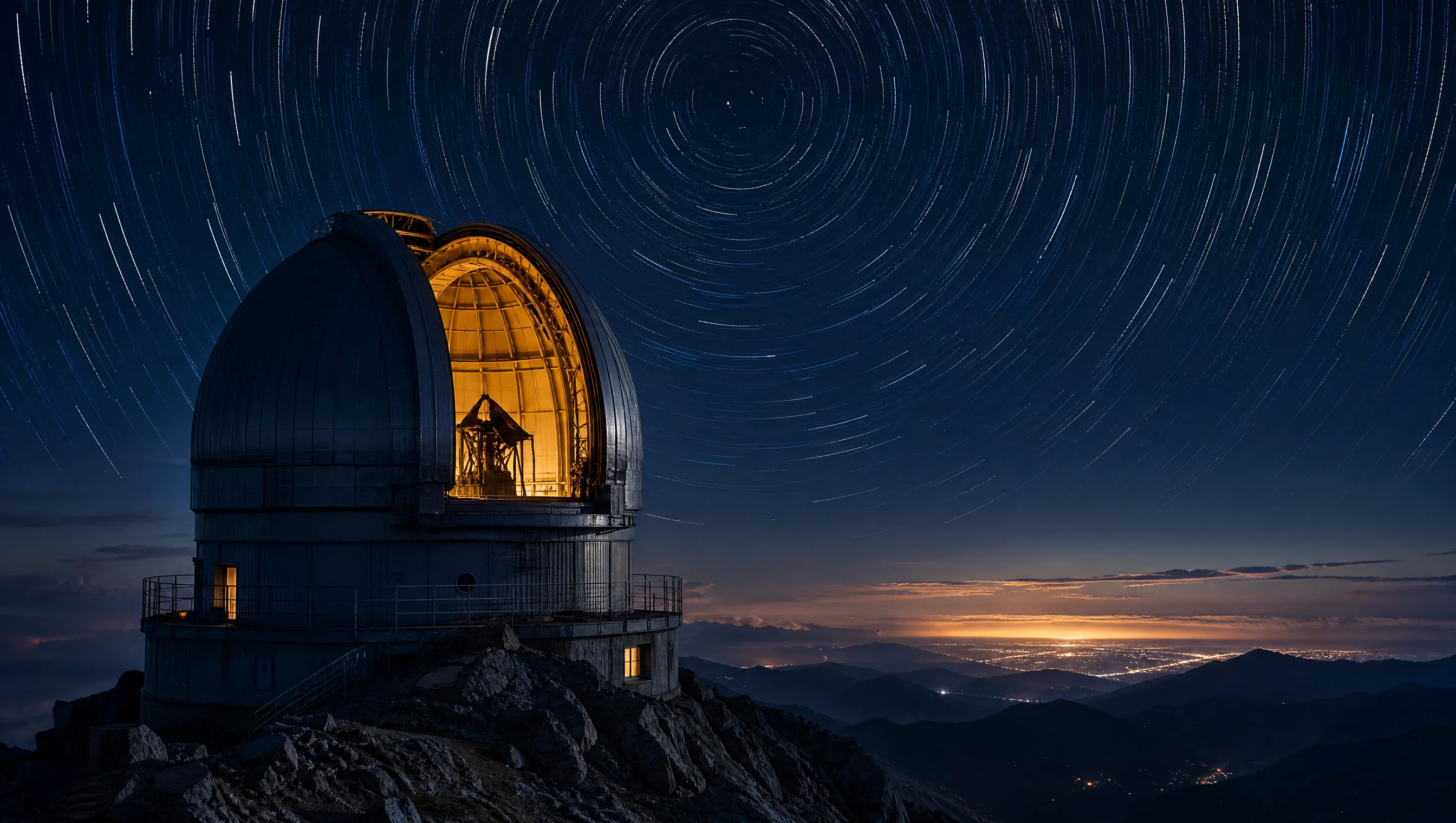
The Dark Energy Spectroscopic Instrument, on a mountaintop in Arizona, has spent five years measuring the positions of tens of millions of galaxies to reconstruct the expansion history of the universe. Its results have arrived in waves, and each wave has leaned the same way.
In April 2024, the first year of data, combined with the cosmic microwave background and supernova catalogs, showed a preference for a dark energy whose strength changes over time, at significance levels between 2.6 and 3.9 sigma depending on the datasets combined (sigma measures how unlikely a result is to be a fluke; five is physics' conventional discovery bar). In March 2025, with three years of data and more than fourteen million galaxies mapped, the preference strengthened, ranging up to 4.2 sigma. The collaboration's co-spokesperson, Will Percival, put the stakes plainly: it is looking more and more like the standard model of cosmology may need modification.
In July 2026, an independent probe using the light of more than 820,000 quasars filtered through intergalactic hydrogen, published in Astronomy and Astrophysics, added its own support for a dynamical dark energy. The survey completed its planned observations in April 2026 with 47 million objects mapped; the full analysis lands in 2027.
The best-fit picture from these measurements is strange and specific: dark energy appears to have grown for billions of years, peaked, crossed a critical threshold, and begun to weaken. And a weakening dark energy changes the ending of the story. If it fades toward zero, the acceleration ends. If it crosses below zero, expansion can slow, halt, and reverse. The universe contracts.
That is no longer a sentence found only in religious texts. In September 2025, Cornell physicist Henry Tye published calculations in the Journal of Cosmology and Astroparticle Physics, using the DESI and Dark Energy Survey data, of a universe that reaches maximum size roughly eleven billion years from now and then contracts to a final crunch at a total age of about 33 billion years. The physicists who have long argued for cyclic cosmologies, in which the cosmos expands and contracts repeatedly, note that a decaying dark energy is precisely the ingredient their models always required. A contracting phase has moved from ruled out to live possibility, contingent on the data holding.
The Redshift Caution, Revisited
There is a second thread in the record's cosmology that Act One flagged and 2026 keeps pulling. The record affirms the expansion itself without reservation:
"You fail to recognize the present outward and uniform expansion of the physical creations of all pervaded space. Your own local creation (Nebadon) participates in this movement of universal outward expansion." (12:4.12)
But it warns, at length, that the velocities calculated from redshift at the greatest distances are distorted:
"Many influences interpose to make it appear that the recessional velocity of the external universes increases at the rate of more than one hundred miles a second for every million light-years increase in distance. By this method of reckoning, subsequent to the perfection of more powerful telescopes, it will appear that these far-distant systems are in flight from this part of the universe at the unbelievable rate of more than thirty thousand miles a second. But this apparent speed of recession is not real; it results from numerous factors of error embracing angles of observation and other time-space distortions." (12:4.14)
The rate quoted, more than one hundred miles a second per million light years, is the Hubble constant as Edwin Hubble estimated it around 1929, roughly 530 in the modern units. Today's measured value is about 70, more than seven times smaller. The record committed itself in print to its era's number and simultaneously declared the naive inference from such numbers unreliable. It was right about the second part in a way its own era could not check: the era's constant was inflated by exactly the kind of calibration errors the passage gestures at, and correcting them took three decades.
The modern situation rhymes. Cosmology's two best methods of measuring today's expansion rate disagree beyond five sigma, the famous Hubble tension, and a June 2026 review calls it the field's defining anomaly. The proposed resolutions are a catalog of "influences interposing": evolving dark energy, a possible vast local void inflating nearby measurements, timescape models in which clocks tick differently in cosmic voids and walls, even a slowly rotating universe. In November 2025, a Yonsei University group went further and argued, from supernova age biases, that the expansion has already begun to decelerate; the claim drew sharp rebuttals in 2026 and most cosmologists are unconvinced, but it was published, debated, and taken seriously enough to rebut. The point is not that any one proposal is right. The point is that "the simple reading of the redshift numbers hides distortions" is now a mainstream research program.
The Ledger
Now the honest accounting, which for this topic must be strict.
The record's cycle length does not fit the standard reading of the data. A phase of "a little more than one billion" years (11:6.4), with a full cycle "a little over two billion" (11:6.5), sits badly against 13.8 billion years of apparently continuous expansion recorded in the cosmic microwave background and the galaxy record. A reader can construct reconciliations, respiration as a property of space distinct from the observed matter expansion, but the plain scorecard entry is: concept newly plausible, stated numbers unsupported.
The DESI signal itself is not a discovery. It hovers below the five sigma threshold, and respected critics, notably George Efstathiou of Cambridge, argue in the Monthly Notices of the Royal Astronomical Society that supernova calibration systematics can produce the whole effect, and that the older data remain fully consistent with an unchanging cosmological constant. The 2027 full-survey release will move this one way or the other; we are marking the date, not calling the result.
And one era-bound number in the same papers deserves its entry: the record promised that new telescopes would reveal "no less than 375 million new galaxies" (12:2.3). Telescopes did that and kept going; current estimates run to hundreds of billions of galaxies at minimum. The prediction was directionally right, more universes beyond the known, and numerically a floor set by the expectations of its era, exactly as the record's own disclaimer about its physical science (101:4.2) tells us to expect.
The Shape of the Claim
Step back and look at what the record wagered. In 1955 it would have been safest to describe simple one-way expansion, and after 1998 the fashionable answer became eternal acceleration. The record chose neither. It described real expansion, warned that the measured rates conceal distortions, and set the whole thing inside a rhythm of expansion and contraction, an hourglass turned over and over on a scale of ages.
Seventy years later: the expansion is confirmed, the measured rates are in open crisis, and the first credible evidence has arrived that the engine of acceleration may be winding down. If DESI's full dataset dissolves the signal, the breathing universe returns to the shelf, and this page will say so. If it holds, then the strangest sentence in Paper 11, that all space alternately contracts and expands, will have gone from unthinkable to under active investigation within a single decade. Either way, we will keep the score in public.
Keep Reading
Act One, The Record and the Science, holds the original five convergences, including the Sagittarius center and an honest miss on the Andromeda distance. The Universe Might Be Spinning follows the rotation question that several of the same datasets have raised. And Dark Islands of Space traces the record's dead suns to the Gaia discoveries.
Connecting Articles
The Universe Might Be Spinning: The Record's Strangest Claim Just Got Interesting
The Record and the Science: Five Places Where the Urantia Book Meets Modern Astronomy
Dark Islands of Space: How Astronomers Learned to Find What Cannot Be Seen
The Runaway Particles: The Record and the Physics of a Collapsing Star
The Newsletter
Get the research behind each piece
Free. New Urantia Book explorations, the sources behind the videos, and early looks. No spam, unsubscribe anytime.
Prefer video? Follow on YouTube and Facebook.
Delivered through Substack. You can also read past issues.