
Dark Islands of Space: How Astronomers Learned to Find What Cannot Be Seen
The Urantia Book describes dead suns of unbelievable density, located by measuring the gravity pull on nearby luminous stars. Between 2022 and 2024, the Gaia mission found the nearest known black holes by exactly that method. The passage, the discoveries, and the honest differences.
The Inventory Includes Things That Emit Nothing
When the record inventories the contents of our superuniverse, it lists the familiar citizens of the sky, and then some unfamiliar ones:
"...This great aggregation of suns, dark islands of space, double stars, globular clusters, star clouds, spiral and other nebulae, together with myriads of individual planets, forms a watchlike, elongated-circular grouping of about one seventh of the inhabited evolutionary universes." (15:3.1)
Dark islands of space. The record devotes a full passage to them, and the passage deserves to be read whole:
"The Dark Islands of Space. These are the dead suns and other large aggregations of matter devoid of light and heat. The dark islands are sometimes enormous in mass and exert a powerful influence in universe equilibrium and energy manipulation. The density of some of these large masses is well-nigh unbelievable. And this great concentration of mass enables these dark islands to function as powerful balance wheels, holding large neighboring systems in effective leash. They hold the gravity balance of power in many constellations; many physical systems which would otherwise speedily dive to destruction in near-by suns are held securely in the gravity grasp of these guardian dark islands. It is because of this function that we can locate them accurately. We have measured the gravity pull of the luminous bodies, and we can therefore calculate the exact size and location of the dark islands of space which so effectively function to hold a given system steady in its course." (15:6.11)
Set aside everything else and look at the last two sentences. They do not merely assert that dark massive objects exist. They state the method by which such objects are found: measure the gravity pull on the luminous bodies you can see, and from that motion calculate the exact size and location of the dark mass you cannot see.
The method itself has a proud but narrow pedigree: Neptune was found in 1846 from its pull on Uranus, and Friedrich Bessel predicted the white dwarf Sirius B in 1844 from Sirius's wander across the sky. What nobody had done, in 1955 or for decades after, was locate a dead, truly invisible stellar remnant this way. Seventy years later, that is the method behind the quietest run of discoveries in modern astronomy.
At a Glance
| Key figure | The record | Modern science |
|---|---|---|
| The objects | "dead suns... devoid of light and heat," density "well-nigh unbelievable" (15:6.11) | Dormant black holes: no light, no X-rays, mass only |
| The method | "measured the gravity pull of the luminous bodies... calculate the exact size and location" (15:6.11) | Astrometric wobble of a companion star (Gaia mission) |
| Nearest found | Gaia BH1: 10 solar masses, 1,560 light-years (2022) | |
| Most massive found | Gaia BH3: 33 solar masses, 1,926 light-years (2024) | |
| The bigger picture | Massive dark bodies as routine sky citizens (15:3.1) | Dark matter known only by gravity; no particle detected (LZ, Dec 2025) |
Three Dark Masses, Found by Their Pull
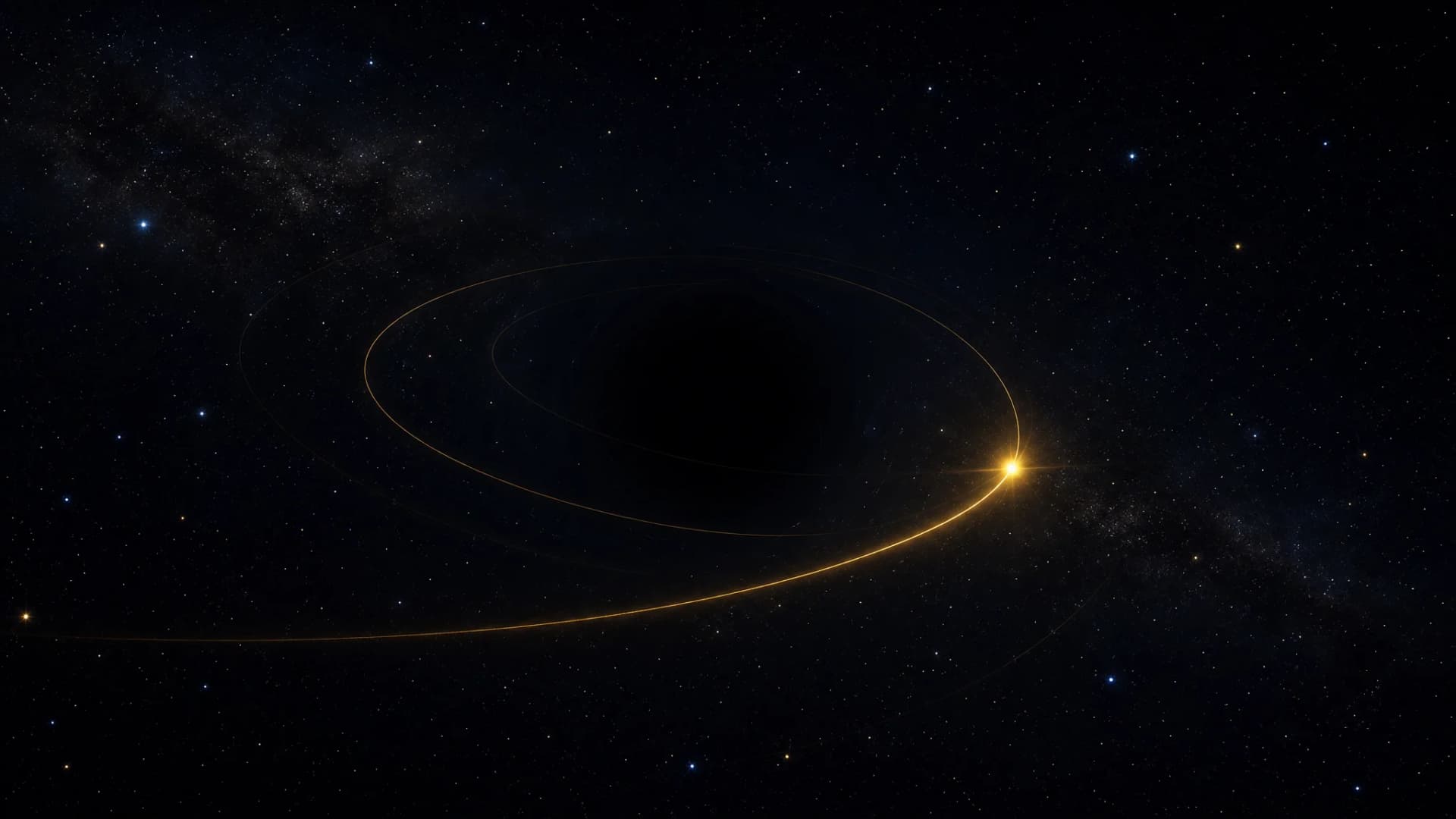
The European Space Agency's Gaia spacecraft spent a decade measuring the positions and motions of nearly two billion stars with fanatical precision. Buried in that flood of data, astronomers noticed a handful of ordinary stars moving wrongly: each one tracing a slow orbit around a companion that emits nothing at all. No light. No X-rays. Only pull.
In November 2022, Kareem El-Badry and colleagues published the first in Monthly Notices of the Royal Astronomical Society: Gaia BH1, a star much like our Sun, about 1,560 light years away, orbiting an unseen object of roughly ten solar masses every 186 days. It was the nearest black hole ever found. The star's wobble was measured; the dark companion's mass and location were calculated from the gravity alone.
In 2023 came Gaia BH2, a red giant swinging around a dark 8.9 solar mass companion on a 1,277 day orbit, at the time the widest black hole binary known. And in April 2024, the Gaia collaboration announced BH3 in Astronomy and Astrophysics Letters: a dormant black hole of about 33 solar masses, roughly 1,926 light years away, orbited by an ancient, metal-poor giant star. It is the most massive stellar-origin black hole known in our galaxy, and it was sitting in our neighborhood, invisible, until the star it holds in leash gave it away.
Read the discovery papers and then reread the record's sentence: "We have measured the gravity pull of the luminous bodies, and we can therefore calculate the exact size and location of the dark islands of space." That is not a loose thematic resemblance. It is the procedure, stated as procedure, seven decades before the discoveries it describes.
Dead Suns, in Both Vocabularies
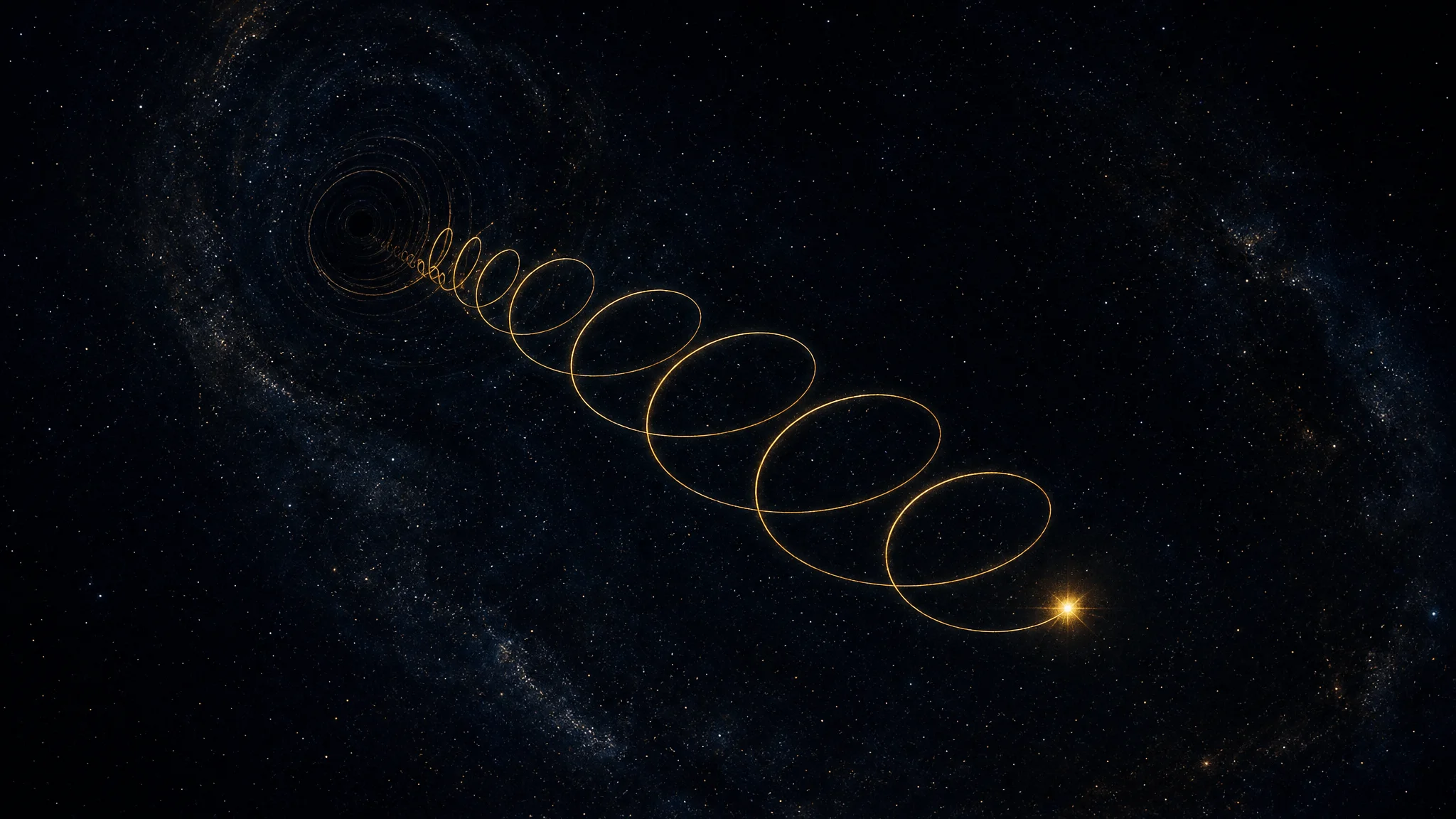
What are these objects? In the modern account, a black hole of stellar origin is the end state of a massive star: the core collapses, the light goes out, and what remains is mass, gravity, and nothing to see. The record's vocabulary is different, but listen to its description of where dark islands come from:
"Burned-out Suns. Some of the dark islands of space are burned-out isolated suns, all available space-energy having been emitted. The organized units of matter approximate full condensation, virtual complete consolidation; and it requires ages upon ages for such enormous masses of highly condensed matter to be recharged in the circuits of space and thus to be prepared for new cycles of universe function following a collision or some equally revivifying cosmic happening." (15:5.11)
Burned-out suns. All energy emitted. Matter at virtual complete consolidation, with density "well-nigh unbelievable." The record also describes a second population with a cooler biography:
"Some of the dense dark islands are the direct result of the accretions of transmuting energy in space. Another group of these dark islands have come into being by the accumulation of enormous quantities of cold matter, mere fragments and meteors, circulating through space. Such aggregations of matter have never been hot and, except for density, are in composition very similar to Urantia." (15:5.10)
Modern astronomy has its own catalog of dark masses in both families: collapsed stellar remnants on one side, and on the other the cold, unluminous bodies: brown dwarfs caught by infrared surveys, and rogue planets found mostly by gravitational microlensing, which is one more way of reading mass from its pull on light.
The Larger Pattern: An Astronomy of Pull
The dark islands sit inside a bigger truth about the modern sky. The single largest component of the material universe, the dark matter that outweighs everything visible five to one, has never been seen at all. Every piece of evidence for it, galaxy rotation curves, gravitational lensing, the acoustic peaks of the cosmic microwave background, the growth of cosmic structure, is gravitational. In December 2025 the LUX-ZEPLIN experiment, the most sensitive dark matter detector ever operated, announced the largest dataset in the history of the search and, once again, no particle. As of this writing, the heaviest ingredient of the cosmos is known exclusively by its pull.
The record is not talking about dark matter; its dark islands are ordinary matter, dead suns and cold accumulations, and we do not stretch the text to cover what it does not say. But the record's larger posture, that the universe is full of massive things that emit nothing and are known by gravity alone, has gone from a strange claim to the daily business of astronomy.
The Ledger
The differences, stated plainly. The record never uses the term black hole and never describes an event horizon or the relativistic physics that defines one; its dark islands are dead and dark, not gravitationally sealed. A reader who wants the record to have described general relativity's strangest object will not find that here, and we do not claim it. The convergence is narrower and, we think, more interesting: the existence of enormous dark masses as a routine population of the sky, their role as gravitational anchors of the systems around them, and above all the method, gravity measured on the luminous, mass calculated for the dark. The record also warned that its physical science would age (101:4.2), and its era's vocabulary shows. The method has not aged a day.
Keep Reading
The Runaway Particles tells the story of how such dead suns die, and of the uncharged particles that carry the collapse. The Universe Might Be Spinning takes the record's structural claims into 2025's rotation debate. And the original survey, The Record and the Science, holds the first five convergences and the honest differences beside them.
Connecting Articles
The Runaway Particles: The Record and the Physics of a Collapsing Star
The Universe Might Be Spinning: The Record's Strangest Claim Just Got Interesting
The Record and the Science: Five Places Where the Urantia Book Meets Modern Astronomy
The Breathing Universe, Act Two: Dark Energy Begins to Weaken
The Newsletter
Get the research behind each piece
Free. New Urantia Book explorations, the sources behind the videos, and early looks. No spam, unsubscribe anytime.
Prefer video? Follow on YouTube and Facebook.
Delivered through Substack. You can also read past issues.