
Göbekli Tepe and Karahan Tepe: The Vanite Memory in Stone
At Şanlıurfa in southeastern Turkey, two stone temple complexes built around 9600 BC have rewritten the standard chronology of human civilization. Hunter gatherers were not supposed to be capable of monumental architecture. We read the Urantia Book as pointing to a population that was. This paper examines the archaeological record at Göbekli Tepe and Karahan Tepe alongside the Urantia Book account of the Nodite, Amadonite, and Vanite peoples of the highlands north of Mesopotamia, of whom it says: "Here, in the vicinity of Lake Van and the southern Caspian Sea region, the Nodites mingled and mixed with the Amadonites" (73:1.6).

Göbekli Tepe and Karahan Tepe: The Vanite Memory in Stone
Derek Samaras
Urantia Book Network, urantiabooknetwork.com
May 2026
Keywords: Göbekli Tepe, Karahan Tepe, Taş Tepeler, Pre-Pottery Neolithic A, Şanlıurfa, monumental architecture, Urantia Book, Andite, Nodite, Vanite, Adamic mission, biological uplift, comparative ancient history, iconographic transmission
Abstract
Göbekli Tepe and Karahan Tepe, two Pre-Pottery Neolithic A and B complexes in Şanlıurfa Province in southeastern Turkey, present the most consequential challenge to the conventional model of human civilizational development discovered in the last hundred years. Their construction dates, between roughly 9600 and 8000 BC, predate every previously known monumental architectural tradition by at least four thousand years. The standard explanatory frameworks, which posit hunter gatherer agency or the spontaneous emergence of organized religion, are credible as far as they go but they do not account for the technical sophistication, the iconographic specificity, or the regional concentration of these sites. This paper proposes a complementary reading drawn from the Urantia Book, which, in passages composed in the early twentieth century and predating the discovery of either site, describes three overlapping post rebellion populations that we place in and around this region. Of the western or Syrian Nodites it says they "journeyed northward, uniting with the Andonites to found the later Nodite centers to the northwest of Mesopotamia" (UB 77:4.3). Of the Vanites it says: "Some of the early associates of Van subsequently settled about the shores of the lake which still bears his name, and their traditions grew up about this locality" (UB 77:4.11). "Ararat became their sacred mountain, having much the same meaning to later-day Vanites that Sinai had to the Hebrews" (UB 77:4.11). The Andite migrations it dates "from about 15,000 to 6000 B.C." (UB 78:3.9). Underlying all three, in our reading, is the mission of Adam and Eve, whom the book calls "the biologic uplifters" (51:0.1) and who "arrived on Urantia, from the year A.D. 1934, 37,848 years ago" (74:0.1). Of their second garden it says: "For twenty thousand years the culture of the second garden persisted" (78:5.1). In our reading its agricultural, architectural, and ethical knowledge was carried outward by the Andites. The Şanlıurfa monuments stand at the geographic and chronological apex of that transmission. Read alongside this framework, the iconography, the geometry, and the abandonment pattern of the Şanlıurfa complexes acquire a coherence that the conventional model has not been able to supply.
Methodology and Sources
This paper proceeds by parallel reading. Mainstream archaeological evidence is treated as primary on questions of dating, stratigraphy, and material catalogue, drawing on the published reports of Klaus Schmidt and the German Archaeological Institute team at Göbekli Tepe (Schmidt 2000, 2006; Notroff, Dietrich, and Schmidt 2014; Dietrich et al. 2012; Clare 2020), and the Karahan Tepe excavation reports of Necmi Karul and Bahattin Çelik (Karul 2021, 2022; Çelik 2011). Comparative frameworks are drawn from Childe (1928), Mellaart (1975), and the broader Pre-Pottery Neolithic literature. The Urantia Book is treated as a textual source on the institutional and population history of the region, with all citations made to the standard Paper:Section.Paragraph reference format and verified verbatim against the canonical 1955 publication. Where the two sources are read against each other, the analytic move is to identify points of independent convergence: features that are documented in the archaeological record on the basis of physical evidence, and features that are documented in the Urantia Book on the basis of textual record, where the two records cohere despite being produced by entirely separate evidentiary streams.
The paper does not propose to displace any element of the mainstream archaeological framework. The dating, the typology, the iconographic catalogue, and the stratigraphic sequence remain as the field has established them. What the paper does propose is that an institutional context for the appearance of mature monumental construction in southeastern Anatolia at 9600 BC, currently absent from the conventional model, is supplied with geographic and chronological precision by a textual source whose relevant passages were composed before the sites under discussion entered the literature. The convergence is offered as a research framework for future testing and refinement, not as a final claim.
The paper is organized in thirteen sections. Section 1 establishes the archaeological anomaly. Section 2 introduces the Urantia Book passages on the regional populations. Section 3 treats the Adamic upliftment as the genetic and curricular underlay for all three populations. Section 4 treats the T pillar as anthropomorphic marker. Section 5 develops the architectural reading of the central pair and surrounding twelve as a lithic transcription of the post rebellion administrative structure. Sections 6 through 8 treat the animal reliefs, the bedrock pillars at Karahan Tepe, and the Karahan Tepe statues respectively. Section 9 develops the teaching center reading. Section 10 addresses the deliberate burial pattern. Section 11 evaluates the explanatory completeness of the conventional model. Section 12 acknowledges limitations and proposes future research. Section 13 concludes. Tables 1 through 4 provide structured summaries of the convergence at the points where it is densest.
1. The Anomaly
When Klaus Schmidt began systematic excavations at Göbekli Tepe in 1995, the archaeological community was still operating under a framework, established over a century of Neolithic studies, in which monumental architecture was understood to follow agricultural sedentism rather than precede it. The standard sequence was tractable: settled villages, surplus food production, social stratification, organized labor, and only then the construction of large ceremonial structures. This sequence has been the organizing assumption of Near Eastern archaeology since the work of V. Gordon Childe in the 1920s.
Göbekli Tepe inverted the sequence. The site, situated on a limestone ridge thirteen kilometers northeast of modern Şanlıurfa, contains at least twenty subterranean stone enclosures, four of which have been substantially excavated. The enclosures are circular to oval, ranging from ten to thirty meters in diameter, lined with carved limestone benches, and centered on pairs of T shaped pillars. The largest pillars stand approximately 5.5 meters tall and weigh in excess of twenty tons. They are decorated with relief carvings of foxes, boars, snakes, scorpions, vultures, cranes, gazelles, lions, and a smaller number of anthropomorphic representations. Radiocarbon dating of charcoal recovered from the fill places the oldest enclosures at approximately 9600 BC, with continued construction and use through approximately 8000 BC.
No residential occupation contemporary with the major construction phase has been identified at Göbekli Tepe. The site appears to have been built and used by populations who lived elsewhere and traveled to the ridge for ceremonial activity. Schmidt characterized the site, in his summary publication, as a "cathedral on a hill" (Schmidt, 2006). The technical sophistication of the construction, the absence of pottery, the absence of metallurgy, the absence of clear evidence of agriculture in the early phases, and the absence of domestic architecture together produce a profile that no preceding model in Neolithic studies anticipated.
Karahan Tepe, located approximately thirty five kilometers east of Göbekli Tepe near the town of Keçili, was identified in 1997 and entered systematic excavation under the direction of Necmi Karul in 2019. The site contains comparable T pillared enclosures along with structural features absent at Göbekli Tepe, including a chamber in which eleven phallic pillars rise directly from the bedrock floor surrounding a single carved anthropomorphic head, and a passage in which a relief carved human face emerges from the living rock of the wall. The dating of the Karahan Tepe primary construction phase places it within the same Pre-Pottery Neolithic A horizon as Göbekli Tepe, with some indications of slightly earlier activity.
The two sites are part of a broader regional cluster. Necmi Karul has reported the identification of approximately a dozen related sites in the Şanlıurfa region under the working designation Taş Tepeler, the stone hills, with construction dates clustering between 10000 and 8000 BC. The geographic concentration is tight. The cultural homogeneity is high. The technical inheritance is shared.
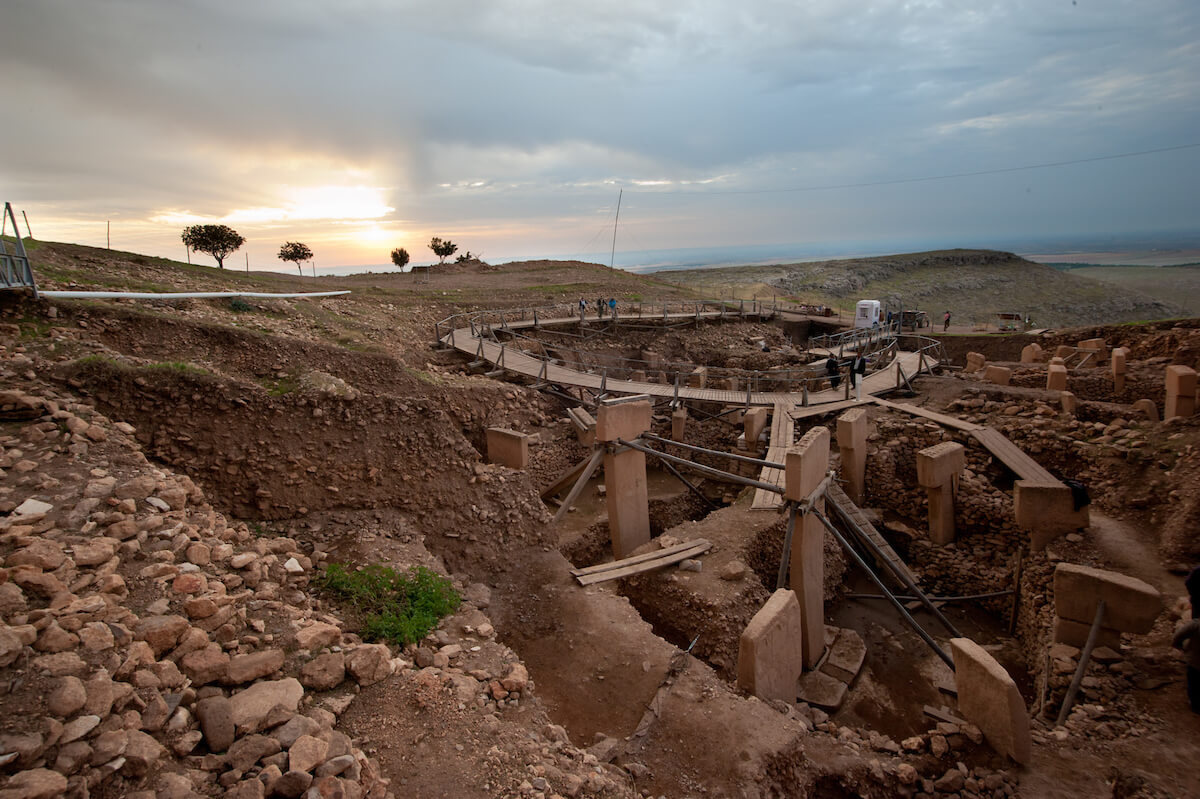
Figure 1: Aerial view of the Göbekli Tepe site under excavation. The four substantially excavated enclosures (A through D) are visible, each centered on pairs of T shaped pillars and surrounded by carved limestone benches. The site contains at least twenty additional enclosures identified through ground penetrating radar but not yet excavated, indicating that the surface reading is a partial sample of a much larger architectural complex.
What is missing from the mainstream account is an explanation of where the technical inheritance came from. The conventional answer, which is that Pre-Pottery Neolithic A populations developed monumental construction independently and somewhat suddenly out of a hunter gatherer base, is consistent with the radiocarbon record but it does not address the question of how people who had not previously built large stone structures arrived at the technical, organizational, and iconographic sophistication evident in the earliest phase of these sites. The earliest enclosures are also the most sophisticated. The sequence does not show experimental development. It shows a mature tradition arriving in the archaeological record already formed.
2. The Urantia Book on the Region
The Urantia Book, published in 1955 from a manuscript that received its substantive content between 1934 and 1942, contains a layered account of the post rebellion history of southwestern Asia. The book does not name Şanlıurfa, but in our reading the region lies among the lands of three successive and overlapping cultural traditions: the western or Syrian Nodite centers, the Vanite settlements around Lake Van and Mount Ararat, and the Andite migrations.
Paper 77, "The Midway Creatures," authored by an Archangel of Nebadon, provides the most concentrated geography. Its section on the Nodite centers opens: "Three out of the four great Nodite centers were established immediately following the Bablot conflict" (77:4.2). The first listed is the western or Syrian center:
"The western or Syrian Nodites. The remnants of the nationalistic or racial memorialists journeyed northward, uniting with the Andonites to found the later Nodite centers to the northwest of Mesopotamia. This was the largest group of the dispersing Nodites, and they contributed much to the later appearing Assyrian stock." (77:4.3)
The geographic phrase is precise: "to the northwest of Mesopotamia" (77:4.3). In our reading it takes in the Anatolian belt running through what is now southeastern Turkey, the Ergani plain, the upper Tigris and Euphrates basins, and the foothills of the Taurus range. This is the region in which Göbekli Tepe, Karahan Tepe, and the broader Taş Tepeler cluster are located. The same passage has the Nodites "uniting with the Andonites" (77:4.3). In our reading those Andonites were the long resident highland population of the Anatolian and Caucasian zone.
The second relevant center is described across 77:4.10 and the following paragraph 77:4.11:
"The northern Nodites and Amadonites—the Vanites. This group arose prior to the Bablot conflict. These northernmost Nodites were descendants of those who had forsaken the leadership of Nod and his successors for that of Van and Amadon." (77:4.10)
"Some of the early associates of Van subsequently settled about the shores of the lake which still bears his name, and their traditions grew up about this locality. Ararat became their sacred mountain, having much the same meaning to later-day Vanites that Sinai had to the Hebrews. Ten thousand years ago the Vanite ancestors of the Assyrians taught that their moral law of seven commandments had been given to Van by the Gods upon Mount Ararat. They firmly believed that Van and his associate Amadon were taken alive from the planet while they were up on the mountain engaged in worship." (77:4.11)
Two geographic anchors appear in this passage. The lake which still bears Van's name is Lake Van, in eastern Anatolia, approximately two hundred kilometers northeast of the Şanlıurfa cluster. Mount Ararat, the volcanic massif rising on the modern border between Turkey, Armenia, and Iran, is approximately three hundred kilometers northeast of Lake Van. In our reading the cultural geography of the Vanites is centered on the highlands of eastern Anatolia. The book dates their teaching near this period: "Ten thousand years ago the Vanite ancestors of the Assyrians taught that their moral law of seven commandments had been given to Van by the Gods upon Mount Ararat" (77:4.11).
The third relevant population is the early Andite stream. Paper 78, also authored by an Archangel of Nebadon, dates the Andite era:
"These racial distributions, associated with extensive climatic changes, set the world stage for the inauguration of the Andite era of Urantia civilization. These early migrations extended over a period of ten thousand years, from 25,000 to 15,000 B.C. The later or Andite migrations extended from about 15,000 to 6000 B.C." (78:3.9)
The Göbekli Tepe and Karahan Tepe construction window of approximately 9600 to 8000 BC falls precisely within the later Andite migration period. The book dates the forming of the Andites to the violet race's "amalgamation with the Nodite and Sangik races, about 15,000 B.C." (78:0.2). Of their routes into Europe it says: "Some entered Europe by way of the islands of the Aegean and up the Danube valley, but the majority of the earlier and purer strains migrated to northwestern Europe by the northern route across the grazing lands of the Volga and the Don" (80:4.1). Paper 78:5.4 records:
"By 12,000 B.C. three quarters of the Andite stock of the world was resident in northern and eastern Europe, and when the later and final exodus from Mesopotamia took place, sixty-five per cent of these last waves of emigration entered Europe." (78:5.4)
For the final exodus the book gives the route of the largest share: "Sixty-five per cent entered Europe by the Caspian Sea route" (78:6.2). That a corridor of the earlier Andite movement passed through the Şanlıurfa region is our reading. Paper 79:0.1 summarizes the broader regional history:
"Southwestern Asia witnessed the successive civilizations of Dalamatians, Nodites, Adamites, and Andites, and from these regions the potentials of modern civilization spread to the world." (79:0.1)
In short, we read the region of Göbekli Tepe and Karahan Tepe as a culturally dense corridor among three institutional traditions of the book: the Syrian Nodite centers "to the northwest of Mesopotamia" (77:4.3), the Vanites about "the lake which still bears his name" (77:4.11), and the Andite migrations (78:3.9).
| Period (approx. BC) | Population | In the Book's Words | Archaeological Horizon |
|---|---|---|---|
| 200,000 to 35,000 | Nodites and Amadonites with Van and Amadon | "Here, in the vicinity of Lake Van and the southern Caspian Sea region, the Nodites mingled and mixed with the Amadonites" (73:1.6) | Upper Paleolithic baseline; predates regional record |
| 35,000 to 28,000 | Adamson and the Adamsonites | "About 35,000 B.C. Adamson visited one of the easternmost of the old Vanite settlements to found his center of civilization" (77:4.13); "The Adamsonites maintained a high culture for almost seven thousand years from the times of Adamson and Ratta" (77:5.9) | Predates regional record |
| 25,000 to 15,000 | Early Adamite expansions from the second garden | "These early migrations extended over a period of ten thousand years, from 25,000 to 15,000 B.C." (78:3.9) | Late Upper Paleolithic transitional |
| 15,000 onward | Adamites and Nodites form the Andites | "the extensive union of the Adamites with the surrounding mixed Nodites to form the Andites" (78:5.1) | Pre-Pottery Neolithic A precursor phase |
| About 10,000 | Andites at Babel | "About twelve thousand years ago a second attempt to erect the tower of Babel was made" (77:3.9) | Functionally adjacent in time to the Şanlıurfa primary phase |
| 9,600 to 8,000 | In our reading, Syrian Nodites, Vanites and Andites overlap in the region | "Ten thousand years ago the Vanite ancestors of the Assyrians taught that their moral law of seven commandments had been given to Van by the Gods upon Mount Ararat" (77:4.11) | Göbekli Tepe and Karahan Tepe primary construction |
| 8,000 to 6,000 | The last Andite waves leave Mesopotamia | "The last three waves of Andites poured out of Mesopotamia between 8000 and 6000 B.C." (78:6.1) | Şanlıurfa cluster systematically buried |
Table 1: Population sequence in southeastern Anatolia and adjacent zones as we read the Urantia Book, mapped to the corresponding archaeological horizon. The periods and population labels are our summary; the third column gives the book's words. Its "twelve thousand years ago" and "Ten thousand years ago", counted from the 1930s, are by our arithmetic about 10,000 and 8000 BC. The book does not name Şanlıurfa, Göbekli Tepe or Karahan Tepe. Archaeological horizons follow the conventional Pre-Pottery Neolithic sequence.
3. The Adamic Upliftment and the Garden Knowledge
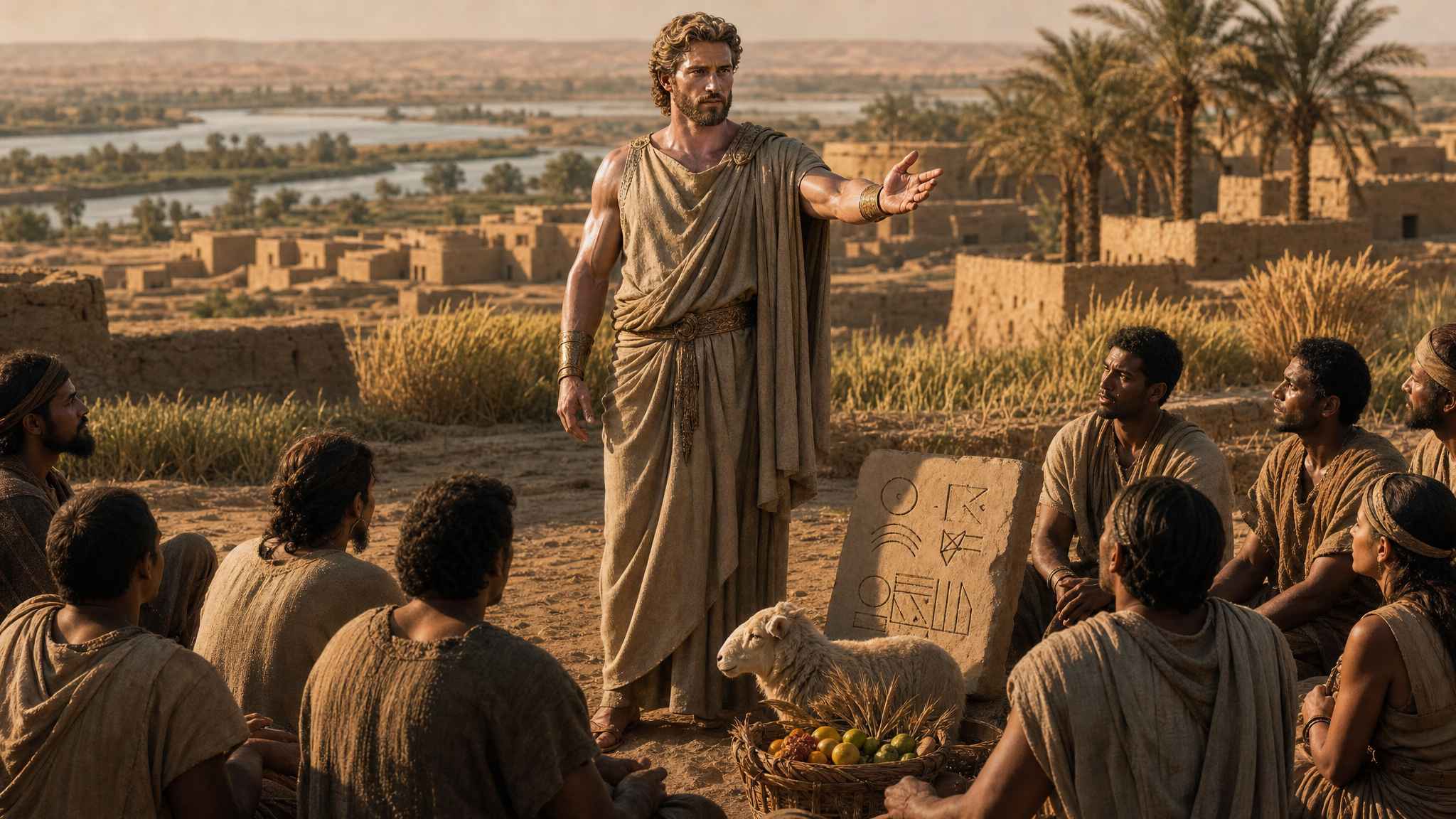
Figure 2: Adam, the biologic uplifter, teaching at the Second Garden in Mesopotamia. The Urantia Book calls Adam and Eve "the biologic uplifters" (UB 51:0.1) and says they "arrived on Urantia, from the year A.D. 1934, 37,848 years ago" (UB 74:0.1). Of the second garden it says: "For twenty thousand years the culture of the second garden persisted" (UB 78:5.1). In our reading that Edenic culture was the curricular underlay carried by the Andites into the Şanlıurfa region in the centuries leading up to 9600 BC.
The third population in the convergence, the Andite stream, deserves separate treatment because the Andites are not simply another branch of the Nodite tradition. The book defines them: "The Andite races were the primary blends of the pure-line violet race and the Nodites plus the evolutionary peoples" (78:4.1). In our reading the institutional knowledge they carried into the Şanlıurfa region was Edenic in origin, not Nodite.
Paper 51:0.1, authored by a Secondary Lanonandek Son, summarizes the role:
"DURING the dispensation of a Planetary Prince, primitive man reaches the limit of natural evolutionary development, and this biologic attainment signals the System Sovereign to dispatch to such a world the second order of sonship, the biologic uplifters. These Sons, for there are two of them—the Material Son and Daughter—are usually known on a planet as Adam and Eve. The original Material Son of Satania is Adam, and those who go to the system worlds as biologic uplifters always carry the name of this first and original Son of their unique order." (51:0.1)
The book says: "ADAM AND EVE arrived on Urantia, from the year A.D. 1934, 37,848 years ago" (74:0.1). It describes both sides of their mission, the teaching and the intended intermarriage, in one paragraph, 74:7.23:
"Adam taught his contemporaries all they could comprehend, but that was not very much, comparatively speaking. Nevertheless, the more intelligent of the races of earth looked forward eagerly to the time when they would be permitted to intermarry with the superior children of the violet race. And what a different world Urantia would have become if this great plan of uplifting the races had been carried out!" (74:7.23)
The first Garden stood on "a long narrow peninsula—almost an island—projecting westward from the eastern shores of the Mediterranean Sea" (73:3.1). The book says the peninsula "had been overrun by these lower-grade Nodites for almost four thousand years after Adam left the Garden when, in connection with the violent activity of the surrounding volcanoes and the submergence of the Sicilian land bridge to Africa, the eastern floor of the Mediterranean Sea sank, carrying down beneath the waters the whole of the Edenic peninsula" (73:7.1). Of the second garden it says: "This site was known to Adam as one of the three original selections of the committee assigned to choose possible locations for the Garden proposed by Van and Amadon" (76:1.3).
Paper 78:5.1 describes the institutional transition that produced the Andite race:
"For twenty thousand years the culture of the second garden persisted, but it experienced a steady decline until about 15,000 B.C., when the regeneration of the Sethite priesthood and the leadership of Amosad inaugurated a brilliant era. The massive waves of civilization which later spread over Eurasia immediately followed the great renaissance of the Garden consequent upon the extensive union of the Adamites with the surrounding mixed Nodites to form the Andites." (78:5.1)
Three implications follow for the reading of Göbekli Tepe and Karahan Tepe.
First, in our reading the population in the Şanlıurfa region by 9600 BC, while institutionally connected to the older Nodite and Vanite traditions, was biologically a hybrid carrying significant Adamic inheritance. The carriers of the surviving traditions were not the relatively pure Nodite population of the deep post rebellion era. They were the Andite synthesis, formed by "the extensive union of the Adamites with the surrounding mixed Nodites" (78:5.1).
Second, in our reading the cultural curriculum carried by these populations was not simply the post rebellion residue of Dalamatia. It was the Edenic curriculum, of which the book says "For twenty thousand years the culture of the second garden persisted" (78:5.1). The book gives the teaching of the first Garden's schools: their forenoons "were devoted to practical horticulture and agriculture" (74:7.2), their subjects included "Health and the care of the body" (74:7.4) and "The golden rule, the standard of social intercourse" (74:7.5), and "The laws of the Garden were based on the older codes of Dalamatia" (74:7.12). In our reading calendrical observation and architectural planning belonged to the same body of teaching. Paper 78:3.10 records:
"It took so long for the earlier waves of Adamites to pass over Eurasia that their culture was largely lost in transit. Only the later Andites moved with sufficient speed to retain the Edenic culture at any great distance from Mesopotamia." (78:3.10)
The Şanlıurfa region is not at any great distance from Mesopotamia. The southern slope of the Taurus range descends directly to the upper Mesopotamian plain. In our reading the Andite migration corridor through this region is the corridor in which the Edenic culture was retained at maximum density. Whatever traditional curriculum the Şanlıurfa builders inherited from the older Nodite and Vanite sources, it was overlaid in the centuries leading up to 9600 BC with the full force of the Edenic transmission carried by the early Andite stream.
Third, the timing record contains a passage that is particularly relevant to the Göbekli Tepe and Karahan Tepe construction window. Paper 77:3.9, authored by an Archangel, records:
"About twelve thousand years ago a second attempt to erect the tower of Babel was made. The mixed races of the Andites (Nodites and Adamites) undertook to raise a new temple on the ruins of the first structure, but there was not sufficient support for the enterprise; it fell of its own pretentious weight. This region was long known as the land of Babel." (77:3.9)
Twelve thousand years ago, measured from the time of the Urantia Book's transmission in the 1930s, dates this Andite construction project, by our arithmetic, to approximately 10,000 BC. The Pre-Pottery Neolithic A construction phase at Göbekli Tepe begins approximately 9600 BC. The two dates are functionally adjacent. While the Urantia Book passage describes a project on the ruins of the first Bablot structure rather than the Şanlıurfa monuments themselves, it places a named Andite construction effort in the broader Mesopotamian region within the same time window as the Göbekli Tepe primary phase. The Andites of the period were attempting monumental construction. The text calls the builders "The mixed races of the Andites (Nodites and Adamites)" (77:3.9), and in our reading they carried the institutional inheritance of both traditions.
In our reading the Edenic culture (78:3.10), transmitted into Mesopotamia through the second garden and dispersed northward through the Andite migrations, is the knowledge body that produced agriculture, animal domestication, organized monotheistic worship, calendrical science, and architectural planning at scales that the regional record had not previously supported. The Şanlıurfa monuments are constructed at the eastern edge of the Andite dispersal arc, by a hybrid population carrying the genetic uplift of Adam, the institutional traditions of the Vanites, and the technical inheritance of the Nodite Smith and Mason guilds. They are the architectural signature of that synthesis at maximum local concentration.
4. The T Pillar as Anthropomorphic Marker
Among the most distinctive features of the Şanlıurfa monuments is the T shaped pillar form. The vertical shaft of the T is decorated with relief carvings on its lateral faces, and the horizontal cap of the T is plain. Several of the central pillars at Göbekli Tepe carry, on their lateral faces, low relief representations of arms with hands meeting near the lower edge of the shaft, as if folded across the body of an enormous figure. Belts and loincloths are carved at the level corresponding to the human waist. The scholarly consensus, articulated in Schmidt's published work and elaborated by his successors, is that the T pillars are anthropomorphic representations, abstract human figures rendered at superhuman scale.
The Urantia Book provides a candidate referent. Of the Prince's staff it says: "These one hundred rematerialized members of the Prince’s staff were chosen by Caligastia from over 785,000 ascendant citizens of Jerusem" (66:2.4). Of their descendants: "The pure-line Nodites were a magnificent race" (77:2.9). In our reading they were remembered as taller than the local norm. The Urantia Book records that "the staff and their early descendants were so regarded by the evolutionary mortals of those distant days; even their stature came to be magnified by tradition" (77:2.3). Genesis 6:4, recording a Hebrew memory of the same population, refers to them as Nephilim, traditionally translated as "giants." The Urantia Book at 77:2.3 identifies the Nephilim with the Nodites:
"The Nephilim (Nodites) were on earth in those days, and when these sons of the gods went in to the daughters of men and they bore to them, their children were the 'mighty men of old,' the 'men of renown.'" (77:2.3)
The passage echoes Genesis 6:4.
The T pillar tradition, on this reading, is not arbitrary symbolic abstraction. It is an iconographic conservation of an ancestral memory: oversized humanoid figures whose physical scale was visible to the populations who remembered them. The arms folded across the body, the carved belts, the visual emphasis on the chest and abdomen of an upright figure, are consistent with a sculptural tradition attempting to render at architectural scale a body type whose actual scale exceeded the human norm.
The geometric vocabulary supports the reading. The T form abstracts the human figure to its minimum recognizable elements: vertical body, horizontal shoulders or head. It is a signature, not an ornament. And the signature appears, with consistent execution, across approximately a dozen sites in the Şanlıurfa cluster, suggesting a shared cultural prototype that had been institutionalized before any of the surviving sites were constructed.
5. The Two Central Pillars and the Twelve Surrounding: An Architectural Reading of the Vanite Ascension
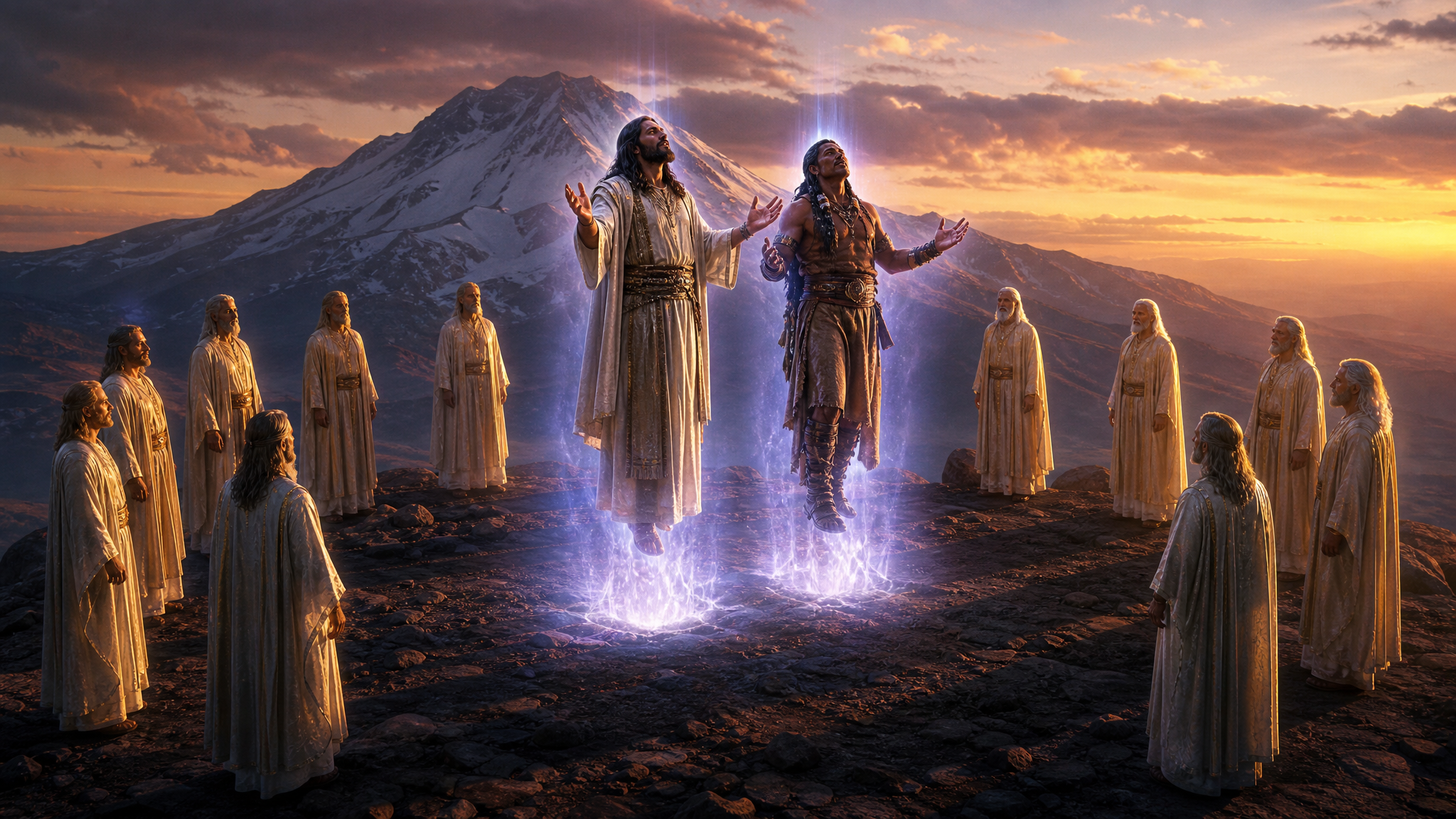
Figure 3: Artistic reconstruction of the ascension of Van and Amadon from Mount Ararat, with the twelve Melchizedek receivers attending. The Vanite tradition recorded at UB 77:4.11 holds that Van and his associate Amadon "were taken alive from the planet while they were up on the mountain engaged in worship" (UB 77:4.11). The book says "The affairs of Urantia were for a long time administered by a council of planetary receivers, twelve Melchizedeks" (UB 67:6.5), and "their planetary policies were faithfully executed by Van" (UB 67:6.6). This composition of two ascended figures at the geometric center, surrounded by a ring of twelve celestial witnesses, is the pattern this paper proposes is encoded in the Göbekli Tepe enclosure architecture.
The architectural template of the Göbekli Tepe enclosures is consistent across the substantially excavated examples. Each enclosure is organized around a pair of large T pillars at the geometric center, oriented in parallel and facing the same direction, and surrounded by a ring of perimeter pillars carved from the bedrock floor or set into the encircling stone bench. The number of perimeter pillars varies modestly by enclosure based on size and preservation, with Enclosure C preserving approximately twelve and Enclosure D preserving approximately eleven (Schmidt 2006; Notroff et al. 2014). The two central pillars are consistently larger than the perimeter pillars, are decorated with the most elaborate relief carving on the site, and carry the anthropomorphic features (arms, hands, belts, loincloths) discussed in Section 4.
The Urantia Book provides a striking candidate referent for this two and twelve organization. Paper 67, "The Planetary Rebellion," authored by a Melchizedek of Nebadon, records the post rebellion administrative arrangement on Urantia:
"The affairs of Urantia were for a long time administered by a council of planetary receivers, twelve Melchizedeks, confirmed by the mandate of the senior constellation ruler, the Most High Father of Norlatiadek." (67:6.5)
The text is explicit: twelve Melchizedek receivers. The same paragraph names Van among their advisers as "the commander in chief of the midway creatures" (67:6.5). The next paragraph records:
"The twelve Melchizedek receivers of Urantia did heroic work. They preserved the remnants of civilization, and their planetary policies were faithfully executed by Van." (67:6.6)
The book continues in the same paragraph: "Within one thousand years after the rebellion he had more than three hundred and fifty advanced groups scattered abroad in the world" (67:6.6). Of Van's companion it says: "Amadon is the outstanding human hero of the Lucifer rebellion" (67:3.8). "This male descendant of Andon and Fonta was one of the one hundred who contributed life plasm to the Prince’s staff, and ever since that event he had been attached to Van as his associate and human assistant" (67:3.8). Paper 77:4.11, in the passage already discussed in connection with the Vanite memory of Mount Ararat, records the Vanite tradition that Van and Amadon were taken alive from the planet:
"They firmly believed that Van and his associate Amadon were taken alive from the planet while they were up on the mountain engaged in worship." (77:4.11)
In our reading the composite institutional memory carried by the Vanite tradition into the Pre-Pottery Neolithic A horizon thus contains two elements: a pair of loyal figures (Van and Amadon) who were taken alive from the planet in an ascension event localized to Mount Ararat, and a council of twelve Melchizedek receivers who took over the planetary administration after the rebellion and whose policies Van had executed on the ground.
In our reading the architectural template at Göbekli Tepe encodes both elements with arresting precision. The central pair of T pillars, larger and more elaborately decorated than the surrounding pillars, oriented together as if engaged in a shared act of standing or worship, encodes Van and Amadon. The surrounding ring of perimeter pillars, varying around the canonical number of twelve, encodes the twelve Melchizedek receivers who governed after the rebellion. The geometry of the enclosure is thus not arbitrary symbolic abstraction. It is a lithic transcription of the post rebellion administrative structure as the Vanite tradition remembered it, with the two ascended figures at the center and the twelve administrators arranged around them.
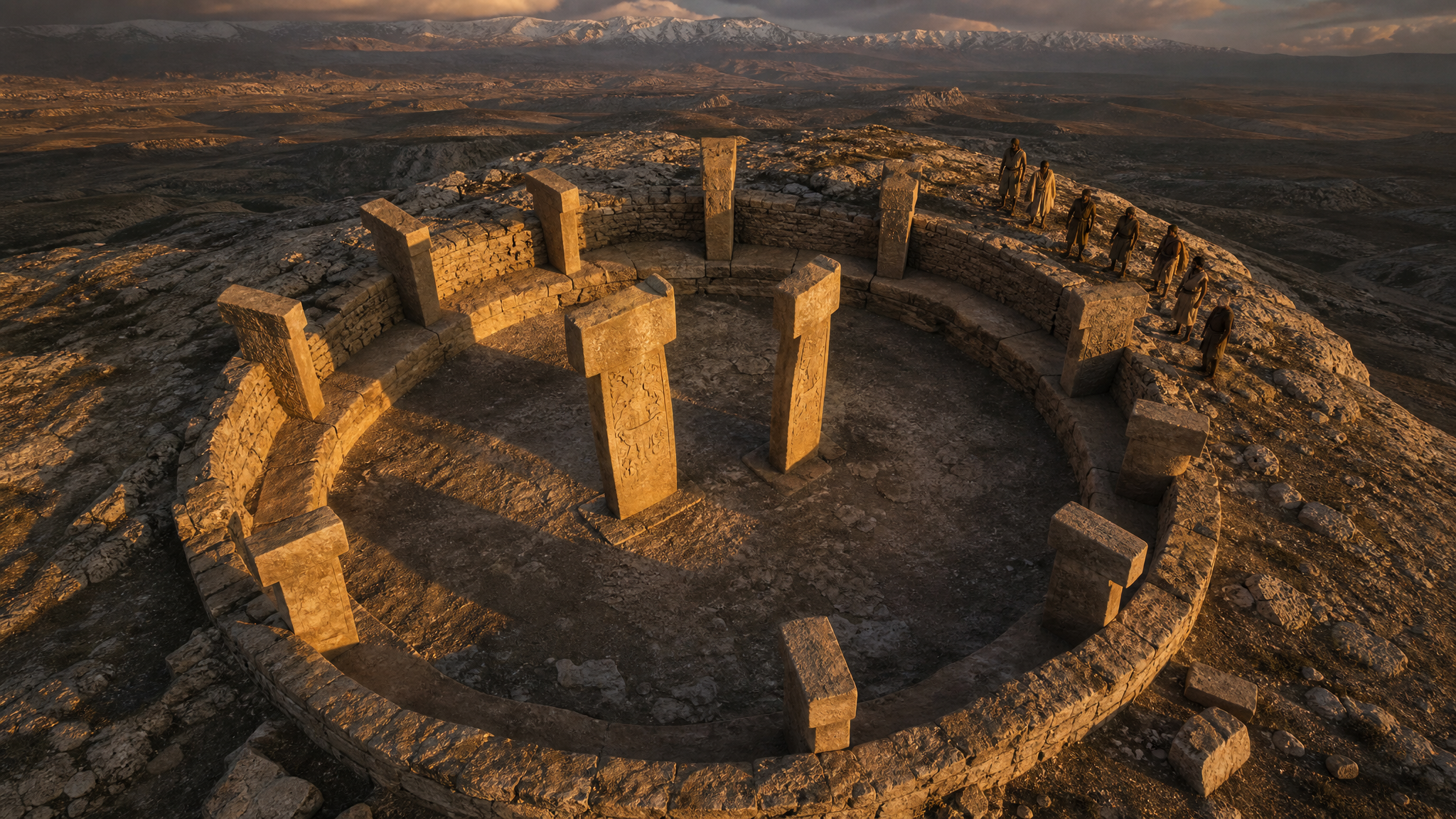
Figure 4: Plan view reconstruction of a Göbekli Tepe enclosure, illustrating the geometric template proposed in this section. Two larger T pillars stand at the geometric center oriented in parallel; a ring of approximately twelve smaller T pillars is set into the carved limestone bench encircling the perimeter. The two-and-twelve organization recurs across the substantially excavated enclosures at Göbekli Tepe, with the perimeter count varying modestly around the canonical figure based on enclosure size and preservation.
| Architectural Feature | Geometric Position | Candidate UB Identity |
|---|---|---|
| Two central T pillars (largest, most elaborately decorated, oriented together) | Geometric center of enclosure | Van and Amadon, the ascended pair (77:4.11, 67:6.6) |
| Ring of approximately twelve perimeter pillars | Circumferential ring around central pair | Twelve Melchizedek receivers (67:6.5, 67:6.6) |
| Anthropomorphic relief work consistent across all pillars in enclosure | Distributed across both central and perimeter | Shared institutional class of being (loyal personalities of the post rebellion administration) |
| Carved limestone bench encircling the perimeter pillars | Outer ring | Communal seating for participants in the worship enacted at the center |
Table 4: The geometric template of the Göbekli Tepe enclosures mapped to the post rebellion administrative structure of Urantia as recorded in the Urantia Book. The central pair of T pillars and the surrounding ring of approximately twelve perimeter pillars correspond, on this reading, to the two ascended Vanite leaders (Van and Amadon) and the twelve Melchizedek receivers whose policies they executed.
The reading is reinforced by the location. Mount Ararat, the sacred mountain of the Vanite ascension memory, sits approximately three hundred kilometers northeast of the Şanlıurfa cluster. Lake Van, the regional anchor of Vanite settlement, sits approximately two hundred kilometers northeast. The Şanlıurfa enclosures, on this reading, are the southern ceremonial extension of a Vanite cultural geography whose religious focus point is the mountain on which the ascension was believed to have occurred. The two central pillars, oriented in parallel and facing in the consistent direction documented across the excavated enclosures, may be oriented toward Mount Ararat itself. This orientation hypothesis is testable against the published azimuths of the central pillars at each enclosure and is offered here as a research direction rather than an established result.
The two and twelve template is not unique to the Şanlıurfa cluster. It recurs across Old World mythology and ritual architecture in forms that have been independently catalogued by historians of religion: the two pillars of Solomon's Temple (Jachin and Boaz) flanked by the twelve oxen supporting the molten sea; the two olive trees of Zechariah 4 standing before the seven branched lampstand whose iconography incorporates twelve loaves of showbread; the twelve apostles of Jesus arranged around the central pair of master and disciple at the Last Supper; the twelve signs of the zodiac arranged around the dual sun and moon. Each of these recurrences is normally treated as an independent symbolic development of the small culture that produced it. Read with the Urantia Book's account, we suggest instead that all of them are downstream cultural memories of a specific historical institutional arrangement (two ascended figures plus twelve administrators) that was first encoded in stone by the Vanite descendants in southeastern Anatolia in the centuries preceding 9600 BC, and that subsequently traveled outward through the Andite migration corridor into the religious traditions of every culture the Andites reached.
If this reading is sustained, the Göbekli Tepe enclosures are the oldest preserved iconographic record of the post rebellion administrative structure of Urantia. They are not merely ceremonial. They are commemorative. Each enclosure stages, in monumental stone, the moment in planetary history when the rebellion ended, the loyal pair was taken up, and the twelve receivers assumed administrative responsibility for the salvage operation that followed. The Vanite descendants, whose oral and institutional memory of these events had been preserved for tens of thousands of years, built the enclosures to keep that memory legible to anyone who came after them. The fact that the iconography is now legible to modern researchers, eleven thousand years after construction and following ninety years of academic excavation, is the most direct vindication of the Vanite intent the historical record has produced.
6. The Animal Reliefs and the Memory of the Prince's Council
The relief carvings on the lateral faces of the T pillars and on the carved benches of the enclosures depict a bestiary: foxes, boars, snakes, scorpions, vultures, cranes, gazelles, lions, and aurochs. The selection is not the bestiary one would expect from a hunter gatherer ritual program organized around primary food species. Cranes and vultures are not subsistence prey. Snakes and scorpions are not hunted. The dominant species are predators and birds, with prey species secondary. The pattern resembles, more closely than any subsistence repertoire, an inventory of taxonomic classes organized for didactic display.
The Urantia Book says of the Prince's staff: "The one hundred were organized for service in ten autonomous councils of ten members each" (66:5.1). Paper 66:5.4 records the second:
"The board of animal domestication and utilization. This council was dedicated to the task of selecting and breeding those animals best adapted to help human beings in bearing burdens and transporting themselves, to supply food, and later on to be of service in the cultivation of the soil. This able corps was directed by Bon." (66:5.4)
Paper 66:5.6 records:
"It was in these days that carrier pigeons were first used, being taken on long journeys for the purpose of sending messages or calls for help. Bon's group were successful in training the great fandors as passenger birds, but they became extinct more than thirty thousand years ago." (66:5.6)
In our reading the institutional memory of an organized program for animal classification, domestication, and didactic presentation reaches back to the original Dalamatian administration, which the book dates "About five hundred thousand years ago" (66:0.2). The book records that "The board of animal husbandry were all swept into rebellion" (67:4.1). In our reading their knowledge passed to the Nodites, and from them, as "the Nodites mingled and mixed with the Amadonites" (73:1.6), into the Vanite line. The bestiary at Göbekli Tepe and Karahan Tepe, organized as it is around dramatic predators and conspicuous birds rather than around food species, is consistent with a teaching program in animal classification that had been transmitted through Nodite and Vanite institutions for tens of thousands of years before the construction of the surviving sites.
The single most discussed image, on Pillar 43 in Enclosure D at Göbekli Tepe, depicts a large bird flanked by smaller birds and reptiles. The bird at the center holds, in what reads as a carrying posture, a circular object. The conventional interpretation has speculated, with considerable disagreement, between a vulture devouring a head and a stylized solar disk. The Urantia Book records that Bon's group "were successful in training the great fandors as passenger birds" (66:5.6). The book dates their extinction "more than thirty thousand years ago" (66:5.6), some twenty millennia before the Göbekli Tepe construction window by our arithmetic, but in our reading the Vanite and Andite descendants who built the site retained institutional and oral memory of these creatures from their earlier Dalamatian inheritance. The dalamatia-is-atlantis article in this series has explored the fandor reading of the Pillar 43 imagery in detail and the evidence for the institutional persistence of fandor memory at Göbekli Tepe is treated there.
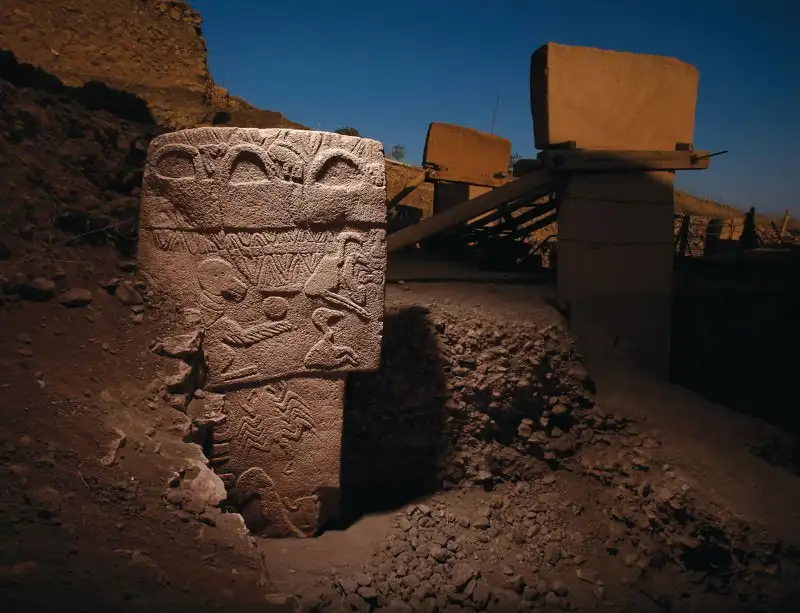
Figure 5: Animal relief panel from a Göbekli Tepe T pillar, showing the dense iconographic stack of birds, snakes, and quadrupeds characteristic of the site's enclosures. The selection emphasizes predators and conspicuous birds rather than primary food species, consistent with a didactic taxonomic program rather than a subsistence ritual repertoire.
| Şanlıurfa Iconographic Feature | Conventional Reading | Candidate UB Institutional Source (our mapping) |
|---|---|---|
| T pillar anthropomorphic form | Abstract human figure at superhuman scale | Memory of corporeal Prince's staff and pure line Nodites whose "stature came to be magnified by tradition" (77:2.3) |
| Bestiary of predators and birds | Ritual or shamanic associations | Bon's board of animal domestication and utilization, training of fandors and other species (66:5.4, 66:5.6) |
| Pillar 43 large carrying bird | Disputed vulture or sun disk | Fandor memory transmitted from Dalamatian transport corps (66:5.6) |
| Bedrock-carved pillars (Karahan Structure AB) | Phallic or fertility complex | Our reading: architectural symbolism of permanent rooting in the planetary substrate, from a headquarters where the book says "every human habitation was provided with abundance of land" (50:4.3) |
| Anthropomorphic head emerging from rock | Ancestor or guardian spirit | Visual signature of being whose origin was not local (parallel of staff descent at 66:2 to 66:3) |
| Karahan Tepe freestanding statue, 2.3 m | Ancestor figure or fertility totem | Memorial portrait of Adam, biologic uplifter, at recorded violet race scale (74:1.1, 51:0.1) |
| Geometric lattice in inner chamber | Snake, star map, or stylized sign | Our reading: a pictographic recording board from the Dalamatian curriculum, where "Fad formulated the first alphabet and introduced a writing system" (66:5.9) |
| T pillar enclosures, non-residential | Cultic gathering place | Our reading: a teaching center on the model of the prince's schools, whose pupils return to "establishing new and potent centers of learning and culture" (50:4.10) |
| Deliberate site burial at end of phase | Ceremonial closure or deconsecration | Our reading: closure as "The last three waves of Andites poured out of Mesopotamia between 8000 and 6000 B.C." (78:6.1) |
Table 3: Iconographic and architectural features of the Şanlıurfa monuments mapped to candidate institutional sources in the Urantia Book record. The conventional readings are not displaced; the table documents the points at which a parallel UB-sourced reading produces additional explanatory detail.
7. The Bedrock Pillars at Karahan Tepe
The architectural feature that most distinguishes Karahan Tepe from Göbekli Tepe is the chamber known in the excavation literature as Structure AB, in which eleven phallic pillars carved directly from the bedrock floor surround a twelfth pillar carved as an anthropomorphic head emerging from the same bedrock. The construction sequence is significant. The chamber was not assembled from quarried stone. It was carved subtractively into the living rock, with the floor and pillars worked from a single continuous limestone bed.
This subtractive technique is a distinct technological signature. It requires sustained chiseling to remove a much larger volume of stone than the additive construction method, and it cannot be corrected if a misjudgment is made. The fact that the chamber was carved from the bedrock rather than constructed from quarried blocks indicates that the builders prioritized the symbolic property of the chamber being part of the earth itself. The pillars do not stand on the rock. They are the rock.
This is not the construction technique of a population learning to work with stone. It is the construction technique of a population deploying stone work as a deliberate symbolic resource, with the choice between additive and subtractive construction made on theological rather than technical grounds. The Urantia Book says: "In the headquarters settlement on your world every human habitation was provided with abundance of land" (50:4.3). "Although the remote tribes continued in hunting and food foraging, the students and teachers in the Prince’s schools were all agriculturists and horticulturists" (50:4.3). The institutional memory of that organizational principle, transmitted through the Nodite and Vanite traditions, would have included a vocabulary of architectural symbolism in which certain structures were carved from the earth itself as a sign of permanent rooting in the planetary substrate.
The carved anthropomorphic head emerging from the bedrock wall in the same complex carries a similar symbolic logic. The figure is not free standing. It does not look at the viewer. It emerges from the rock face, as if the rock had given birth to it. In the iconographic vocabulary of Pre-Pottery Neolithic A populations whose institutional memory traced through the Nodite descendants of the Planetary Prince's staff, an anthropomorphic figure emerging from the living rock is the visual signature of a being whose origin was not local. It came from the world itself.
8. The Karahan Tepe Statue and the Adamic Memory
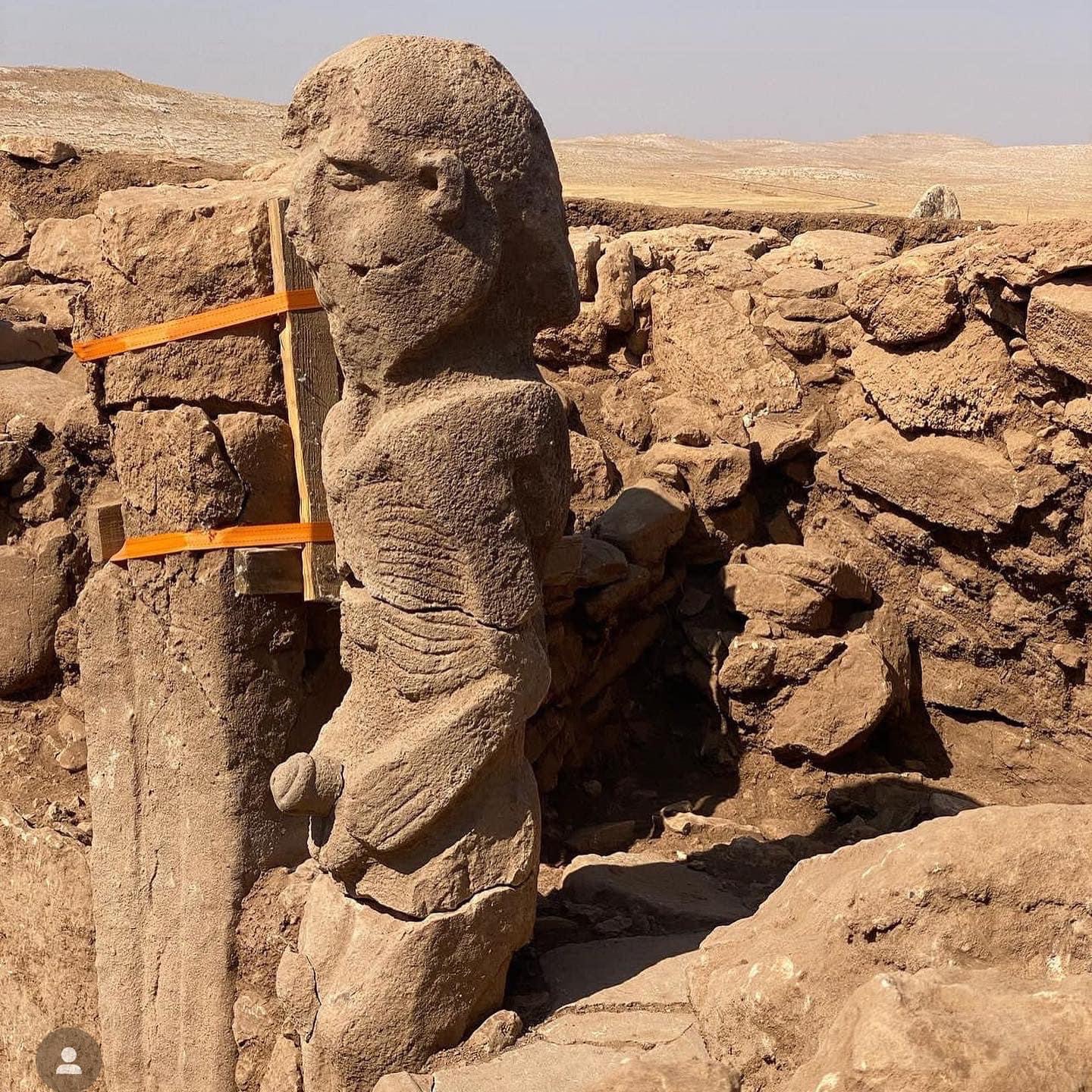
Figure 6: Karahan Tepe limestone statue photographed during excavation work, June 2025. The figure is shown supported by transport straps for repositioning. Note the nudity, the etched rib cage, the hands brought toward the lower abdomen, and the scale (the figure is roughly equivalent to an adult human). The Karahan Tepe excavation under Necmi Karul has recovered, between 2023 and 2025, two figurative anthropomorphic statues of comparable scale and consistent iconography from the same enclosure. Photograph by Marco Restano via Wikimedia Commons, CC BY-SA 4.0.
The Karahan Tepe excavation under Necmi Karul has recovered, between 2023 and 2025, two freestanding limestone statues of men of comparable scale and consistent iconography from the same enclosure. The first, announced in September 2023, is a 2.3 meter seated figure fixed within a wall niche, hands clasping the phallus, ribs and spine deeply etched, and was characterized by the excavators as a probable representation of an honored deceased ancestor. The second, revealed in 2025, is a standing figure carved from a single block of limestone, nude, with ribs showing, hands brought toward the lower abdomen in a gesture functionally equivalent to the first statue's, and was found in the same enclosure as the seated figure together with a square wall niche holding a human skull. Karul has described these statues, in initial press communications and conference reporting, as the most realistic anthropomorphic representations yet recovered from the Taş Tepeler horizon.
The recovery of two statues, not one, is significant. A single specimen could be argued as an outlier. Two specimens with consistent iconographic conventions (nudity, anatomical realism with emphasized rib cage, gesture concentrated at the procreative center, scale above the regional human norm) demonstrate that the iconography is systematic. The Karahan Tepe enclosure is staging a deliberate visual program, executed across multiple sculptures, in which a specific class of being is being represented with a consistent set of conventions.
The two statues together present three iconographic features that are difficult to reconcile with the standard "ancestor figure" or "fertility totem" interpretations. The features below are illustrated by the second statue (Figure 6) but apply consistently to both.
The first is the gesture itself. The hands are not in a casual or generic ritual posture. They are clasped over the genital area, in a configuration that emphasizes the procreative function. This is not a minor compositional detail. The statue's principal sculptural focus, after the face, is the procreative center of the body and the gesture that frames it. In a sculpture of the Pre-Pottery Neolithic A horizon, where most anthropomorphic representation is highly abstracted, the choice to emphasize the procreative center with such precision is a deliberate iconographic statement.
The second is the anatomical realism. The rib cage is carved through the chest as a series of distinct horizontal lines, the abdominal musculature is differentiated, and the arms display proportional joint articulation. These are portrait choices, not symbolic abstraction. The sculptor was attempting to render a specific being, not a general class of beings.
The third is the scale. The first Karahan Tepe statue is documented at 2.3 meters tall. The second statue, while not yet given a published measurement at the time of writing, is comparable in scale based on the excavation imagery. Both stand approximately one third taller than the average male of the regional population at this date. The Urantia Book records the height of Adam and Eve directly:
"The Planetary Adam and Eve of Urantia were members of the senior corps of Material Sons on Jerusem, being jointly number 14,311. They belonged to the third physical series and were a little more than eight feet in height." (74:1.1)
A little over eight feet is approximately 2.45 meters. The Karahan Tepe statue stands at 2.3 meters. The match between the recorded height of Adam and the height of the statue is within the margin of artistic compression at architectural scale. The statue is neither a generic ancestral figure at human scale nor a hyperbolic Nephilim figure at the legendary scale of the magnified tradition. It is at the scale that the Urantia Book records for the violet race ancestor at 74:1.1.
| Class of Being | Height | Metric Equivalent | Karahan Tepe Statue Match |
|---|---|---|---|
| Average regional male, c. 9400 BC | approx. 5'7" (our estimate; no source cited) | approx. 1.70 m | No (statue 35% taller) |
| Adam and Eve, violet race ancestors | "a little more than eight feet" (74:1.1) | approx. 2.45 m | Yes (within 6% compression) |
| Pure line Nodites and Prince's staff descendants | "stature came to be magnified by tradition" (77:2.3); height not given | n/a | Indeterminate against the statue |
Table 2: Comparative scale of human and Adamic body classes; the regional figure is our estimate and the other two rows are the Urantia Book's words, with the Karahan Tepe statue's measured height of 2.3 meters mapped against each. The Urantia Book records the height of Adam and Eve directly at 74:1.1 but does not assign a specific height to the corporeal Prince's staff or to pure line Nodites, noting only that "even their stature came to be magnified by tradition" (77:2.3). The statue's measured scale matches the recorded Adamic class within the tolerance expected for stone portraiture at architectural display.
Of Adam's mission the book says:
"DURING the dispensation of a Planetary Prince, primitive man reaches the limit of natural evolutionary development, and this biologic attainment signals the System Sovereign to dispatch to such a world the second order of sonship, the biologic uplifters." (51:0.1)
It describes the plan of intermarriage in these words: "the more intelligent of the races of earth looked forward eagerly to the time when they would be permitted to intermarry with the superior children of the violet race" (74:7.23). The iconographic signature of a biologic uplifter, encoded in stone by a population whose institutional memory of him survived, by our arithmetic from the book's dates (74:0.1, 76:5.5), for some twenty-six thousand years after his physical death, would be expected to emphasize precisely the body region and the gestural posture that the Karahan Tepe statues actually display.
This identification is offered as a working hypothesis rather than a finished claim. The Karahan Tepe statues, two specimens recovered between 2023 and 2025, sit within a surrounding context that is still being excavated. What the reading does is locate the iconographic peculiarities of this statue within an existing institutional tradition that is independently described in the Urantia Book record. The procreative gesture is not inexplicable. The portrait realism is not inexplicable. The superhuman but moderate scale is not inexplicable. They are the expected features of a memorial sculpture for a biologic uplifter, carved by a Vanite Nodite Andite descendant population whose oral and institutional memory of the violet race ancestor had been preserved for hundreds of generations and whose immediate ancestral pool, by 9400 BC, carried his blood.
If this reading is sustained by future excavation and contextual analysis, the Karahan Tepe statues are the oldest preserved portraits of the Adamic mission on Urantia. The mainstream literature does not currently entertain this hypothesis, and the present paper does not assert that it should. What this paper does assert is that the iconographic profile of the statue is more parsimoniously explained by the Adamic identification than by the alternatives currently in circulation, and that the explanatory burden is now distributed across a set of features (gesture, realism, scale, regional context, and date) which together produce a tighter convergence than any rival identification has produced.
9. The Burial Pattern and the Teaching Center Reading
A defining feature of both Göbekli Tepe and Karahan Tepe is the absence of contemporary residential architecture and the corresponding absence of a domestic refuse profile. There are no residential floors, no hearths in domestic configuration, no extensive food preparation deposits. The faunal remains at Göbekli Tepe consist primarily of bones from large feasting events, with deposits clustered around the enclosures rather than dispersed across a settlement footprint. The site was not lived in. It was visited.
This profile is consistent with the function of a teaching center serving a regional population that lived elsewhere. In our reading the original Dalamatian institutional model was a hub and spoke arrangement in which the central headquarters housed the staff and their immediate students, while the broader population lived in dispersed settlements and traveled periodically to the center for instruction. Paper 50, on the Planetary Princes, describes their schools:
"The prince's corporeal staff early organize the planetary schools of training and culture, wherein the cream of the evolutionary races are instructed and then sent forth to teach these better ways to their people. These schools of the prince are located at the material headquarters of the planet." (50:4.1)
The dispersal mechanism is described at 50:4.10:
"From such a world center of culture and achievement there gradually radiates to all peoples an uplifting and civilizing influence which slowly and certainly transforms the evolutionary races. Meantime the educated and spiritualized children of the surrounding peoples who have been adopted and trained in the prince's schools are returning to their native groups and, to the best of their ability, are there establishing new and potent centers of learning and culture which they carry on according to the plan of the prince's schools." (50:4.10)
In our reading the Pre-Pottery Neolithic A complexes of the Şanlıurfa region carry the architectural and functional signature of teaching centers in this exact tradition. The book says Van kept such a network alive after the rebellion: "Within one thousand years after the rebellion he had more than three hundred and fifty advanced groups scattered abroad in the world" (67:6.6). They are non residential. They are iconographically dense. They are constructed at scales that imply the participation of a regional population larger than any local village could supply. And they are decorated with a curriculum of animal and anthropomorphic imagery that reads more readily as a didactic program than as a subsistence ritual.
Of the faculty under Fad's leadership the book says:
"Fad formulated the first alphabet and introduced a writing system. This alphabet contained twenty-five characters. For writing material these early peoples utilized tree barks, clay tablets, stone slabs, a form of parchment made of hammered hides, and a crude form of paperlike material made from wasps' nests. The Dalamatia library, destroyed soon after the Caligastia disaffection, comprised more than two million separate records and was known as the 'house of Fad.'" (66:5.9)
And at 66:5.10 the text records the racial preferences in writing systems:
"The blue man was partial to alphabet writing and made the greatest progress along such lines. The red man preferred pictorial writing, while the yellow races drifted into the use of symbols for words and ideas, much like those they now employ." (66:5.10)
The second of the early sites carved from the bedrock at Karahan Tepe contains a relief carved lattice on one wall that has been variously interpreted as a rendering of a snake, a star map, or a stylized signature pattern. The lattice is geometrically precise and does not correspond to any known natural form. In a teaching center context it would function as a board, an iconographic surface on which abstract relations were rendered in stone for ongoing reference. The form is consistent with a population whose institutional memory traced through the Dalamatian writing tradition described above.
10. The Buried Sites and the Cultural Pivot
Both Göbekli Tepe and Karahan Tepe were deliberately buried at the end of their primary use period. The fill is not the natural sedimentary record of an abandoned site eroded by rainfall and wind over millennia. It is engineered. The enclosures were systematically backfilled, primarily with limestone rubble and faunal debris from feasting deposits, and the entire complex was sealed beneath a deliberate cap of soil. The work involved represents the inverse, in labor terms, of the original construction. Whoever buried these sites did so with intention, with organization, and with completion.
The mainstream archaeological literature has offered several explanations for the deliberate burial: the closing of a ceremonial cycle, the deconsecration of obsolete sacred architecture, the protection of sites from invading or hostile populations, or some combination. None of these explanations is unreasonable. None of them, however, addresses the larger pattern. The deliberate burial is not unique to Göbekli Tepe and Karahan Tepe. It is repeated across the Şanlıurfa cluster as a regional convention.
The Urantia Book says: "By 12,000 B.C. three quarters of the Andite stock of the world was resident in northern and eastern Europe" (78:5.4). It also says: "The last three waves of Andites poured out of Mesopotamia between 8000 and 6000 B.C." (78:6.1). The deliberate burial of the Şanlıurfa monuments, dated approximately 8000 BC at Göbekli Tepe and continuing into the Pre-Pottery Neolithic B horizon at Karahan Tepe and related sites, falls within that final outflow. In our reading the institutional population that built and maintained these monuments was, during this period, leaving the region. The burial of the sites is consistent with a deliberate closure by a population preparing to depart, sealing the centers of its institutional life behind it as it dispersed outward. The regional cluster at Şanlıurfa was not abandoned to decay. It was put away.
11. Why the Conventional Account Is Incomplete
The mainstream archaeological treatment of Göbekli Tepe and Karahan Tepe has been intellectually careful and empirically rich. The radiocarbon record has been built systematically. The iconographic catalogues are thorough. The architectural analysis is precise. The successor scholars to Klaus Schmidt, including Lee Clare at Göbekli Tepe and Necmi Karul at Karahan Tepe, have refined the chronology, identified the residential signal that was previously thought to be entirely absent, and developed nuanced models of the social organization required to produce the monuments. None of the work summarized in this paper is intended to displace any of that contribution.
What the conventional account has not been able to supply is an explanation of where the technical, iconographic, and organizational inheritance came from. The Pre-Pottery Neolithic A populations did not invent monumental construction in the archaeological sense of a developmental sequence visible in the record. The earliest enclosures are also the most sophisticated. The T pillar form arrives in the record already mature. The iconographic vocabulary is consistent across the regional cluster from the beginning. The organizational logistics of quarrying, transporting, raising, and decorating multi ton pillars require sustained coordination at a scale that is not visible in any predecessor archaeological context in the region.
The archaeological record of southeastern Anatolia in the period preceding 9600 BC does not provide a developmental sequence adequate to explain what appears at Göbekli Tepe. The conventional response has been to attribute this to incomplete excavation, to argue that future field seasons will yield earlier and more rudimentary sites in the regional sequence. This is a reasonable hypothesis. It has not yet been confirmed. And the temporal compression of the existing record, combined with the iconographic and architectural sophistication of the earliest phase, is at minimum consistent with the alternative hypothesis that the relevant tradition was carried into the region by a population whose institutional memory predates the regional sequence.
In our reading the Urantia Book is one of the few sources in which that population is named. Three populations the book describes lie, on our reading, in and around this region in the millennia preceding the Şanlıurfa monuments: the Nodites who "journeyed northward, uniting with the Andonites to found the later Nodite centers to the northwest of Mesopotamia" (77:4.3); the Vanites, of whom it says "Some of the early associates of Van subsequently settled about the shores of the lake which still bears his name" (77:4.11); and the Andites, whose migrations it dates "from about 15,000 to 6000 B.C." (78:3.9). The convergence of these three populations in the centuries leading up to 9600 BC produces a candidate institutional context for the monuments that the conventional record does not have to supply from within itself.
12. Limitations and Future Research
The framework proposed in this paper carries several limitations that bear acknowledgment.
First, the Urantia Book is a textual source whose authorship and transmission are described in the work itself but are not subject to independent historical verification in the conventional sense. The paper has treated its claims as research framework rather than as established historical fact, and the convergence with the archaeological record is offered as evidence of explanatory power rather than as proof of textual provenance. Researchers who do not accept the Urantia Book's framing of its own composition will not find that framing strengthened by the convergence. Researchers who consider the Urantia Book a serious historical document will find the convergence corroborative.
Second, the regional cluster is still under active excavation. Approximately a dozen Taş Tepeler sites have been identified, of which only Göbekli Tepe and Karahan Tepe have been substantially excavated. The full iconographic and architectural inventory will not be available for many years. The reading proposed here is based on the published material as of the date of writing and remains provisional pending the recovery of additional context.
Third, the identification of the Karahan Tepe statues as Adamic memorial portraits is offered as a working hypothesis. The argument rests on three independent features (gesture, scale, and portrait realism) which together produce a tighter convergence with the Urantia Book account of the Adamic mission than has been produced by alternative identifications. The recovery of a second specimen at the same enclosure between 2023 and 2025 strengthens the argument materially, demonstrating that the iconographic conventions are systematic across multiple sculptures rather than peculiar to a single carving. Further specimens from related sites in the cluster, if recovered, will continue to test these conventions across an expanding sample. The hypothesis predicts that, if the framework is correct, future Pre-Pottery Neolithic A figurative sculpture from the region will cluster around the Adamic and Nodite scale ranges established here, will show a degree of portrait realism distinguishing it from generic ancestor figures, and will display gestural conventions consistent with the Urantia Book's institutional assignments to the modeled beings.
Fourth, the convergence between Paper 77:3.9's reference to "about twelve thousand years ago" and the Göbekli Tepe primary phase rests on a reading of the Urantia Book's relative dating language. The text was transmitted in the 1930s; "twelve thousand years ago" thus calibrates to approximately 10,000 BC. If the Urantia Book's relative dates are read as anchored to a different reference epoch, or if the language is read as approximate to a wider tolerance, the convergence is loosened correspondingly.
Fifth, future research priorities suggested by this framework include the systematic comparison of the Şanlıurfa iconographic catalogue against the figurative traditions of other sites along the Andite migration corridor (the Çatalhöyük seated figures, the Vinča figurines, the Cucuteni-Trypillia ceramics, the Halaf and Hassuna pottery traditions), the analysis of the genetic profile of any human remains recovered from the cluster against the Urantia Book's predictions for the Andite synthesis composition, and the geographic mapping of T pillar tradition outliers against the predicted dispersal corridors. None of these tests is dispositive in isolation, but the convergence or divergence of multiple independent tests would substantially refine the explanatory weight that the framework can carry.
13. Conclusion
The reading proposed in this paper does not require any concession from the mainstream archaeological framework on dating, iconographic cataloguing, or stratigraphy. The radiocarbon dates stand. The Pre-Pottery Neolithic chronology stands. The architectural typology stands. What the Urantia Book provides is an institutional context, missing from the conventional record, in which the appearance of mature monumental construction in southeastern Anatolia at 9600 BC ceases to be anomalous and becomes the predicted output of three documented and overlapping cultural traditions whose presence in and around this region is, on our reading, described in a text composed before the sites were known to modern scholarship.
The convergence is geographically tight. The western or Syrian Nodites are placed "to the northwest of Mesopotamia" (77:4.3), which is where the Şanlıurfa cluster is located. The Vanites are placed about "the lake which still bears his name" (77:4.11), with Ararat as "their sacred mountain" (77:4.11), the regional anchors immediately to the northeast of the cluster. In our reading the Andite migration stream, carrying Adamic blood and Edenic curriculum from the second garden in Mesopotamia, passes through the region in the relevant period. Paper 77:3.9 places a named Andite construction effort "About twelve thousand years ago" (77:3.9) in the land of Babel, which is functionally adjacent in time to the Göbekli Tepe primary phase. The bestiary, the T pillar form, the bedrock construction, the teaching center function, and the deliberate burial are all consistent with the institutional traditions associated with these populations in the Urantia Book record.
The genetic and cultural fingerprint of the Adamic mission is not incidental to this reading. It is central. In our reading the population that built Göbekli Tepe and Karahan Tepe was a fusion stock carrying biological inheritance from the mission of "the biologic uplifters" (51:0.1), and it was deploying technical and ceremonial knowledge that traces to the second garden, of which the book says "For twenty thousand years the culture of the second garden persisted" (78:5.1). The monumental architecture, the organized agriculture in the surrounding regional record, the calendrical and astronomical precision, the moral curriculum implied by the iconographic program, all of these are signatures of the Edenic transmission, encoded in stone by the Andite synthesis at maximum local concentration before the population dispersed outward.
The two sites do not require ancient astronauts. They do not require pre flood Atlantis. They do not require lost technology. They require only that the people who built them carried, into the centuries leading up to 9600 BC, an institutional memory of monumental construction and didactic iconographic display whose origin lies further back in time than the Pre-Pottery Neolithic A horizon. The Urantia Book, in the passages cited above, provides such a memory, and on our reading it places its bearers in and around the right region in the right millennia.
The most important question that remains open is the question that the field is itself asking with renewed intensity following the Karahan Tepe excavations: what is the relationship between the regional cluster and the broader Mesopotamian and Anatolian sequence that follows it. This paper's reading, which is our interpretation and not a statement of the Urantia Book, is that the same institutional populations who built the Şanlıurfa monuments dispersed outward through the Andite migrations, carrying their architectural and iconographic vocabulary to the qanat constructors of Persia, the megalithic builders of the Atlantic facade, the Tarim Basin metallurgists, and the trans Pacific navigators who reached the Andes. The Urantia Book never names Göbekli Tepe, Karahan Tepe or Şanlıurfa, and it records no dispersal from them. What it does record is Andite dispersal out of Mesopotamia. Of the last three waves, which "poured out of Mesopotamia between 8000 and 6000 B.C." (78:6.1), it says: "Sixty-five per cent entered Europe by the Caspian Sea route" (78:6.2); "Ten per cent, including a large group of the Sethite priests, moved eastward through the Elamite highlands to the Iranian plateau and Turkestan" (78:6.3); "Ten per cent of the Mesopotamians turned eastward in their northern trek, entering Sinkiang" (78:6.4); "Ten per cent of these fleeing Andites made their way across Arabia and entered Egypt" (78:6.5); and the last five per cent "refused to leave their homes" (78:6.6). In other paragraphs it says: "For almost fifteen thousand years centers of mixed Andite culture persisted in the basin of the Tarim River in Sinkiang" (79:1.2). And: "One hundred and thirty-two of this race, embarking in a fleet of small boats from Japan, eventually reached South America" (78:5.7). The book gives no date for that voyage, names no landing site, and does not place it among the last waves (78:5.7, 79:5.9). The book also limits the American link: of the civilizations founded "In Mexico, Central America, and in the mountains of South America" (79:5.8) it says that they "were evolutionary products of the Sangiks, notwithstanding that traces of Andite blood reached Peru" (79:5.9). The genetic evidence we have checked fits the Pacific crossing only in part: it shows contact between Polynesians and Native Americans around A.D. 1200, with gene flow from the Americas into Polynesia (Ioannidis et al. 2020, Nature 583: 572 to 577). The direction is the reverse of the book's account, in which Andites reach South America (78:5.7), and the date is thousands of years after the Andite migrations, which the book places "from about 15,000 to 6000 B.C." (78:3.9). The book never mentions qanats, so the link to the qanat constructors of Persia, like every other link from the Şanlıurfa monuments in this reading, is our inference and not the book's claim. The corpus of UBN articles cited at the close of this paper traces those onward dispersals in detail.
What was built at Göbekli Tepe and Karahan Tepe was not an isolated regional miracle. It was the high water mark of a tradition whose origins lie in the post rebellion Anatolian highlands, whose dispersal, in our reading, carried that tradition outward with the Andite migrations, and whose memory survives in stone for any researcher willing to read the iconography on its own terms.
Continue Reading
The dispersal of the Şanlıurfa tradition is traced across the broader Andite era in the following pieces:
-
The Andite Emergence. The full institutional account of the population whose migrations, the book says, spread the culture of Mesopotamia "over Europe, India, China, northern Africa, and the Pacific Islands" (78:5.8), with detailed treatment of the qanat hydraulic transmission (our interpretation; the Urantia Book never mentions qanats), the megalithic blast radius, and the Smith Guild metallurgical tradition.
-
Dalamatia Is Atlantis. The original Dalamatian headquarters, the Bablot conflict, the Nodite dispersion, and the fandor memory at Göbekli Tepe Pillar 43.
-
The 132 Sailors and the Feathered Serpent: Quetzalcoatl's Andite Origin. The Pacific voyage of the one hundred and thirty-two Andites who reached South America from Japan (78:5.7), a voyage the book does not date, and our interpretation of its echo in Mesoamerican memory. Of the civilizations founded "In Mexico, Central America, and in the mountains of South America" (79:5.8) the book itself says that they "were evolutionary products of the Sangiks, notwithstanding that traces of Andite blood reached Peru" (79:5.9).
-
Who Were the Olmec? A Urantia Book Reading. The amalgamated race of the Americas as the parallel case in which a high civilization arose in genuine isolation from the Andite stream.
-
Watchers Were Real: The UB Has Names. The institutional identification of the rebel staff and its descendants whose mixed populations form the immediate Nodite ancestry of the Şanlıurfa builders.
-
The Lake Van Name Preservation. The continuity of the Van name from the post rebellion period through the modern toponym, with the implications for cultural memory transmission across roughly two hundred thousand years.
References
Primary Source
The Urantia Book. 1955. Chicago: Urantia Foundation. References by paper, section, and paragraph as follows.
Paper 50: The Planetary Princes (50:4.1, 50:4.3, 50:4.10). Paper 51: The Planetary Adams (51:0.1). Paper 66: The Planetary Prince of Urantia (66:0.2, 66:2.4, 66:5.1, 66:5.4, 66:5.6, 66:5.9, 66:5.10). Paper 67: The Planetary Rebellion (67:3.8, 67:4.1, 67:6.5, 67:6.6). Paper 73: The Garden of Eden (73:1.6, 73:3.1, 73:7.1). Paper 74: Adam and Eve (74:0.1, 74:1.1, 74:7.2, 74:7.4, 74:7.5, 74:7.12, 74:7.23). Paper 76: The Second Garden (76:1.3, 76:5.5). Paper 77: The Midway Creatures (77:2.3, 77:2.9, 77:3.9, 77:4.2, 77:4.3, 77:4.10, 77:4.11, 77:4.13, 77:5.9). Paper 78: The Violet Race After the Days of Adam (78:0.2, 78:3.9, 78:3.10, 78:4.1, 78:5.1, 78:5.4, 78:5.7, 78:6.1, 78:6.2, 78:6.3, 78:6.4, 78:6.5, 78:6.6). Paper 79: Andite Expansion in the Orient (79:0.1, 79:1.2, 79:5.8, 79:5.9). Paper 80: Andite Expansion in the Occident (80:4.1).
Archaeological and Comparative Literature
Çelik, Bahattin. 2011. "Karahan Tepe: A New Cultural Centre in the Urfa Area in Turkey." Documenta Praehistorica 38: 241 to 253.
Childe, V. Gordon. 1928. The Most Ancient East: The Oriental Prelude to European Prehistory. London: Kegan Paul.
Clare, Lee. 2020. "Göbekli Tepe, Turkey. A Brief Summary of Research at a New World Heritage Site (2015 to 2019)." e-Forschungsberichte des Deutschen Archäologischen Instituts, no. 2: 81 to 88.
Dietrich, Oliver, Manfred Heun, Jens Notroff, Klaus Schmidt, and Martin Zarnkow. 2012. "The Role of Cult and Feasting in the Emergence of Neolithic Communities: New Evidence from Göbekli Tepe, South-eastern Turkey." Antiquity 86 (333): 674 to 695.
Ioannidis, Alexander G., et al. 2020. "Native American Gene Flow into Polynesia Predating Easter Island Settlement." Nature 583 (7817): 572 to 577.
Karul, Necmi. 2021. "Buried Buildings at Pre-Pottery Neolithic Period: Karahantepe." Türk Arkeoloji ve Etnografya Dergisi 81: 17 to 32.
Karul, Necmi. 2022. "Karahantepe: A New Neolithic Centre in Southeastern Anatolia." Antiquity 96 (390).
Mellaart, James. 1975. The Neolithic of the Near East. London: Thames and Hudson.
Notroff, Jens, Oliver Dietrich, and Klaus Schmidt. 2014. "Building Monuments, Creating Communities: Early Monumental Architecture at Pre-Pottery Neolithic Göbekli Tepe." In Approaching Monumentality in Archaeology, edited by James F. Osborne, 83 to 105. Albany: SUNY Press.
Schmidt, Klaus. 2000. "Göbekli Tepe, Southeastern Turkey: A Preliminary Report on the 1995 to 1999 Excavations." Paléorient 26 (1): 45 to 54.
Schmidt, Klaus. 2006. Sie bauten die ersten Tempel: Das rätselhafte Heiligtum der Steinzeitjäger. München: C.H. Beck.
Note on Citations
Every direct quotation from the Urantia Book is verbatim from the cited paragraph and was verified against the canonical 1955 publication. Citations follow the standard Paper:Section.Paragraph format used in Urantia Book scholarship. Quotations keep the book's own punctuation, including its em dashes; our own sentences use none. Mainstream archaeological references follow the Chicago author-date format. All figures appear with the original source credit in the caption text.
Author Information
Derek Samaras is the founder of the Urantia Book Network (urantiabooknetwork.com), a research and publication initiative dedicated to mapping the historical and cultural claims of the Urantia Book against the archaeological, linguistic, and anthropological record. Correspondence: through urantiabooknetwork.com.
Connecting Articles


The Newsletter
Get the research behind each piece
Free. New Urantia Book explorations, the sources behind the videos, and early looks. No spam, unsubscribe anytime.
Prefer video? Follow on YouTube and Facebook.
Delivered through Substack. You can also read past issues.