
Near-Death Experiences: What Are People Actually Seeing?
Millions of people have reported NDEs. The tunnel. The light. The life review. The feeling of not wanting to return. No materialist framework explains these consistently. The Urantia Book describes what's on the other side of that threshold in structural detail, and the match is striking.

Something Is Happening at the Threshold
In 1975, Raymond Moody published Life After Life and introduced the term "near-death experience" to the mainstream. Since then, the research has accelerated dramatically. The AWARE study at the University of Southampton documented verified perceptions during clinical death, with patients describing observations from outside their bodies that were later confirmed accurate. Cardiologist Pim van Lommel published a prospective study in The Lancet, one of medicine's most rigorous journals, documenting NDE reports from 344 cardiac arrest survivors, with a significant subset experiencing consciousness during periods of measurable brain flatline.
Eben Alexander, a Harvard-trained neurosurgeon who spent his career dismissing NDEs as brain-generated hallucinations, went into a week-long coma from bacterial meningitis in 2008. What he experienced while his neocortex was completely shut down, the part of the brain that supposedly generates consciousness, changed everything he thought he knew.
The experiences being reported across cultures, across centuries, across wildly different belief systems, share a consistent structure:
- A sensation of leaving the body
- A tunnel or passage
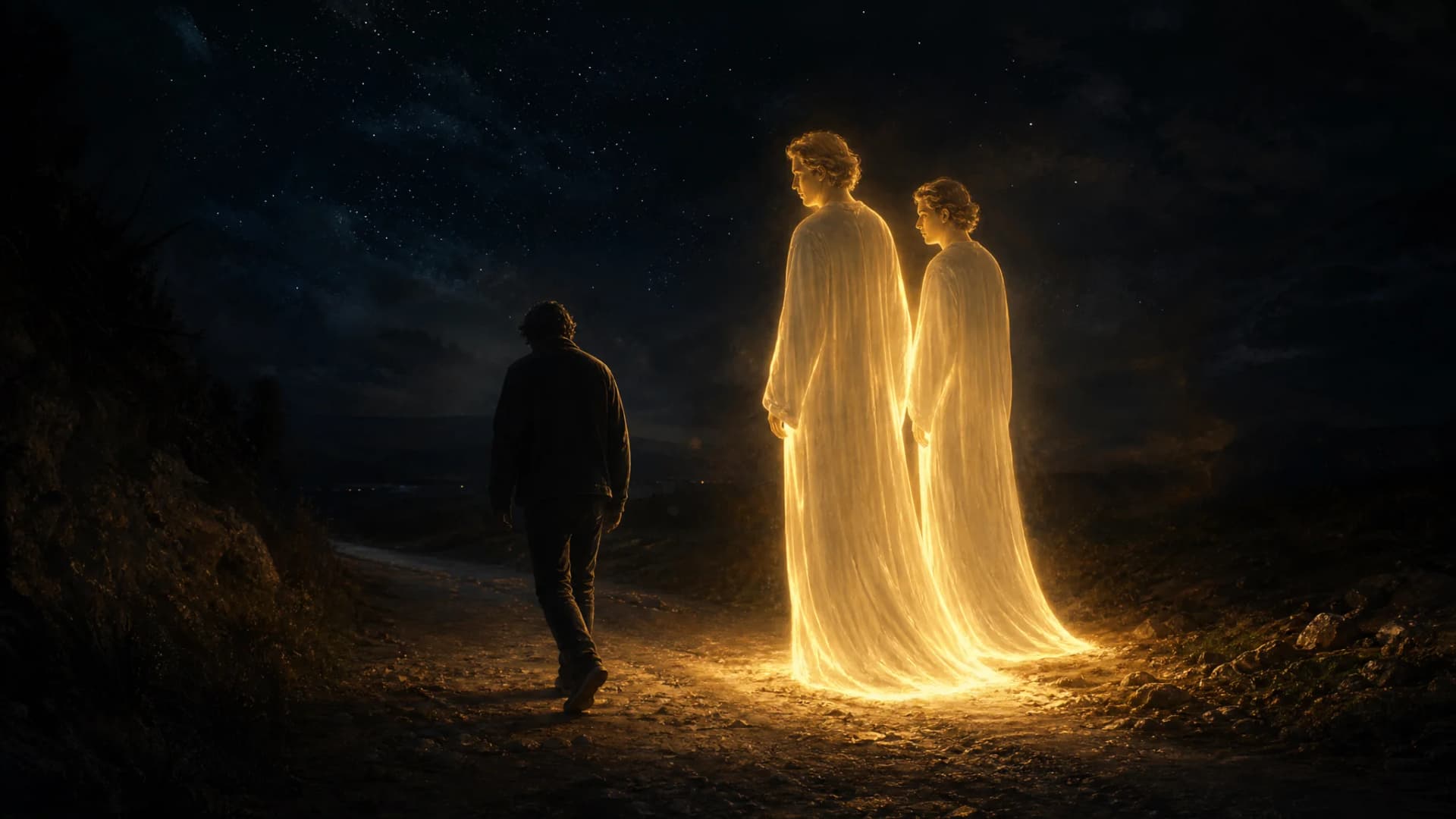
- Beings of light, often experienced as loving and familiar
- A life review, not judgmental but complete, feeling one's own actions from every perspective simultaneously
- A boundary, threshold, or limit that cannot be crossed
- An overwhelming reluctance to return
Mainstream science has no satisfying explanation for why these experiences are (a) phenomenologically consistent across cultures, (b) sometimes accompanied by accurate perceptions of physical reality during clinical death, and (c) so profoundly transformative that virtually no NDE experiencer maintains the same priorities, fears, or worldview afterward.
The Urantia Book, written in the 1930s, decades before the NDE research began, describes in structural detail what exists on the other side of that threshold. The match is not perfect, because NDEs appear to involve brief, partial, and sometimes disorienting contact with what the Urantia Book describes as an extensive system of post-mortem experience. But the structural elements align in ways that deserve serious attention.
What the Urantia Book Says Death Actually Is
The Urantia Book's framework for death is technical in a way that most religious traditions are not. It distinguishes carefully between the physical body, the mind, the soul, the personality, and what it calls the Thought Adjuster, the actual fragment of God that lives within every human mind from roughly the first moment of moral decision-making (UB 108:2.1).
When physical death occurs:
The Thought Adjuster departs for Divinington (112:4.1), carrying with it the memory transcription of the mortal career (112:3.5).
The personality is effectually safeguarded in the custody of dependable universe trustees, existing as a potential waiting for re-expression (112:5.15).
The soul, the morontia (spiritual) reality that has been built up over a lifetime through every sincere moral choice and spiritual striving, is in the keeping of the seraphic guardians assigned to that individual (UB 113:3.4).
Resurrection, the reassembly of the surviving self, occurs on the mansion worlds. This is not a metaphor. The Urantia Book describes the mansion worlds as seven physical spheres, satellites of the first transitional-culture world in our local system (UB 47:0.1). These are actual places with actual architecture, actual social structure, and an actual transition curriculum for newly arrived survivors (UB 47:3.1).
The reassembled person on the first mansion world is recognizably themselves. They remember their life. They recognize other survivors they knew on earth. But they are in a morontia body, a form that is physical but of a higher material order than the electrochemical biology of earth, tuned to a different range of experience (UB 48:1.1).
The NDE Elements, Mapped
The Tunnel
The Urantia Book describes the transit from physical death to mansion world arrival as involving a period of unconsciousness for most survivors, a sleep of death during which the identity rests in the keeping of celestial custodians (UB 30:4.12). But it also notes that the experience varies significantly depending on the individual's spiritual development and the circumstances of death.
The tunnel sensation reported in NDEs may correspond to the initial phase of this transit, a briefly conscious experience of the transition mechanism itself, before full unconsciousness sets in or before the person is returned to physical life.
The Light
Repeatedly, NDE experiencers describe beings of intense, non-blinding light. Light that feels like love, like intelligence, like presence. Some identify these beings as deceased relatives. Some experience a supreme, overwhelming Light that they identify as God or the divine.
The Urantia Book describes the immediate post-mortem environment as involving seraphic beings, the guardian angels assigned to every mortal, who serve as custodians of the soul and mind patterns through the transition (UB 113:3.4). It also describes the Thought Adjuster, which carries the most intimate record of a person's inner life, as returning to the individual in the resurrection process. This reunion with one's own deepest self that would have every quality of recognition and love that experiencers describe.
The Life Review
The "panoramic life review," in which the person simultaneously experiences their entire life from every perspective, including the perspective of every person they affected, is one of the most consistently reported and most structurally detailed NDE elements.
The Urantia Book does not locate this life review at the moment of death specifically, but it does describe an extensive process on the first mansion world where mortal deficiencies are identified and corrected. Almost the entire experience of mansion world number one pertains to deficiency ministry, addressing what was missed or undeveloped during the mortal life (UB 47:3.8).
The NDE version may be an accelerated, partial preview of what becomes a more complete and extended process in the early mansion world curriculum.
The Boundary
Nearly every NDE includes a point at which the experiencer encounters a limit (a line, a wall, a river, a horizon) that they understand they cannot cross while still alive. Cross it and you don't come back.
The Urantia Book describes the mansion world arrival process as involving specific administrative mechanisms that require a functioning morontia form, which hasn't been assembled yet while the physical body is still alive. The boundary may simply be the threshold of that process: you can witness it, approach it, but not enter it without the full transition mechanism being engaged.
The Reluctance to Return
Virtually every NDE experiencer reports not wanting to return. The experience is uniformly described as more real than physical life, more beautiful, more loving, more free. The return to the body feels like a diminishment.
This is consistent with the Urantia Book's description of the mansion worlds as genuine advancement: life that is richer, more connected, less limited, more vibrant than the physical life that preceded it. If even a partial glimpse of that reality is what NDE experiencers are accessing, the reluctance to return makes complete sense.
What This Means for the Hard Problem of Consciousness
The deepest question in neuroscience and philosophy of mind is called the "hard problem of consciousness," the question of why physical processes in the brain give rise to subjective experience at all. Why does it feel like something to be alive?
Materialist frameworks assume consciousness is a product of the brain. But this creates immediate problems with NDE data: if consciousness is simply brain activity, it should not be able to generate coherent, accurate perceptions during periods of clinical death when the brain is flatlined or its function is severely compromised.
The Urantia Book's framework resolves this by locating consciousness not in the brain, but in the interaction between the material mind (which does reside in the electrochemical brain) and the Thought Adjuster (which is an actual fragment of infinite God, indwelling the individual from the first moral decision) (UB 111:1.1).
In this framework, the brain is the instrument through which mind operates in the physical domain, an electrochemical mechanism. But human consciousness is not limited to that mechanism: Adjusters "must, perforce, do all their work upon an intellectual foundation," and the soul, the morontia reality co-created by mind and Adjuster, represents a dimension of selfhood that is not dependent on brain chemistry (UB 111:1.1).
This is why NDEs can produce accurate perceptions during clinical death. If consciousness were purely brain-generated, clinical brain death should produce nothing. The fact that it produces some of the most vivid and organized experiences humans report suggests that the brain is a necessary instrument for normal physical perception but is not the totality of what perceives.
The Urantia Book Has Been Saying This Since 1934
It is worth noting that the Urantia Papers were transmitted and compiled in the 1930s, and the published book appeared in 1955, twenty years before Raymond Moody coined the term "near-death experience," thirty years before the first systematic NDE research, and long before the questions being raised by the AWARE study or Eben Alexander's testimony were part of mainstream discourse.
The Urantia Book describes the mansion worlds, the morontia transition, the seraphic guardians, the Thought Adjuster's departure and return, not as theological speculation, but as specific, structural description of a post-mortem reality that is currently inhabited by billions of personalities who have passed through the physical-death threshold before us.
Those descriptions are now finding their echo in the testimonies of millions of people who went to that threshold and came back.
That convergence is worth investigating.
Explore the full mansion world structure: The Mansion Worlds
On the Thought Adjuster, the fragment of God within you: The Thought Adjuster
For the architecture of the universe beyond: The Convergence
Byline: Derek Samaras | Urantia Book Network | April 2026
Connecting Articles


The Newsletter
Get the research behind each piece
Free. New Urantia Book explorations, the sources behind the videos, and early looks. No spam, unsubscribe anytime.
Prefer video? Follow on YouTube and Facebook.
Delivered through Substack. You can also read past issues.