
The First Comparative Religion Study: Ganid, Jesus, and the Alexandrian Compilation
During Jesus's Mediterranean tour with the Indian youth Ganid in 22-23 CE, they spent months at the Alexandrian library compiling extracts from every major religious tradition of the ancient world. The resulting manuscript, preserved in India for hundreds of years, identified the highest truth in Cynicism, Judaism, Buddhism, Hinduism, Zoroastrianism, Jainism, Shinto, Taoism, Confucianism, and the living gospel. Ganid's compilation is the first systematic comparative religion study in human history.
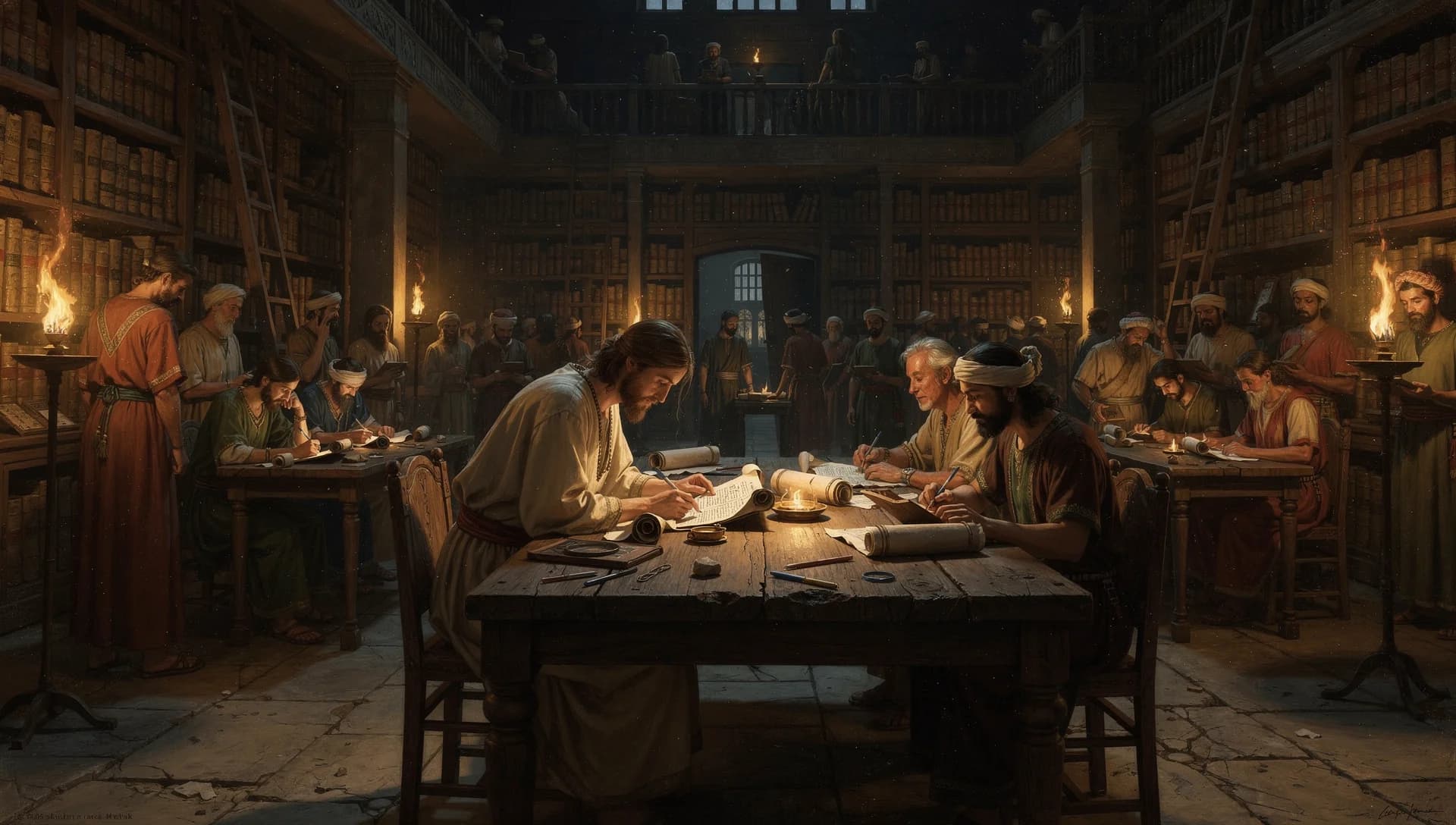
First systematic comparative religion study = Ganid's Alexandrian compilation of world religious teachings
This article expands on the decoder mapping. For the side-by-side card and quick reference, see the mapping page.
The Alexandrian Compilation
Around 22 to 23 CE, Jesus traveled the Mediterranean as tutor to a young Indian named Ganid, son of the wealthy merchant Gonod. The party stayed for months at Alexandria, the principal intellectual center of the Greco-Roman world. Its great library held about a million manuscripts gathered from Greece, Rome, Palestine, Parthia, India, China, and Japan. While they were there, Ganid set himself a remarkable project. He wanted to assemble, in one place, what each of the world's religions actually taught about God and the relations between God and mortal man.
To pull this off, Ganid hired more than sixty learned translators at his father's expense. The finished manuscript was organized under ten headings. On the Urantia Book's account, this is the first systematic comparative religion study in human history, predating the modern academic version of that enterprise by roughly nineteen centuries.
What the Urantia Book Says
The Urantia Book documents the Alexandrian compilation in detail at UB 131.
"DURING the Alexandrian sojourn of Jesus, Gonod, and Ganid, the young man spent much of his time and no small sum of his father's money making a collection of the teachings of the world's religions about God and his relations with mortal man. Ganid employed more than threescore learned translators in the making of this abstract of the religious doctrines of the world concerning the Deities." (131:0.1)
The fate of the manuscript afterward is also recorded:
"There is presented herewith an abstract of Ganid's manuscript, which he prepared at Alexandria and Rome, and which was preserved in India for hundreds of years after his death. He collected this material under ten heads, as follows:" (131:0.2)
The ten traditions appear as successive sections of UB 131: Cynicism (131:1), Judaism (131:2), Buddhism (131:3), Hinduism (131:4), Zoroastrianism (131:5), Suduanism or Jainism (131:6), Shinto (131:7), Taoism (131:8), Confucianism (131:9), and "Our Religion" (131:10). The last refers to the living teaching of Jesus as Ganid and his father had come to understand it through their daily contact with him on the road.
The character of the work is what makes it striking. Each section presents what Ganid identified as the highest truth within a given tradition, drawing out the common threads rather than the dividing lines.
The wider context is laid out across UB 130 (On the Way to Rome), UB 131 (The World's Religions), UB 132 (The Sojourn at Rome), and UB 133 (The Return from Rome). For roughly two years Jesus traveled with Gonod and Ganid from Palestine through Sidon, Antioch, Cyprus, Crete, Carthage, Naples, Rome, Milan, Corinth, Athens, Ephesus, Cyprus again, and back to Palestine through Damascus. He served as tutor to Ganid and as private secretary and translator to Gonod, which gave the compilation a steady teaching context to grow inside.
The Alexandrian phase is documented at UB 130:3-4. The party stayed in the city about three months. Ganid worked daily with his translators in the library, and Jesus took part in the research and the conversations.
"Here were assembled nearly a million manuscripts from all the civilized world: Greece, Rome, Palestine, Parthia, India, China, and even Japan. In this library Ganid saw the largest collection of Indian literature in all the world; and they spent some time here each day throughout their stay in Alexandria." (130:3.4)
What the Ancient Sources Say
The setting is solid history. The Library of Alexandria was founded under Ptolemy I Soter in the early third century BCE and grew across the Ptolemaic period into the principal intellectual institution of the ancient Mediterranean. Mostafa el-Abbadi's The Life and Fate of the Ancient Library of Alexandria (UNESCO, 1990) is the standard scholarly treatment of its history, structure, and decline.
By the first century CE, when Jesus and Ganid arrived, the library was still substantially intact, although it had taken some damage during Caesar's Alexandrian campaign in 48 BCE. Roy MacLeod's The Library of Alexandria: Centre of Learning in the Ancient World (I. B. Tauris, 2000) treats the institution across its full arc.
The modern academic comparative religion tradition came much later. Max Müller's Sacred Books of the East series (1879 to 1910), Mircea Eliade's A History of Religious Ideas (1978 to 1985), and Huston Smith's The World's Religions (1958) all carry forward, in modern form, the same comparative project that Ganid's compilation pioneered on the Urantia Book's account.
Whether the historical Alexandrian compilation actually existed is hard to settle through mainstream historical methods. The Urantia Book presents it as fact, with detailed content preserved at UB 131:1-10. The compilation itself, as a distinct document, does not survive in the Indian textual record, although the book notes that it was preserved in India "for hundreds of years after his death" (131:0.2). The narrative is that the manuscript existed, lasted a long time, and was eventually lost.
The ten traditions covered are substantial. Cynicism stands for the Greek philosophical and ascetic tradition coming down from Diogenes. Judaism covers the Hebrew prophetic and monotheistic tradition in its early first-century form. Buddhism is included roughly six centuries after its founding. Hinduism appears in its first-century Vedic and Upanishadic elaboration. Zoroastrianism brings in the Persian ethical and dualistic tradition. Suduanism, which the book identifies with Jainism, contributes the Indian ascetic and non-violence tradition. Shinto carries the Japanese ancestor, kami, and nature tradition. Taoism brings the Chinese unitive philosophy. Confucianism brings the Chinese ethical and social teaching. "Our Religion" is the living teaching of Jesus as Ganid had come to know it.
The extracts the Urantia Book preserves at 131:1-10 are what Ganid identified as the highest truth in each tradition. Read together, they show a striking common substrate. Each tradition contains some monotheistic-leaning content, ethical teaching, the promise of salvation, and an inner spiritual orientation. The differences read as cultural and linguistic variations on shared content, not as incompatible systems.
Jesus's role in all of this matters. He is documented across UB 130 to 132 as Ganid's tutor throughout the tour, teaching on religious and philosophical questions and discussing the compilation directly with the boy. The book's preservation of Jesus's own assessments of the world's religions is one of its unusual features. Most religious traditions preserve only the teachings of their founder. The Urantia Book preserves those teachings plus the founder's own appraisal of the other traditions of his time.
Why This Mapping Matters
Ganid's Alexandrian compilation is, on the Urantia Book's account, the first systematic comparative religion study in human history, roughly nineteen centuries ahead of the modern academic version. The systematic scope, the ten traditions covered, and the focus on identifying the highest truth in each rather than privileging one over the others, is the modern comparative approach in ancient form.
Jesus's participation has weight too. His teaching about truth in other religious traditions is not preserved in the canonical New Testament gospels, which capture him in the Palestinian context of first-century Jewish debate. The Urantia Book records that his broader teaching, including his appreciative reading of non-Jewish traditions, was substantial, and it is preserved in UB 130 and 131.
The framework that Ganid's compilation models matters for how Urantia Book readers approach the world's religions today. The compilation does not reject non-Christian content as false or demonic, which is the older Christian apologetic posture. It identifies the highest truth in each tradition and honors what they hold in common. That fits the broader theology of the Urantia Book, which sees Salem-derived content preserved (often heavily altered) across many traditions, producing genuine if partial truth in each.
The extracts at UB 131:1-10 give direct access to what the book presents as Jesus's own appraisal of the major religious traditions. That is unusual material within the wider Urantia Book corpus. Most of the book deals with universe administration, the history of Urantia, or teaching given by personalities other than Jesus. UB 131 preserves Jesus participating in comparative analysis, weighing in on traditions outside his own.
The Alexandrian setting carries additional significance. The compilation took shape in the same intellectual environment that would soon produce Philo's Hellenistic-Jewish synthesis and the broader Alexandrian theology that shaped early Christianity. Ganid worked there roughly forty years before Philo's main teaching career, and about seventy-five years before Paul's Alexandrian-influenced mission. The Urantia Book locates this early engagement with that intellectual world well in advance of its later effects on Christian thought.
The Indian preservation matters as well. The book records that the manuscript was kept in India "for hundreds of years after his death" (131:0.2). Ganid himself was an Indian youth who returned home at the end of the tour. The pathway of preservation suggests an Indian religious institution that carried the compilation through real time-depth before it was finally lost.
The point of the mapping is this. Ganid's Alexandrian compilation should be read as a serious comparative religion project preserved in part at UB 131:1-10, not as background color in a longer narrative. The inclusive and appreciative reading it models gives Urantia Book readers a working example of how to engage the world's religions comparatively rather than polemically.
Sources
- The Urantia Book, Paper 130 (On the Way to Rome), Paper 131 (The World's Religions), Paper 132 (The Sojourn at Rome), Paper 133 (The Return from Rome). Urantia Foundation, first printing 1955. Cited passages: 130:3.4, 131:0.1-2, 131:1-10.
- el-Abbadi, Mostafa. The Life and Fate of the Ancient Library of Alexandria. UNESCO, 1990.
- MacLeod, Roy, editor. The Library of Alexandria: Centre of Learning in the Ancient World. I. B. Tauris, 2000.
- Müller, Max, editor. The Sacred Books of the East. Oxford University Press, 1879-1910 (fifty volumes).
- Eliade, Mircea. A History of Religious Ideas. University of Chicago Press, 1978-1985 (three volumes).
- Smith, Huston. The World's Religions: Our Great Wisdom Traditions. HarperOne, revised edition 1991.
- Jaspers, Karl. The Great Philosophers. Harcourt Brace, 1957-1966 (three volumes).
Confidence and Evidence
- Confidence: UB CONFIRMED
- Evidence rating: MODERATE
- Basis: The Urantia Book directly documents Ganid's Alexandrian compilation at UB 131:0.1-2, with detailed content preserved at UB 131:1-10. Mainstream historical methods cannot independently verify the compilation as a distinct textual entity, but the preserved content gives the substance of what it contained. The Alexandrian library context itself is well documented in mainstream scholarship.
Related Decoder Articles
- Axial Age = Salem Continuity and Seven Teachers
- Melchizedek = Machiventa and the Salem Enterprise
- Lao-Tse's Tao = Salem Content Preserved in China
Byline: Derek Samaras | Urantia Book Network | April 2026
Connecting Articles
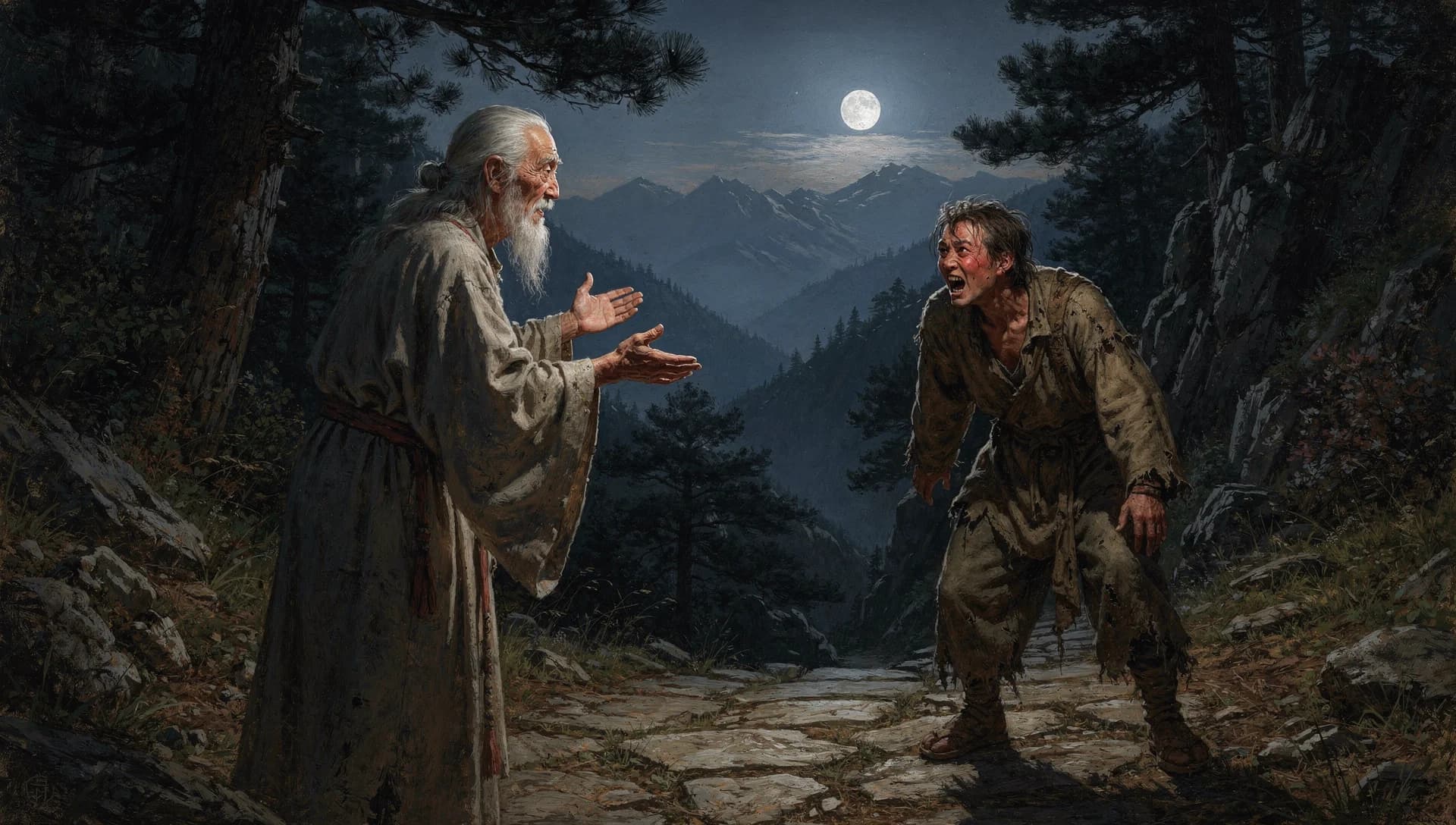
Return Good for Evil: Lao-tse's Anticipation of Jesus
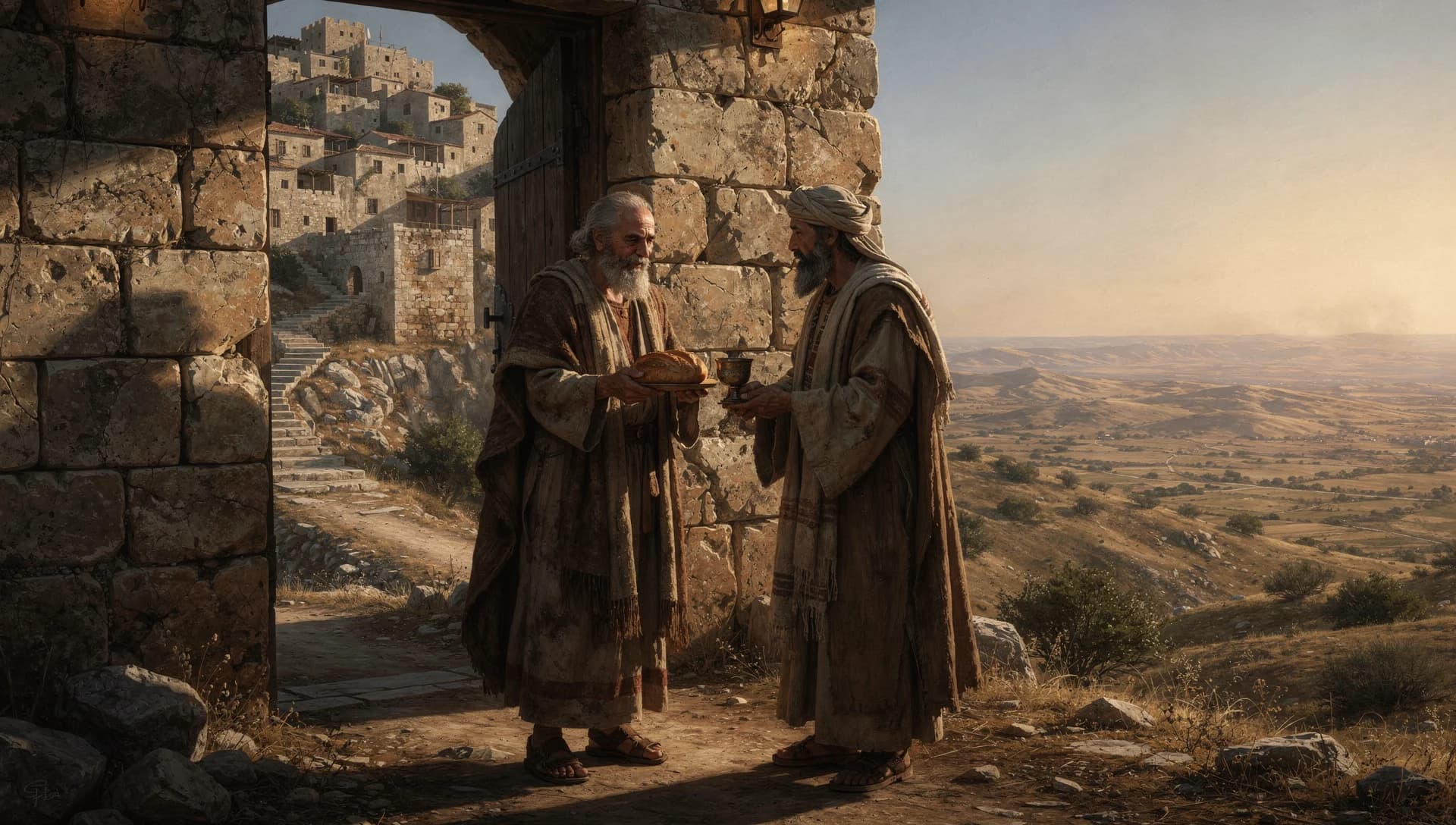
The Sage of Salem: Machiventa Melchizedek and the Universal Thread Through All Religions
The All-Night Talk: Jesus and Angamon, Leader of the Stoics
Day After Day: Jesus and Mardus, Leader of the Roman Cynics
The Newsletter
Get the research behind each piece
Free. New Urantia Book explorations, the sources behind the videos, and early looks. No spam, unsubscribe anytime.
Prefer video? Follow on YouTube and Facebook.
Delivered through Substack. You can also read past issues.