
 Mythic
Assyrian Winged Figure Reliefs (Nimrud, ~900-700 BC)
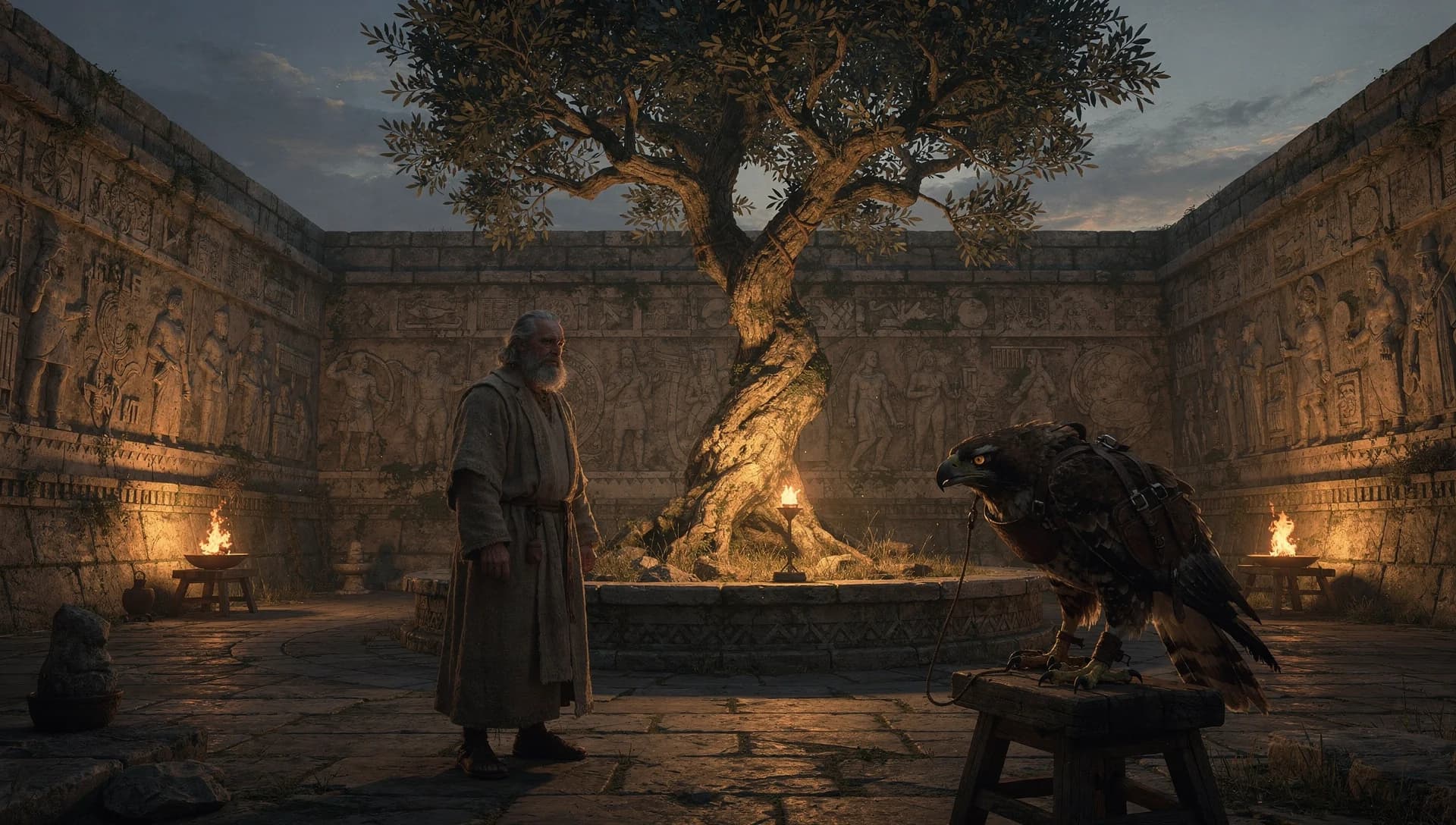 UB
UBVan + Fandor + Tree of Life
Full Article
Read the deep-dive article on this connection
Van + Fandor + Tree of Life = Assyrian Winged Figure Reliefs (Nimrud, ~900-700 BC)
The Connection
Assyrian palace reliefs show a winged figure beside a bull and a sacred tree. The UB reading: Van (superhuman figure) who rode Fandor (associated with bulls/livestock transport) and guarded the Tree of Life. The three elements (superhuman being, large bird/bull, sacred tree) appear together in both traditions.
UB Citation
UB 66:4.13, 73:6
Academic Source
British Museum Nimrud Gallery; Layard excavation records
Historical Evidence(Moderate evidence)
British Museum Lamassu (Ashurnasirpal II, 883-859 BCE, Nimrud): Human-headed winged bulls flanking doorways. Interior walls show the Sacred Tree attended by winged figures (apkallu). The recurring composition places Sacred Tree at center, flanked by winged figures, with winged bulls guarding doorways. These three motifs appear as a unified symbolic system across multiple Assyrian palace sites. The kingdom of Urartu (9th-6th century BCE), centered at Lake Van in eastern Turkey, preserves nearly identical relief carvings: winged figures flanking a sacred tree. Urartu literally means "Kingdom of Van." Urartian "Biainili," possibly pronounced "Vanele," became "Van" in Old Armenian. The same three-element composition (superhuman figure, winged creature, sacred tree) persists in a kingdom whose name echoes the UB character who guarded these very things.
Deep Dive
Walk into the Assyrian galleries of the British Museum and you encounter, immediately and unforgettably, the lamassu of Ashurnasirpal II: human-headed winged bulls, taller than a man, that once flanked the doorways of the king's Northwest Palace at Nimrud. Behind them, on the walls of the reconstructed throne room, you find a recurring composition. At the center stands a stylized tree, with palmette fronds, geometric branches, and crossing tendrils. Flanking the tree are bearded winged figures, standing or kneeling, holding a small bucket in one hand and a fir cone in the other, gesturing toward the tree as if pollinating it or performing some ritual at its base. Above the figures sometimes hovers a winged disc with a human form inside it, the symbol of Ashur. The composition is not unique to Nimrud; it appears at Khorsabad under Sargon II, at Nineveh under Sennacherib, and on cylinder seals throughout the Neo-Assyrian period. It is one of the most thoroughly attested religious images in the ancient Near East.
Three elements always appear together: a superhuman winged figure, a sacred tree, and (in the doorways or as architectural framing) the great bull-bodied gateway guardians. The composition is treated by modern Assyriologists as a unified symbolic system, but its referents have remained obscure. Why a winged figure rather than a regular priest? Why a sacred tree rather than another cultic object? Why the bull-bodied guardians rather than other apotropaic symbols? Each piece has its own iconographic literature, and no consensus has emerged on what the unified composition meant to the Assyrians who lived with it daily.
The Urantia Book account places three matching elements in the same Mesopotamian region, separated from the Assyrians by roughly two hundred thousand years of cultural memory. Van, the loyal corporeal staff member, was a superhuman being. He survived the Lucifer rebellion, kept the tree of life alive in his highland retreat, and was subsequently associated with the planting of the tree in the Garden of Eden when Adam and Eve arrived. He rode fandors. The corporeal staff in their Dalamatia setting were associated with bulls, the most prized of the domestic animals managed by Bon's council. UB 73:6 describes the tree of life as a real shrub from Edentia, transplanted to Urantia during Caligastia's administration, regrown after the rebellion by Van and his associates, and finally planted in the central courtyard of the Garden temple. Three elements: superhuman figure, sacred tree, large livestock. The same three elements appear together in the Assyrian palace composition.
The geographic specificity strengthens the case. Van's highland retreat, where he and Amadon sustained the tree of life for over one hundred fifty thousand years, was in the mountains north of Mesopotamia. Lake Van in eastern Turkey takes its name from the kingdom of Urartu (Biainili in Urartian, possibly pronounced Vanele), centered there from the ninth through sixth centuries BCE. The Urartian kingdom produced its own version of the sacred tree composition, with winged figures flanking a stylized tree, on bronze plaques and stone reliefs. Urartu was overrun by the Assyrians in the seventh century BCE, and the iconographic tradition transferred. The carriers of the tree composition were thus, on the UB reading, the literal cultural heirs of the territory in which Van had maintained the tree of life for one hundred and fifty thousand years.
Two more details. First, the bucket and cone in the winged figure's hands have been variously interpreted as anointing implements, fertilization devices, or apotropaic tools. The Akkadian name for the cone is mullilu, "purifier." The standard reading is that the figure is performing some maintenance or blessing on the tree. UB 73:6 describes Van as the figure who "regrew" the tree from its central core, who "transplanted" it from the highland to the Garden, who is essentially the tree's caretaker. The Assyrian ritual gesture, on the UB reading, is the iconographic memory of Van's actual function: maintaining and propagating the tree of life. Second, the winged disc above the composition. UB cosmology depicts celestial beings, including the Most Highs of Edentia who originally sent the tree of life shrub, as inhabiting realms above the planetary surface. A winged disc with a humanoid figure inside, hovering over the sacred tree composition, is a plausible iconographic memory of Edentia, the constellation administrative sphere from which the tree of life originated.
The strongest counterargument is that the composition is fully explainable within Mesopotamian theological development without reference to any underlying historical layer. The sacred tree is the date palm, central to Mesopotamian agriculture; the winged figure is an apkallu, one of the seven antediluvian sages from Berossus; the bull-bodied guardians are protective spirits like the lamassu and shedu of Akkadian magical literature. Each element has a known intra-Mesopotamian explanation. The reply is that the intra-Mesopotamian explanations are themselves derived from the same memory layer. The apkallu were sent before the flood to teach civilization, in groups associated with cities, with one of them serving as advisor to the king: this is the cultural memory of the Prince's staff, which UB 66 describes as one hundred superhuman beings sent before the flood to teach civilization, organized into ten councils. The "intra-Mesopotamian explanation" is the same UB account in cuneiform clothing.
Key Quotes
“During the days of the Prince's rule the tree was growing from the earth in the central and circular courtyard of the Father's temple. Upon the outbreak of the rebellion it was regrown from the central core by Van and his associates in their temporary camp. This Edentia shrub was subsequently taken to their highland retreat, where it served both Van and Amadon for more than one hundred and fifty thousand years.”
“When Van and his associates made ready the Garden for Adam and Eve, they transplanted the Edentia tree to the Garden of Eden, where, once again, it grew in a central, circular courtyard of another temple to the Father. And Adam and Eve periodically partook of its fruit for the maintenance of their dual form of physical life.”
“The sacred tree, attended by winged genie figures with bucket and cone, was a central image of Assyrian royal ideology, repeated across reliefs in the throne room and adjacent chambers.”
Cultural Impact
The Assyrian sacred-tree composition is one of the most influential religious images in human history, even though most viewers do not know its name. Through Phoenician art, the composition entered Greek and Etruscan iconography, where it influenced the depictions of Athena's olive, the gardens of the Hesperides, and the imagery surrounding sacred groves. Through the Hebrew tradition, the same composition reappears in the description of the cherubim flanking the ark of the covenant and the carved palms and cherubim on the walls of Solomon's Temple (1 Kings 6:29-32). The Christian tradition inherits the composition through the Old Testament references and reinterprets it as the Tree of Life flanked by angelic guardians, an image that becomes ubiquitous in medieval church art, in illuminated manuscripts, and in the iconography of Eden itself. The kabbalistic Tree of Life, the alchemical world tree, and the Christian crucifix-as-tree all descend through this lineage. Modern New Age iconography, with its sacred trees flanked by angelic figures, is the latest layer of a composition that began in Van's highland retreat one hundred and fifty thousand years ago and was preserved in the soil of the same region until Layard excavated it in the nineteenth century.
Modern Resonance
When tourists today walk past the Assyrian reliefs in the British Museum or the Louvre, what they are seeing is, on the UB reading, a stylized memory of a real being and a real plant. Van was not a Mesopotamian sky-god but the loyal corporeal staff member who guarded the tree of life. The tree was not the date palm allegorized but a literal Edentia shrub. The winged figures with their buckets and cones are the priestly memory of an actual maintenance ritual. The lamassu at the doorways are the cultural memory of bull-shaped associations of the staff. None of this requires the Assyrians to have known any of it consciously; they inherited the iconography and adapted it for their own theology of kingship and royal protection. The persistence of the composition for two and a half millennia of Mesopotamian civilization is itself the puzzle that conventional explanations have failed to fully solve. The UB explanation: it persisted because it was anchored in real planetary history.
Related Mappings
Related Articles
Where to next
The free newsletter. The research behind each piece, no spam.