
 Mythic
Anunnaki, "princely offspring / staff of the prince"
 UB
UBCorporeal Staff (100 members)
Full Article
Read the deep-dive article on this connection
Corporeal Staff (100 members) = Anunnaki, "princely offspring / staff of the prince"
The Connection
The academic etymology of Anunnaki is literally "offspring/staff of the prince." The UB's 100 corporeal staff ARE the staff of the Prince. They descend from heaven to teach civilization: agriculture, metallurgy, writing, medicine. The number and civilizing function match directly.
UB Citation
UB 66:2-4, 66:5
Academic Source
Katz, The Image of the Netherworld (2003); Pennsylvania Sumerian Dictionary
Historical Evidence(Strong evidence)
ORACC (U. Penn): Sumerian "da-nun-na" etymologically analyzed as "princely offspring" or "royal offspring." S.N. Kramer identifies the Anunnaki as offspring of An and Ki. Britannica confirms the etymology as "princely seed." In the Atrahasis Epic, the Anunnaki function as a council of senior divine beings making decisions about humanity. "Staff of the Prince" and "princely offspring" are remarkably close semantic parallels.
Deep Dive
Open the Pennsylvania Sumerian Dictionary, look up "Anunnaki," and you find the etymology spelled out: da-nun-na, "princely offspring" or "royal offspring," sometimes rendered "princely seed." ORACC, the Open Richly Annotated Cuneiform Corpus housed at the University of Pennsylvania, gives the same reading. Britannica, the Encyclopaedia Iranica, and the standard reference Black and Green's Gods, Demons, and Symbols of Ancient Mesopotamia (1992) all agree on the literal meaning. The word names a body of senior gods who are the offspring or staff of the prince. Of which prince, the texts disagree: sometimes An, sometimes Enlil, sometimes Anu collectively. But the word itself is unambiguous. It is staff-of-the-prince language, and it is one of the oldest god-words in Sumerian.
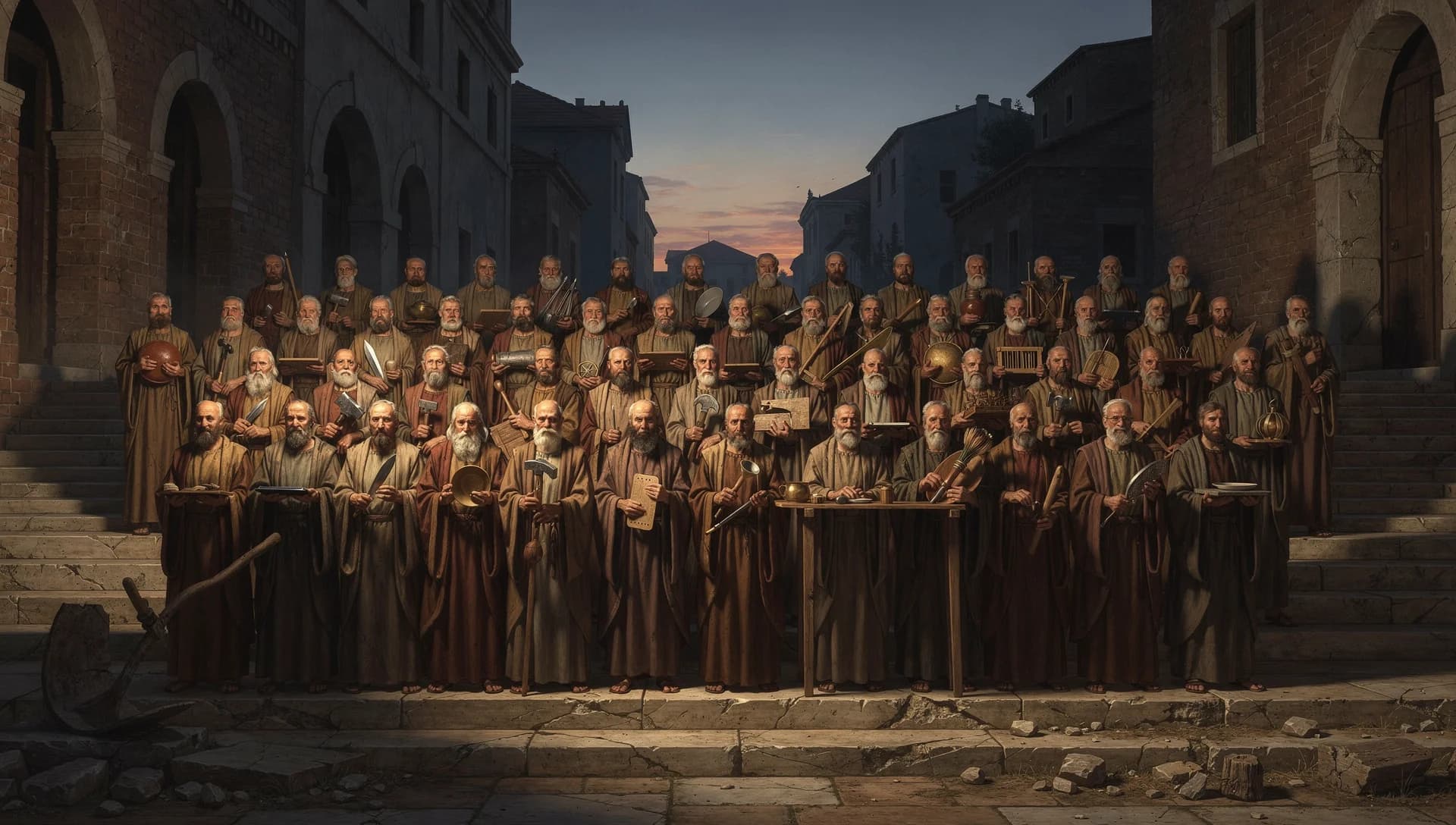
The Urantia Book gives us, on the planetary administration side, a corps of one hundred specially prepared corporeal beings who arrived with the Planetary Prince to teach civilization. Paper 66 introduces them: "The Planetary Prince of Urantia was not sent out on his mission alone but was accompanied by the usual corps of assistants and administrative helpers." They were drawn from various orders of universe personalities, brought down to material form, and organized into ten autonomous councils of ten members each. They are called, throughout the UB, the corporeal staff of the Prince. They are, literally, staff of the prince. The Sumerian etymology and the UB's own usage are identical phrases describing identical functional roles.
The match goes beyond etymology. The Anunnaki in the Atrahasis Epic function as a council of senior divine beings making decisions about humanity. They allocate domains, they pass judgments, they confer about the labor problem. The UB's corporeal staff function as ten councils of ten making decisions about every domain of nascent human civilization: food, animal husbandry, predation defense, education, industry, religion, health, art and science, tribal government, and the supreme court. The structural overlap is precise: a council-organized body of senior administrators delivering organized civilization to early humanity.
The number deserves attention. The UB says one hundred staff. The Mesopotamian tradition is less rigid: sometimes Anunnaki are seven, sometimes fifty, sometimes more. But the seven-hundred figure of the great gods of heaven and earth in some lists, plus the seven principal Anunnaki who issue judgments, plus the larger council of fifty: these numbers are administrative summaries of a body that the UB describes as one hundred. Within that one hundred, ten head the councils. The "fifty" of some Mesopotamian lists may track the post-rebellion divisions: forty loyalists plus ten council heads, or sixty defectors. Or the numbers may be priestly approximations across a memory channel five thousand years deep. The point is that the Mesopotamian Anunnaki are not a single named pantheon but an administrative body of senior beings, exactly the category the UB names.
The strongest counterargument is that the Anunnaki are gods, not personnel. They are addressed in prayers, given offerings, named in temple inventories. They are theological persons, not administrative staff. The reply is that this is precisely what mortals would do with a real corporeal staff who had taught them civilization, defended them from predators, and then either died or vanished after the rebellion. They would deify them. The same Mesopotamian tradition that calls them gods also remembers them as physically embodied: descending, eating, drinking, sweating, conceiving offspring with mortal women. That is not the behavior of metaphysical deities; that is the behavior of the corporeal staff exactly as Paper 67 describes.
What the parallel implies is that the foundational god-list of Sumerian religion, the Anunnaki, is the cultural memory of a real corporeal staff who really did descend, really did teach civilization, and really did get caught up in a rebellion that left some of them deified for their good work and others remembered as troublemakers. That is the parsimonious read. The etymology, "princely offspring," is not figurative or theological; it is descriptive. They were the staff of the prince. They were, literally, the offspring or attendants of the head of the planetary administration. Five thousand years of priestly handling did not erase that meaning; it preserved it as the very name of the senior god-class.
Key Quotes
“The Planetary Prince of Urantia was not sent out on his mission alone but was accompanied by the usual corps of assistants and administrative helpers.”
“The one hundred were organized for service in ten autonomous councils of ten members each. When two or more of these ten councils met in joint session, such liaison gatherings were presided over by Daligastia.”
“Black and Green render Anunnaki as the collective designation of the great gods, with the etymological sense "princely offspring" of An, comprising the senior council of the pantheon.”
“The text opens with the Anunnaki imposing labor on the lesser Igigi, then convening as a council to address the resulting unrest. (Paraphrased from the Lambert & Millard edition.)”
Cultural Impact
The Anunnaki concept is one of the most influential transmissions in religious history. The word and the structure pass directly into Akkadian, Babylonian, and Assyrian theology, where the Anunnaki are seven principal judges of the underworld and a senior divine council. The concept enters the Hebrew tradition as the bene Elohim, the "sons of God" of Genesis 6 and Job 1, and the divine council in Psalm 82 where Yahweh passes judgment on lesser elohim. From that point the structure flows into Second Temple Jewish angelology, where the Watchers of 1 Enoch 6-16 are explicitly the descended sons of God who taught humanity forbidden arts. From there into Christian angelology, with the seven archangels of Tobit and Revelation as the latest stratum. The Quranic tradition preserves Harut and Marut, two angels of Babylon who taught humanity magic. Hindu tradition has the Saptarishi, seven sages who descended from heaven to teach civilization. Greek tradition has the Titans, an older generation of divine beings overthrown but remembered as civilization-bringers. Every one of these traditions is a refraction of the same pattern: a body of senior beings, descended, teaching, then somehow falling. Cultural memory of the corporeal staff is the deepest theological strand in human religion.
Modern Resonance
Search "Anunnaki" on YouTube and you get a billion-view rabbit hole. Sitchin's translation of Sumerian Anunnaki as "those who from heaven came to earth" launched the ancient astronaut industry, and his successors have built an entire alternate history around the proposition that the Anunnaki were extraterrestrials who genetically engineered humanity. Academic Sumerologists have demolished Sitchin's linguistics repeatedly. But the popular fascination remains because the underlying datum is real: a body of senior beings really did descend to early Mesopotamia, really did teach civilization in organized councils, really did interbreed with mortals after the rebellion produced the Nephilim, and really did vanish from the historical record. The Urantia Book is the parsimonious account that resolves the puzzle without needing reptilian ETs from Nibiru. The Anunnaki were the corporeal staff of the Planetary Prince, exactly as their name says: princely offspring, staff of the prince. They were not extraterrestrials, they were Lanonandek-class and other order universe personalities materialized for a planetary mission, and they have descendants among us through the Nodite line.
Related Mappings
Related Articles
Where to next
The free newsletter. The research behind each piece, no spam.