
 Mythic
Huluppu Tree, sacred tree in Inanna's garden
 UB
UBTree of Life, sacred shrub
Full Article
Read the deep-dive article on this connection
Tree of Life, sacred shrub = Huluppu Tree, sacred tree in Inanna's garden
The Connection
Enki rescues the Huluppu Tree and gives it to Inanna in her garden at Uruk. Van transplants the Tree of Life to the Garden of Eden for Adam and Eve. Both: a sacred tree, tended by a wisdom figure, delivered to a garden, for a powerful feminine figure. The structural mapping is 1:1.
UB Citation
UB 66:4.13, 73:6
Academic Source
ETCSL 1.3.1: Gilgamesh, Enkidu, and the Netherworld
Historical Evidence(Strong evidence)
The sacred/cosmic tree is one of the most frequently depicted motifs in Neo-Assyrian art (Ashurnasirpal II reliefs, 883-859 BCE). British Museum: "The palm branch symbolises the tree of life plucked for the benefit of the king." Brooklyn Museum and Yale collections confirm the motif. The sacred tree spans from the Sumerian huluppu tree narrative through 2,000+ years of Assyrian palace reliefs.
Deep Dive
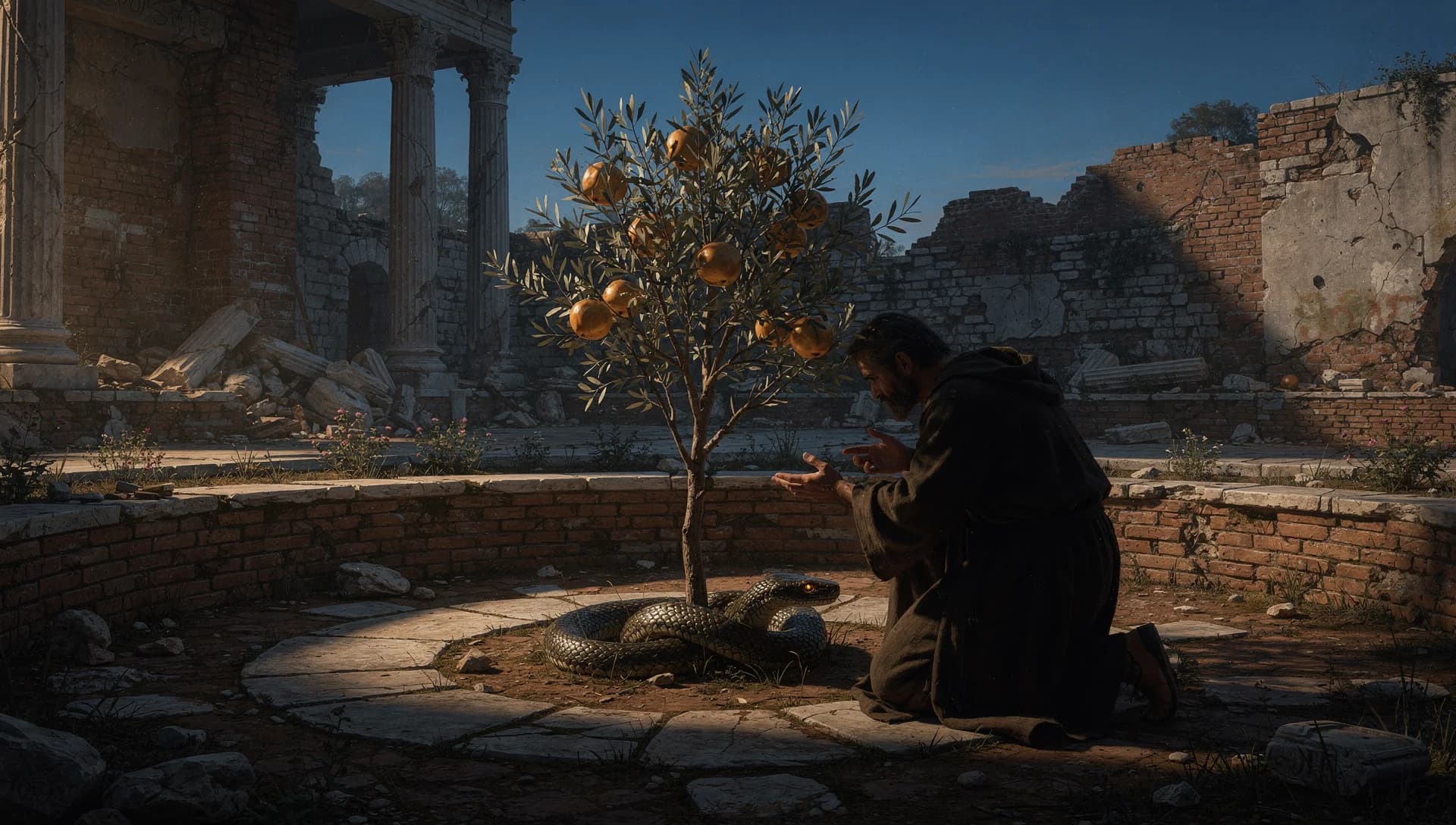
The huluppu narrative survives as the prologue to Gilgamesh, Enkidu, and the Netherworld, ETCSL composition 1.8.1.4, preserved on Sumerian school tablets from Nippur dating to roughly 1800 BCE. The story opens with cosmic origins: heaven and earth separated, the gods distributed, the universe organized. Then it narrows to a particular tree, a young huluppu, growing on the bank of the Euphrates. The river uproots it. Inanna, the great goddess of Uruk, finds it floating downstream and rescues it. She plants it in her own holy garden in Uruk, intending that when it grew large enough, she would carve from it her sacred throne and bed. She tends the tree for ten years. It grows large, but then a serpent who knows no charm has nested in the roots, an Anzu bird has built its nest in the crown, and the demoness Lilitu has settled in its trunk. Inanna weeps. Gilgamesh, the hero, comes to her aid: he cuts down the serpent at the roots, drives the Anzu away, expels the demoness, and gives Inanna the wood for her throne and bed.
The narrative is unmistakably structured around a sacred garden, a sacred tree, a powerful feminine figure who tends the tree, a serpent at the roots, and a hero who restores order. The Hebrew Genesis 2-3 has the same five elements: a sacred garden (Eden), a sacred tree (the tree of life and the tree of knowledge), a powerful feminine figure (Eve), a serpent (the tempter), and a divine response (cherubim with flaming swords guarding the tree). The two narratives are clearly cousins. They cannot be borrowed in either direction in any simple way; the Sumerian text predates the Hebrew composition by more than a millennium and the cultural transmission is partial. They share a common ancestor.
The Urantia Book provides the common ancestor. UB 73:6 describes the tree of life, the Edentia shrub, planted in the central courtyard of the Father's temple at Dalamatia during the Prince's rule. After the rebellion it is regrown by Van. After Adam and Eve arrive, it is transplanted to the Garden of Eden and grown in the central courtyard of another temple to the Father. UB 73:6.7 records that when Adam's plans went astray and the Adamites were forced to leave Eden, "the Nodites invaded Eden, they were told that they would become as 'gods if they partook of the fruit of the tree.' Much to their surprise they found it unguarded. They ate freely of the fruit for years, but it did nothing for them; they were all material mortals of the realm; they lacked that endowment which acted as a complement to the fruit of the tree." The tree was eventually destroyed by fire during one of the internal Nodite wars.
Read against the huluppu narrative, the structural mapping is dense. A sacred tree, originally divinely provided, ends up in a garden, tended by a powerful feminine figure (Eve = Inanna), associated with a serpent (Serapatatia and the serpent symbolism that surrounds Eve's default), threatened or destroyed by invasion, and finally lost to its rightful possessors. The Anzu in the crown and the demoness in the trunk are stylized memory of the various agents that disrupted the tree's intended use, including the Nodites who invaded and ate the fruit without effect. The Anzu in the huluppu specifically maps to the great-bird memory we have already discussed: the fandor that Adam and Eve rode and that was associated with Edenic life.
Two further details. First, Inanna's garden is in Uruk, in southern Mesopotamia, in the precise region where UB tradition places the second garden after the first Eden (the peninsula in the eastern Mediterranean) submerged. The geography of the huluppu narrative is consistent with a memory of the second garden. Second, the throne and bed Inanna intended to carve from the tree are the appropriate furniture of a Material Daughter. The tree of life sustained Adam and Eve's dual physical form; cutting wood from it for ceremonial royal furniture would be a debased memory of the tree's actual function, namely sustaining the Material Daughter herself.
The strongest counterargument is the same as for Adapa: the structural similarity may be archetypal rather than historical. Sacred trees in gardens, with associated serpents and feminine figures, are widespread in mythology. The Greek Hesperides garden, the Norse Yggdrasil, the Iranian Hom tree, and the Indian kalpataru are all examples. Why call any of them historical memories rather than archetypal patterns? The answer is twofold. First, the geographic concentration: the densest, most detailed versions cluster in Mesopotamia and the Levant, the precise region where UB tradition places the actual gardens. Second, the structural specificity: the Mesopotamian and Hebrew accounts share not just the general motifs but the particular sequence of elements (planted, tended by feminine figure, invaded or threatened, fruit consumed wrongly, sacred function lost) that fits the UB account of the Edenic timeline. Archetypal explanations work for the diffuse global pattern. Historical explanation works better for the specific Mesopotamian-Levantine cluster.
Key Quotes
“When Van and his associates made ready the Garden for Adam and Eve, they transplanted the Edentia tree to the Garden of Eden, where, once again, it grew in a central, circular courtyard of another temple to the Father. And Adam and Eve periodically partook of its fruit for the maintenance of their dual form of physical life.”
“When the plans of the Material Son went astray, Adam and his family were not permitted to carry the core of the tree away from the Garden. When the Nodites invaded Eden, they were told that they would become as "gods if they partook of the fruit of the tree." Much to their surprise they found it unguarded.”
“A young huluppu tree on the bank of the Euphrates was uprooted by the river; the goddess Inanna rescued it and planted it in her holy garden in Uruk, intending to carve from it her throne and bed when it grew large.”
Cultural Impact
The huluppu narrative is the single most consequential prologue in Mesopotamian literature, because the elements it preserves (sacred garden, sacred tree, feminine guardian, serpent, restoration) become the framework for Genesis 2-3 and through Genesis for the entire Western theological tradition. The Christian doctrine of the fall, the Augustinian doctrine of original sin, the medieval iconography of Eden, the Renaissance paintings of Adam and Eve, the Miltonian epic, and the modern philosophical reflection on innocence and knowledge all descend ultimately from this template. The Islamic tradition preserves a parallel descent through the Quranic account of Adam, Iblis, and the forbidden tree. The Greek tradition refracts the same complex through the Hesperides garden, the apple of discord, and Pandora's jar. The Hindu kalpataru, the Buddhist Bodhi tree, the Norse Yggdrasil, and the Mesoamerican world trees all preserve fragments of the sacred-tree memory in their respective regional idioms. Inanna and Eve are, on the UB reading, the same person remembered by different priesthoods: a Material Daughter whose tragic association with the sacred tree became the foundational story of nearly every theological tradition in the literate world.
Modern Resonance
Feminist Bible scholarship since Phyllis Trible has worked to rehabilitate Eve from the misogynist patristic tradition that made her the prototype of female disobedience. Sumerian studies has performed an analogous rehabilitation of Inanna, who was distorted in later Akkadian and Hellenistic syncretism into the more dangerous Ishtar/Astarte figure but whose Sumerian original is a powerful, complex divine feminine. The UB account aligns with both rehabilitations and offers a sharper reading: Eve and Inanna are the same Material Daughter, and her default was a tactical misjudgment in service of an accelerated mission, not a moral failing. She was deceived by Serapatatia, who himself believed he was acting in the planet's interest. The "fall" was a real planetary tragedy, but Eve was not a villain. The contemporary effort to recover the dignity of Eve, when read through the UB framework, is recognizably the same effort the Sumerians were already making with Inanna in the second millennium BCE.
Related Mappings
Related Articles
Where to next
The free newsletter. The research behind each piece, no spam.