
 Mythic
Pure Land Buddhism: the Western Paradise of Amitabha
 UB
UBThe mansion worlds and the morontia career of ascending mortals
Full Article
Read the deep-dive article on this connection
The mansion worlds and the morontia career of ascending mortals = Pure Land Buddhism: the Western Paradise of Amitabha
The Connection
Pure Land Buddhism, founded on the vows of Amitabha Buddha, teaches that faithful devotees will be reborn at death into a paradise in the West where conditions are ideal for the completion of spiritual awakening. The UB teaches that ascending mortals wake after death on the first mansion world, a specific and literal place where the conditions are perfected for the continuation of spiritual growth toward fusion with the Father. Both traditions describe a post-mortem location designed to facilitate spiritual progress that was interrupted by mortal death.
UB Citation
UB 47-48 (mansion worlds)
Academic Source
Unno, Shin Buddhism: Bits of Rubble Turn into Gold (2002); Amstutz, Interpreting Amida (1997)
Historical Evidence(Moderate evidence)
Taitetsu Unno's Shin Buddhism and Galen Amstutz's Interpreting Amida document the Pure Land tradition as a distinctive Mahayana stream emphasizing faith-oriented practice and a post-mortem paradise structured for the completion of enlightenment. The tradition entered China via Kumarajiva (c. 402 CE) and Japan via Honen and Shinran. The UB's mansion-world teaching describes an actual morontia location designed to continue what mortal life began, a functional parallel to the Pure Land teaching although the metaphysics differ.
Deep Dive
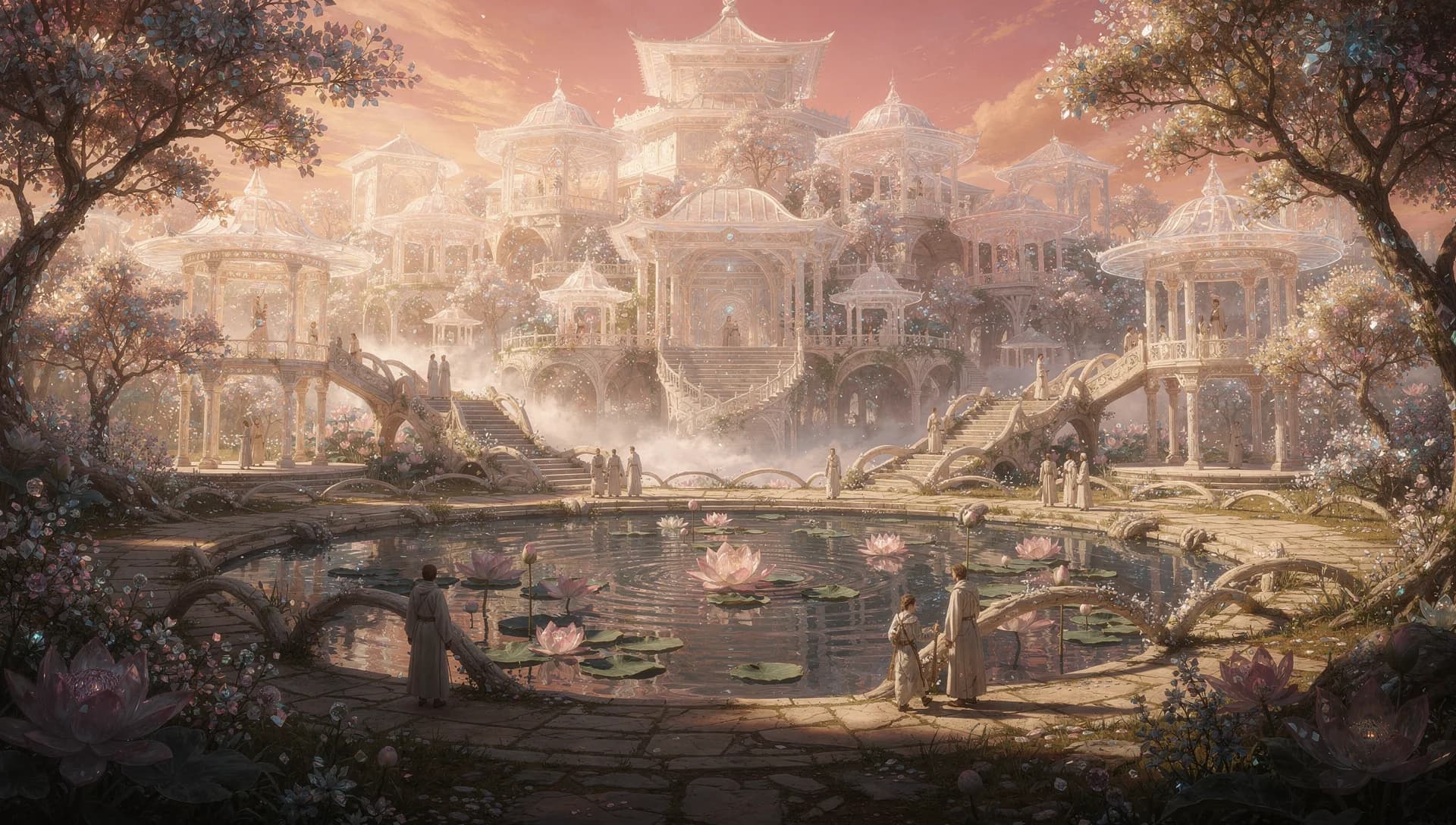
In the Larger Sutra on Amitayus, one of the foundational texts of Pure Land Buddhism, the bodhisattva Dharmakara, before his awakening as Amitabha Buddha, makes forty-eight vows describing the Pure Land that his future buddha-field will be. The land lies in the West, beyond ten trillion buddha-lands. The conditions there are perfected: there is no suffering, no temptation, no obstruction to spiritual progress. Beings reborn there hear the dharma in the rustling of jeweled trees, see the Buddha's face directly, progress smoothly toward final awakening without the obstacles of ordinary mortal life. The eighteenth vow, the great vow, promises that anyone who calls Amitabha's name with sincere faith will be reborn in the Pure Land at the moment of death. This devotional commitment, the simple recitation of the name (in Chinese, Namo Amituofo; in Japanese, Namu Amida Butsu), is the core practice of one of the largest Buddhist movements in the world.
The Urantia Book, in Papers 47 and 48, describes a structurally similar reality. After mortal death, the ascending mortal does not pass into final union with deity, nor does the mortal experience instant awakening into ultimate truth. The mortal awakens, after a period of unconsciousness, on the first of seven mansion worlds, the resurrection halls of the local universe. The mansion worlds are real morontia spheres orbiting the system capital, designed and equipped for the continuation of spiritual growth that mortal death interrupted. Conditions are perfected for what the soul still needs to accomplish: completion of the educational, ethical, and contemplative training that the mortal life began. The ascending mortal progresses through the mansion worlds, each adding new capacities and refinements, before passing on to higher morontia training spheres and eventually toward fusion with the indwelling Adjuster.
The structural fit is precise on the central feature: a post-mortem location designed specifically to facilitate the completion of spiritual progress that was interrupted by mortal death. Both traditions describe a real place. Both describe perfected conditions for spiritual work. Both describe a continuation rather than a termination of the path. Both describe entry contingent on a particular orientation in mortal life: in Pure Land Buddhism, faith in Amitabha; in the UB account, faith in God and willingness to do God's will.
Taitetsu Unno's 2002 monograph Shin Buddhism: Bits of Rubble Turn into Gold provides the standard contemporary academic-and-devotional treatment of the Pure Land tradition in its Japanese Shin Buddhist form. Unno documents the Pure Land theology of other-power (tariki) as opposed to self-power (jiriki), with the Shin tradition placing maximum emphasis on the gracious vow of Amitabha as the ground of the practitioner's salvation. Galen Amstutz's 1997 Interpreting Amida traces the Pure Land tradition through its Indian, Central Asian, Chinese, and Japanese transmissions. The Pure Land tradition entered China via Kumarajiva's translation of the Larger Sutra around 402 CE, was systematized by Tanluan, Daochuo, and Shandao, was carried to Japan by Honen (1133-1212) and his disciple Shinran (1173-1262), and continues today as one of the largest Buddhist denominational families.
The metaphysical differences between Pure Land Buddhism and the UB mansion world doctrine are significant. The Pure Land is characterized in the sutras as a buddha-field, a result of Amitabha's bodhisattva merit, accessible by faith in his vow. The UB mansion worlds are characterized as morontia spheres, real physical-spiritual locations administered by the local universe authorities, accessible to all faith-sons of God by the universal arrangement of the ascension scheme. The Pure Land tradition holds that rebirth in the Pure Land essentially completes the practical work of liberation, with full awakening following easily once the practitioner is in the perfected environment. The UB account describes the mansion worlds as the first of many stages in a vast morontia and spirit-level ascent that culminates in Paradise. The Pure Land's emphasis on devotional faith in Amitabha as the entry condition is structurally analogous to but theologically distinct from the UB's emphasis on faith in the Universal Father as the entry condition.
Despite these differences, the structural fit is unusual in its precision. Most religious traditions either have no specific post-mortem cosmography (vague heaven and hell) or have a single binary destination (heaven, hell, possibly purgatory). The Pure Land tradition is one of the few major religious traditions that describes a post-mortem location specifically designed for the completion of spiritual progress that mortal life interrupted. The UB description matches this functional structure with unusual fidelity.
The strongest counterargument is that the Pure Land tradition emerged within Buddhism's own internal logic of buddha-fields and devotional practice and does not require external Salem-influence to explain. This is a fair point. The reply is that the specific functional structure (a perfected location for the completion of post-mortem spiritual work, accessible by faith) is unusual enough across world religions that its appearance in Pure Land Buddhism deserves explanation. The UB account does not require Salem influence on Pure Land specifically; it requires only that the Pure Land tradition has independently arrived at a structural insight that matches a real cosmological reality the UB describes from another angle.
What the parallel implies is that the Pure Land devotional intuition, that mortal death is not the end of spiritual work and that conditions exist somewhere for that work to continue, is a real intuition encoding real cosmological information. The Pure Land tradition's specific cosmology is mythologically embellished, and the practice of name-recitation as the entry condition is theologically narrower than the actual scheme. But the underlying intuition is sound. The mansion worlds are real. The continuation is real. The faith-condition for entry is real. The Pure Land devotee who dies with sincere faith and lives a moral life will, on the UB account, awaken on the first mansion world and find that the conditions match the devotional expectation more closely than would be expected.
Key Quotes
“Buddhism entered China in the first millennium after Christ, and it fitted well into the religious customs of the yellow race. In ancestor worship they had long prayed to the dead; now they could also pray for them. Buddhism soon amalgamated with the lingering ritualistic practices of disintegrating Taoism. This new synthetic religion with its temples of worship and definite religious ceremonial soon became the generally accepted cult of the peoples of China, Korea, and Japan.”
“Unno documents the Pure Land tradition's emphasis on other-power and the gracious vow of Amitabha as the ground of the practitioner's salvation, with the Pure Land itself described as a perfected location designed for the completion of awakening.”
“Amstutz traces the transmission of the Pure Land tradition through its Indian, Central Asian, Chinese, and Japanese channels, with the Pure Land cosmology consistently described as a real post-mortem location accessible by faith.”
Cultural Impact
Pure Land Buddhism is one of the largest Buddhist devotional traditions in the world, with hundreds of millions of practitioners across China, Japan, Korea, Vietnam, and the East Asian diaspora. In Japan, the Jodo Shu and Jodo Shinshu (Shin Buddhism) denominations together constitute the largest single Buddhist tradition in the country, with Shinran's reformulation of Pure Land theology in the thirteenth century producing one of the most theologically sophisticated devotional traditions in any world religion. The Pure Land tradition's emphasis on faith and grace, rather than self-effort, has produced extensive comparative dialogue with Protestant Christianity, particularly Lutheran and Reformed traditions, with twentieth-century theologians like Karl Barth and Karl Rahner taking serious interest in Shin Buddhism as a non-Christian articulation of grace-centered religion. The Pure Land devotional practice of name-recitation has shaped East Asian popular religious life in ways comparable to the rosary or the Jesus Prayer in Christianity, providing a simple accessible practice that the entire population can engage. The Pure Land cosmology of the Western paradise has shaped East Asian art and literature for over a millennium, from Tang dynasty cave paintings at Dunhuang to contemporary Japanese Buddhist devotional aesthetics.
Modern Resonance
The Pure Land tradition addresses one of the most pressing existential questions: what happens after death, and is mortal life all we get to make spiritual progress? The UB framework offers a precise answer that aligns with the Pure Land devotional intuition while extending and refining it. Yes, mortal death is not the end of spiritual progress. Yes, there is a real location designed for the continuation of that progress. Yes, faith plays a real role in the transition. The mansion worlds are not Amitabha's specific buddha-field, but they perform the same structural function. For the Pure Land devotee, the UB framework offers an extension rather than a contradiction: the underlying intuition is right, the specific cosmology is somewhat mythologically embellished, the actual mansion-world arrangement is more universal than the sectarian devotional framing suggests. For the contemporary Western seeker drawn to the Pure Land tradition for its devotional warmth, the framework offers historical and cosmological context that takes the tradition seriously without requiring acceptance of all its mythological specifics. For the dying believer of any tradition, the framework offers genuine comfort: the post-mortem continuation is real, the conditions are perfected for what the soul still needs to accomplish, and the work begun in mortal life will be completed.
Related Mappings
Salem gospel, almost revived in India
= Gautama Siddhartha, the Buddha who almost found the gospel
Best godless philosophy on the planet
= Buddhism as spiritual philosophy without personal deity
Remarkable civil ruler, compared to Ikhnaton of Egypt
= Emperor Asoka, Buddhist monarch of India
The promised return of Michael after his bestowal on Urantia
= Maitreya, the future Buddha whose arrival will renew the Dharma
Related Articles
Where to next
The free newsletter. The research behind each piece, no spam.