
 Mythic
Gautama Siddhartha, the Buddha who almost found the gospel
 UB
UBSalem gospel, almost revived in India
Full Article
Read the deep-dive article on this connection
Salem gospel, almost revived in India = Gautama Siddhartha, the Buddha who almost found the gospel
The Connection
The UB gives Gautama one of its most poignant descriptions: he almost revived the Salem gospel of salvation by faith but ultimately missed the key element. He correctly diagnosed suffering, correctly identified spiritual liberation as the goal, but formulated a godless philosophy rather than a personal relationship with deity. He came remarkably close to the truth.
UB Citation
Academic Source
Gethin, The Foundations of Buddhism (1998); Strong, The Buddha: A Short Biography (2001)
Historical Evidence(Moderate evidence)
The UB states that Gautama's "gospel could have been the means of restoring the simple Salem faith" but he failed to grasp the personality of God. Rupert Gethin documents the Buddha's deliberate agnosticism on metaphysical questions (the "unanswered questions"), including whether God exists. John Strong traces the Buddha's emphasis on practical liberation over theological speculation. The UB reading is sympathetic: Gautama was brilliant and sincere but missed the one essential teaching that would have transformed his philosophy into a living gospel.
Deep Dive
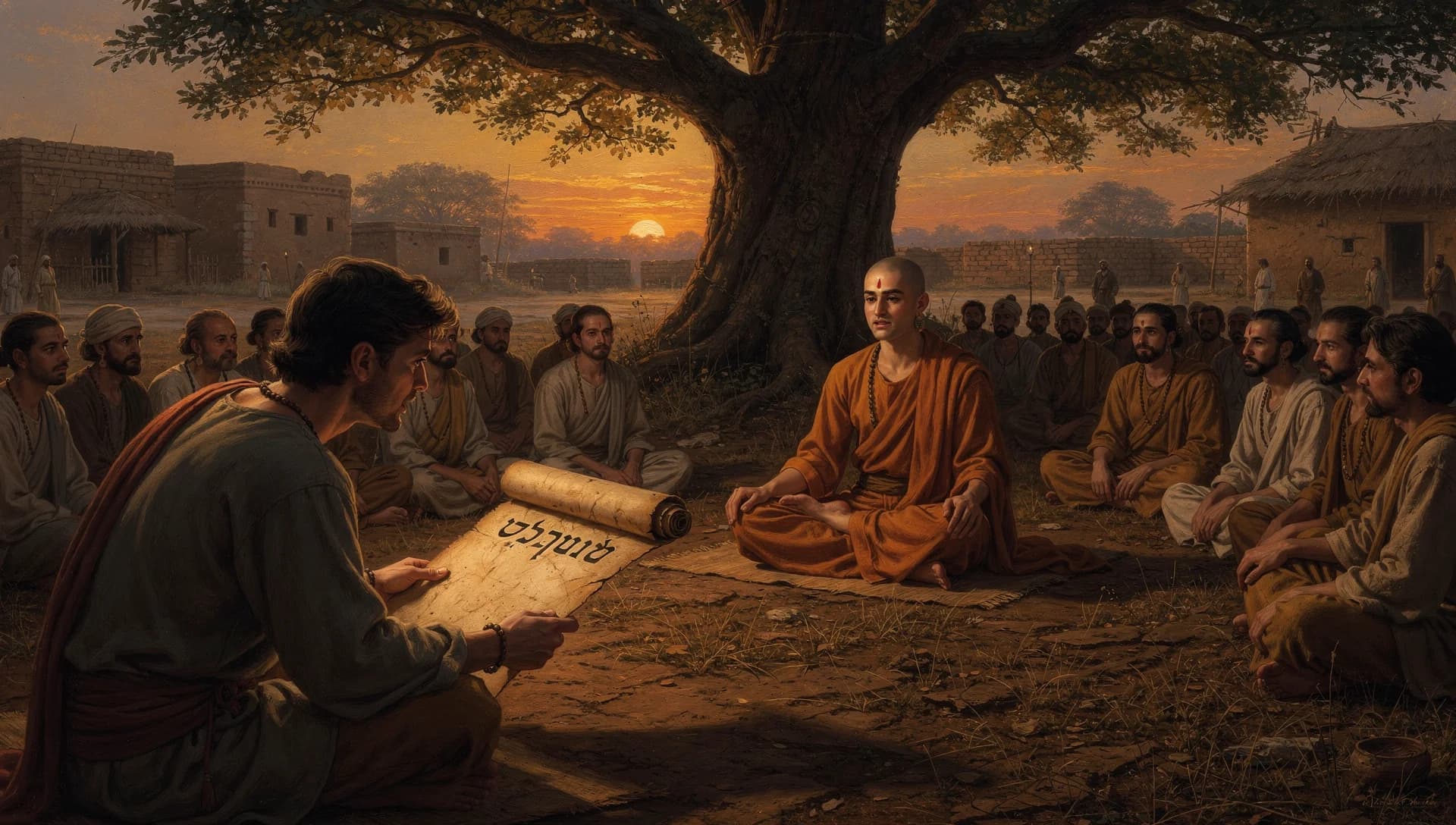
In the deer park at Sarnath, six miles from the holy city of Varanasi (which the Urantia Book calls Benares), Siddhartha Gautama gave what the Buddhist tradition remembers as the First Sermon, the setting in motion of the Wheel of Dharma. He had spent six years in ascetic practice, abandoned that practice as a dead end, and arrived at his middle-way insight while sitting under a peepal tree at Bodh Gaya. The First Sermon was given to five former companions, the ascetics he had left when he turned away from extreme self-mortification. The four noble truths and the eightfold path were laid out. The Sangha was founded. Within forty-five years, an entire spiritual tradition would be in motion that would, by the third century BCE, become the dominant religion of the Indian subcontinent.
The Urantia Book's account of Gautama is remarkable in two respects. It is unusually warm: the UB clearly admires Gautama as one of the most sincere and brilliant religious teachers in human history. And it is unusually specific: Paper 94:7.5 records that a pupil named Bautan, in the second year of Gautama's school at Benares, imparted to his teacher the traditions of the Salem missionaries about the Melchizedek covenant with Abraham. The UB further records that while Siddhartha did not have a very clear concept of the Universal Father, he took an advanced stand on salvation through faith, simple belief, and declared himself before his followers, sending his students out in groups of sixty to proclaim the glad tidings of free salvation, that all men, high and low, can attain bliss by faith in righteousness and justice.
This is one of the most specific historical claims the UB makes about a major world religion. There was Salem-derived material in Gautama's intellectual environment. He encountered it through a specific student. He incorporated the salvation-by-faith teaching into his developing system. He sent missionaries out in groups of sixty (a striking organizational detail that mirrors the Salem missionary practice). He came remarkably close to fully reviving the Salem gospel in Indian form. And he missed the one essential element: the personality of God as Father.
Rupert Gethin's 1998 monograph The Foundations of Buddhism documents the Buddha's deliberate agnosticism on metaphysical questions, the so-called unanswered questions or undetermined points. Asked whether the world is eternal, whether the self continues after death, whether there is a god, the Buddha refused to answer, on the grounds that the questions were not conducive to liberation. John Strong's 2001 biography The Buddha: A Short Biography traces the Buddha's emphasis on practical liberation over theological speculation. The historical Buddha was not, on the surviving textual evidence, an atheist; he was an agnostic about metaphysical questions and a strong proponent of personal moral and meditative practice as the path to awakening.
The structural fit with the UB account is precise. A teacher who has encountered Salem-derived material on salvation by faith, who has incorporated the moral and faith-orientation of that teaching into his system, but who has not been given (or has not received) the additional teaching of God as personal Father, would produce exactly what the historical Buddha produced: a brilliant ethical and meditative system oriented around personal liberation, anchored in faith in the dharma rather than faith in a personal God. The salvation-by-faith element is there in the Buddha's frequent emphasis on faith (saddha) in the dharma as a precondition for entering the path. The personal-Father element is missing. The UB account explains exactly why: Bautan transmitted the Melchizedek covenant teaching, but the personal-deity element had been so degraded in transmission that what Gautama received was a depersonalized faith framework.
The strongest counterargument is that the historical Buddha was working entirely within the Indian Brahmanical and Sramana traditions, with no need for an external Salem-missionary input to produce his teaching. The reply is that the specific organizational detail of sending missionaries out in groups of sixty is a striking parallel to the Salem missionary practice that does not have an obvious internal-Indian explanation. The salvation-by-faith framework is also unusual in the early Indian context, where the Brahmanical tradition emphasized ritual and the Sramana tradition emphasized ascetic practice. Faith as the entry point to a path is a more distinctive feature of the Salem-derived theological vocabulary than of the surrounding Indian alternatives.
What the parallel implies is significant for the Buddhist-Christian dialogue and for the contemporary spiritual seeker drawn to Buddhism. The UB account does not say Buddhism is wrong. It says Buddhism is the brilliant working-out of a partially-received Salem teaching, missing the personal-Father element that would have transformed the philosophy into a living gospel. The Buddhist contemplative tradition, the Buddhist ethical framework, the Buddhist analysis of suffering and craving, are all preserved as real spiritual achievements. The missing piece is the personal relationship with God as Father. The UB undertakes to supply that piece for the Buddhist who is willing to receive it. For the contemporary practitioner, the framework allows a serious engagement with Buddhism's spiritual achievements without requiring abandonment of the personal-God orientation.
Key Quotes
“At Benares Gautama founded his school, and it was during its second year that a pupil, Bautan, imparted to his teacher the traditions of the Salem missionaries about the Melchizedek covenant with Abraham; and while Siddhartha did not have a very clear concept of the Universal Father, he took an advanced stand on salvation through faith, simple belief. He so declared himself before his followers and began sending his students out in groups of sixty to proclaim to the people of India “the glad tidings of free salvation; that all men, high and low, can attain bliss by faith in righteousness and justice.””
“Gethin documents the Buddha's deliberate agnosticism on metaphysical questions including the existence of God, with the Buddha consistently redirecting attention from speculative cosmology toward the practical work of liberation from suffering.”
“Strong traces the historical Buddha's emphasis on personal moral practice and meditative discipline as the path to awakening, with theological speculation explicitly set aside as not conducive to liberation.”
Cultural Impact
The Buddha is one of the four or five most influential individual figures in human spiritual history, alongside Jesus, Muhammad, Moses, and possibly Confucius and Lao-tse. The tradition he founded shaped the religious life of the Indian subcontinent for fifteen centuries before being largely displaced by Hindu and Islamic competitors, and shaped East Asia for two millennia, where it remains a primary spiritual tradition in China, Japan, Korea, Vietnam, Thailand, Burma, Cambodia, Laos, Sri Lanka, Tibet, and Mongolia. The contemporary Western encounter with Buddhism, beginning seriously in the nineteenth century with the work of T.W. Rhys Davids and the Pali Text Society, intensifying in the twentieth century with figures like D.T. Suzuki, Thich Nhat Hanh, the Dalai Lama, and Chogyam Trungpa, has reshaped Western spirituality, psychology (the mindfulness movement), philosophy (analytic Buddhist studies, Buddhist phenomenology), and ethics (the engaged Buddhism tradition). Through the secular mindfulness movement (Jon Kabat-Zinn, Sharon Salzberg, Tara Brach), Buddhist contemplative techniques have entered mainstream Western medicine, education, and corporate training, often stripped of their religious framing but carrying their underlying psychological architecture. The Buddha's image, the dharma wheel, and the lotus have become globally recognizable symbols.
Modern Resonance
The contemporary Western interest in Buddhism is one of the most significant religious phenomena of the past century. The UB framework offers a way to engage Buddhism deeply without abandoning a personal-God theology. The framework affirms Buddhism's spiritual achievements: the analysis of suffering, the practice of mindfulness, the ethical training, the contemplative discipline, the philosophical sophistication. It supplies the missing element that the historical Buddha did not receive: the personal Father, the indwelling Adjuster, the destiny of personality fusion with the divine. For Western Buddhists who have found in Buddhism a depth their inherited Christianity lacked, the UB framework offers a way to keep the depth while restoring the personal-deity element. For Buddhists who have rejected Western theistic religion as incompatible with rational inquiry, the UB framework offers a theistic religion that is rationally articulated and historically anchored. For Christians worried that Buddhism is a competitor, the framework presents Buddhism as a partial preservation of the same Salem-derived teaching that Christianity also inherited, with each tradition preserving real elements of the underlying truth. Buddhism becomes an honored partial preservation, not a rival.
Related Mappings
Best godless philosophy on the planet
= Buddhism as spiritual philosophy without personal deity
Remarkable civil ruler, compared to Ikhnaton of Egypt
= Emperor Asoka, Buddhist monarch of India
The promised return of Michael after his bestowal on Urantia
= Maitreya, the future Buddha whose arrival will renew the Dharma
Salem missionary commission: to carry the gospel to every people
= Bodhisattva vow: to delay nirvana until all beings are liberated
Related Articles
Where to next
The free newsletter. The research behind each piece, no spam.