
 Mythic
Emperor Asoka, Buddhist monarch of India
 UB
UBRemarkable civil ruler, compared to Ikhnaton of Egypt
Full Article
Read the deep-dive article on this connection
Remarkable civil ruler, compared to Ikhnaton of Egypt = Emperor Asoka, Buddhist monarch of India
The Connection
The UB names Asoka as "next to Ikhnaton in Egypt, one of the most remarkable civil rulers between Melchizedek and Michael." Both used political power to advance spiritual teaching. Asoka trained and sent forth over 17,000 missionaries, making Buddhism the dominant faith across much of Asia within a single generation.
UB Citation
Academic Source
Thapar, Asoka and the Decline of the Mauryas (1961); Allen, Ashoka: The Search for India's Lost Emperor (2012)
Historical Evidence(Moderate evidence)
The UB explicitly compares Asoka to Ikhnaton of Egypt as remarkable civil rulers who leveraged political power for spiritual reform. Romila Thapar documents Asoka's transformation from military conqueror to Buddhist patron, with his rock and pillar edicts promoting dharma (moral law) across the Mauryan Empire. Charles Allen traces Asoka's missionary campaign across South and Central Asia. The comparison is to Ikhnaton (Egyptian pharaoh, not Hindu figure), highlighting a cross-cultural pattern the UB identifies: exceptional civil rulers who advance spiritual truth through governance rather than force.
Deep Dive
In 261 BCE, the Mauryan emperor Asoka conducted a military campaign against the kingdom of Kalinga, on the eastern coast of India. The conquest was successful. According to Asoka's own subsequent inscriptions, one hundred fifty thousand were deported, one hundred thousand were killed, and many times that number perished in the aftermath. In the wake of the slaughter, Asoka underwent a personal transformation that is one of the most fully documented religious conversions in the ancient world. He embraced Buddhism, renounced military expansion, and committed the resources of the largest empire in Indian history to the propagation of dharma, the moral law of the Buddhist tradition, throughout South and Central Asia. He inscribed his commitment in stone, on rocks and pillars across his empire, in some of the earliest decipherable Indian inscriptions. He sent Buddhist missionaries to Sri Lanka, Burma, the Hellenistic kingdoms of the West, Central Asia, and probably to China. Within a single generation, Buddhism was transformed from a regional Indian movement into a transcontinental religion.
The Urantia Book at 94:9.1 places Asoka in extraordinary company: next to Ikhnaton in Egypt, Asoka was one of the most remarkable civil rulers between Melchizedek and Michael. The comparison is to Ikhnaton, the eighteenth-dynasty pharaoh who attempted, around 1350 BCE, to install Aten-monotheism as the official Egyptian religion and who is the subject of an extended treatment in Paper 95. Both men used political power to advance spiritual teaching. Both ran into the limits of what political power can accomplish in the spiritual domain. Both left enduring inheritances that outlasted the political projects in which the inheritances were embedded.
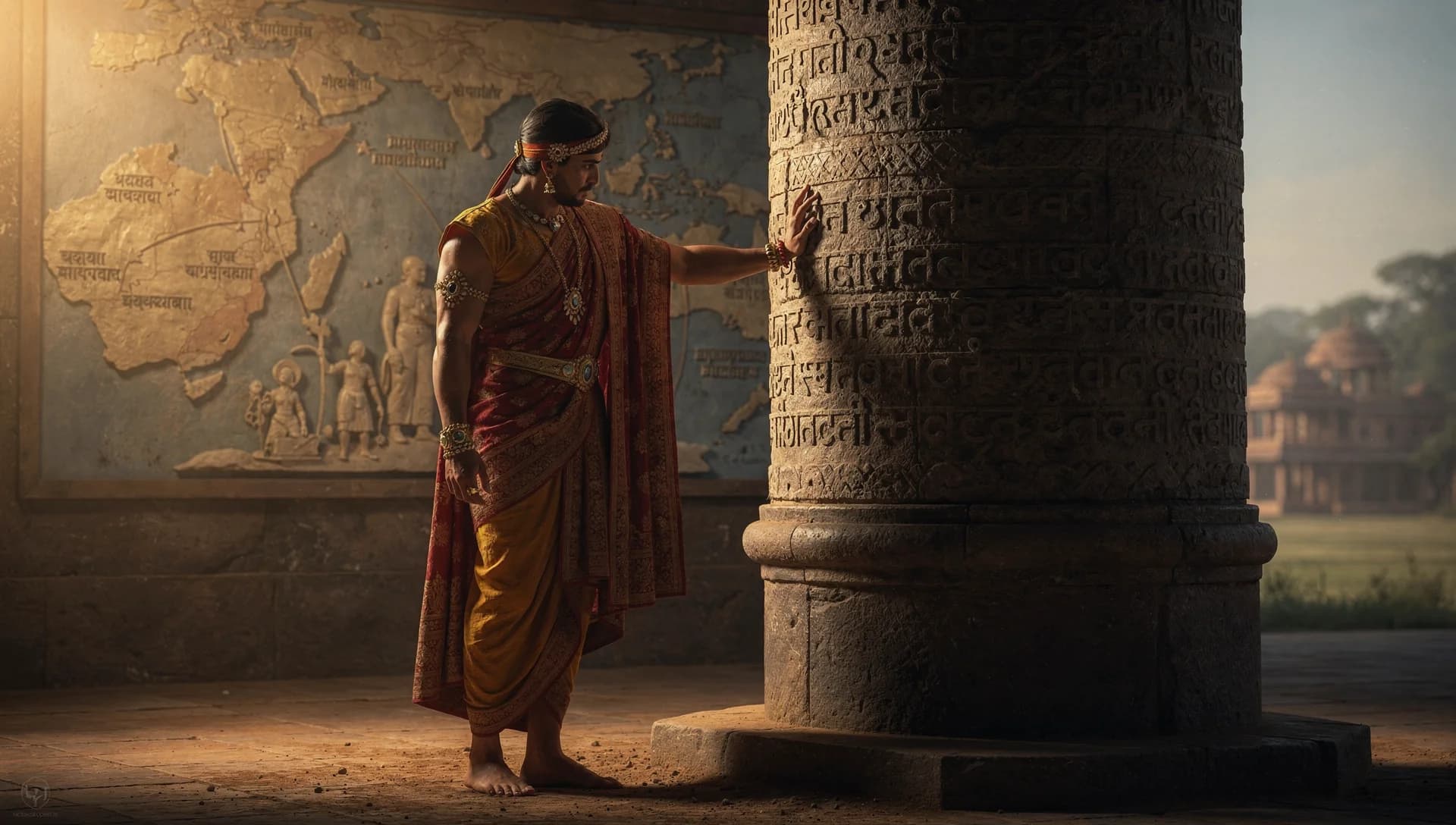
Romila Thapar's foundational 1961 monograph Asoka and the Decline of the Mauryas remains the standard scholarly treatment. Thapar documents Asoka's transformation from military conqueror to Buddhist patron through the rock and pillar edicts, which can still be read at sites from Kandahar to Sri Lanka. The Major Rock Edicts express Asoka's commitment to dharma in terms that reach beyond Buddhist sectarian identity to a broad ethic of non-violence, religious tolerance, care for animals, and moral self-cultivation. The Pillar Edicts, inscribed on tall stone columns crowned with animal capitals (the lion capital from Sarnath is the modern Indian state emblem), record the emperor's specific reforms: prohibition of animal sacrifice, planting of medicinal herbs, digging of wells, treatment of wounded soldiers and animals, support for the Sangha. Charles Allen's 2012 book Ashoka: The Search for India's Lost Emperor traces the rediscovery of Asoka in the nineteenth century, when James Prinsep deciphered the Brahmi script of the inscriptions and revealed an emperor whose name had been almost completely lost from Indian historical memory.
The structural fit with the UB account is clean. The UB notes that Asoka built a great Indian empire through the propaganda of his Buddhist missionaries and that during a period of twenty-five years he trained and sent forth more than seventeen thousand missionaries to the farthest frontiers of all the known world. In one generation he made Buddhism the dominant religion of one half the world. It soon became established in Tibet, Kashmir, Ceylon, Burma, Java, Siam, Korea, China, and Japan. The geographic spread the UB names is exactly what the historical record documents. The mechanism, royal patronage of organized missionary effort, is exactly what Asoka's inscriptions describe.
The comparison with Ikhnaton is theologically interesting. Ikhnaton's monotheistic reform failed almost immediately after his death, with the Egyptian priesthood reverting to the Amun-Ra polytheism within a generation. Asoka's Buddhist reform also faced reversal under his successors and eventual displacement of Buddhism from India by Hindu and later Islamic competitors. But both reforms left an enduring genetic contribution: Ikhnaton's monotheistic impulse fed into the broader monotheistic stream that would surface in Hebrew prophetic religion, and Asoka's missionary effort planted Buddhism in the cultures (Sri Lanka, Tibet, China) where it would endure and flourish for two millennia.
The UB's pairing of Ikhnaton and Asoka identifies a particular pattern of historical religious leadership: a civil ruler who personally encounters spiritual teaching, who uses the resources of state power to propagate it, who experiences immediate political setback or partial failure, but who succeeds in giving the teaching a vehicle for survival and spread that pure individual spiritual leadership could not have provided. This is a particular kind of religious genius, distinct from prophetic charisma or contemplative depth, oriented around the question of how spiritual teaching gets carried into history. Asoka's missionary corps is the largest single act of religious propagation between Buddha and Constantine.
The strongest counterargument is that Asoka's religious commitment may have been more political than personal, with the dharma reform serving the practical purpose of unifying a sprawling, ethnically diverse empire under a common moral language. The reply is that Asoka's edicts include personal expressions of remorse for the Kalinga slaughter that read as authentically transformational, and that the scope of the missionary effort exceeds what political utility alone would have required. The UB account treats Asoka as personally committed, and the historical evidence supports that reading.
What the parallel implies is that the religious historian should pay attention to the distinctive contribution of the politically-positioned spiritual reformer. Ikhnaton and Asoka are the two great examples between Melchizedek and Michael; the lineage continues through Constantine, Charlemagne, and others, but with diminishing purity of motive. The contemporary parallel might be the religious leadership exercised by figures with significant institutional or political reach, where the question is whether they are using the platform for genuine spiritual purposes or for political ones. The UB's evaluation of Asoka invites a sympathetic but discriminating reading of such figures.
Key Quotes
“Buddhism prospered because it offered salvation through belief in the Buddha, the enlightened one. It was more representative of the Melchizedek truths than any other religious system to be found throughout eastern Asia. But Buddhism did not become widespread as a religion until it was espoused in self-protection by the low-caste monarch Asoka, who, next to Ikhnaton in Egypt, was one of the most remarkable civil rulers between Melchizedek and Michael. Asoka built a great Indian empire through the propaganda of his Buddhist missionaries. During a period of twenty-five years he trained and sent forth more than seventeen thousand missionaries to the farthest frontiers of all the known world. In one generation he made Buddhism the dominant religion of one half the world.”
“Thapar documents Asoka's transformation from military conqueror to Buddhist patron through the rock and pillar edicts, with the empire-wide propagation of dharma framed as a deliberate state policy following the emperor's personal conversion after the Kalinga campaign.”
“Allen traces the rediscovery of Asoka through nineteenth-century epigraphic work and reconstructs the emperor's missionary campaign as one of the largest organized religious propagations of the ancient world.”
Cultural Impact
Asoka's missionary effort is the single most important event in the spread of Buddhism beyond the Indian subcontinent. The Sri Lankan Buddhist tradition traces its origin directly to Asoka's son Mahinda, who arrived on the island around 247 BCE. The Burmese, Thai, Cambodian, and Lao Buddhist traditions all depend, by various transmission routes, on the Asokan missionary expansion. The Central Asian Buddhist heritage, which lasted for over a millennium before being displaced by Islam, was an Asokan inheritance. The Chinese, Korean, and Japanese Buddhist traditions ultimately depend on the Central Asian transmission. The total population of contemporary Buddhists, roughly five hundred million, are nearly all in cultures that received Buddhism through chains of transmission that begin with Asoka. Beyond Buddhism, Asoka has become a model figure in modern Indian nationalism (Nehru explicitly invoked him), in international peace activism (the lion capital is on the United Nations grounds), and in religious-tolerance discourse (his Major Rock Edict 12 is one of the earliest documented affirmations of religious pluralism in any culture). The lion capital from Sarnath is the modern Indian state emblem, and the dharma chakra (wheel of dharma) from his pillars is on the Indian national flag.
Modern Resonance
Asoka's example raises an enduringly relevant question: when, if ever, is it appropriate to use political power to advance religious teaching? The UB's positive evaluation of Asoka is striking given its general suspicion of politicized religion. The framework distinguishes Asoka from later examples (Constantine, the Crusader states, the Mughal religious-policy fluctuations, contemporary Christian nationalism) by attending to motive and method. Asoka's method was missionary rather than coercive, oriented toward propagation by example and teaching rather than by force or legal compulsion. His motive, by the evidence of his own inscriptions, was personal moral transformation followed by a desire to share what he had received. The UB framework allows the religious historian to honor this kind of leadership while keeping a sharp critical eye on later examples where motive and method drift toward coercion. For contemporary leaders with religious commitments and significant political reach, Asoka stands as the model of how to do this well: personal commitment first, propagation by means consistent with the teaching, and acceptance that political power has limited capacity to do spiritual work.
Related Mappings
Salem gospel, almost revived in India
= Gautama Siddhartha, the Buddha who almost found the gospel
Best godless philosophy on the planet
= Buddhism as spiritual philosophy without personal deity
The promised return of Michael after his bestowal on Urantia
= Maitreya, the future Buddha whose arrival will renew the Dharma
Salem missionary commission: to carry the gospel to every people
= Bodhisattva vow: to delay nirvana until all beings are liberated
Related Articles
Where to next
The free newsletter. The research behind each piece, no spam.