
 Mythic
Anzu / Zu Bird, monstrous divine bird
 UB
UBFandor, giant passenger bird
Full Article
Read the deep-dive article on this connection
Fandor, giant passenger bird = Anzu / Zu Bird, monstrous divine bird
The Connection
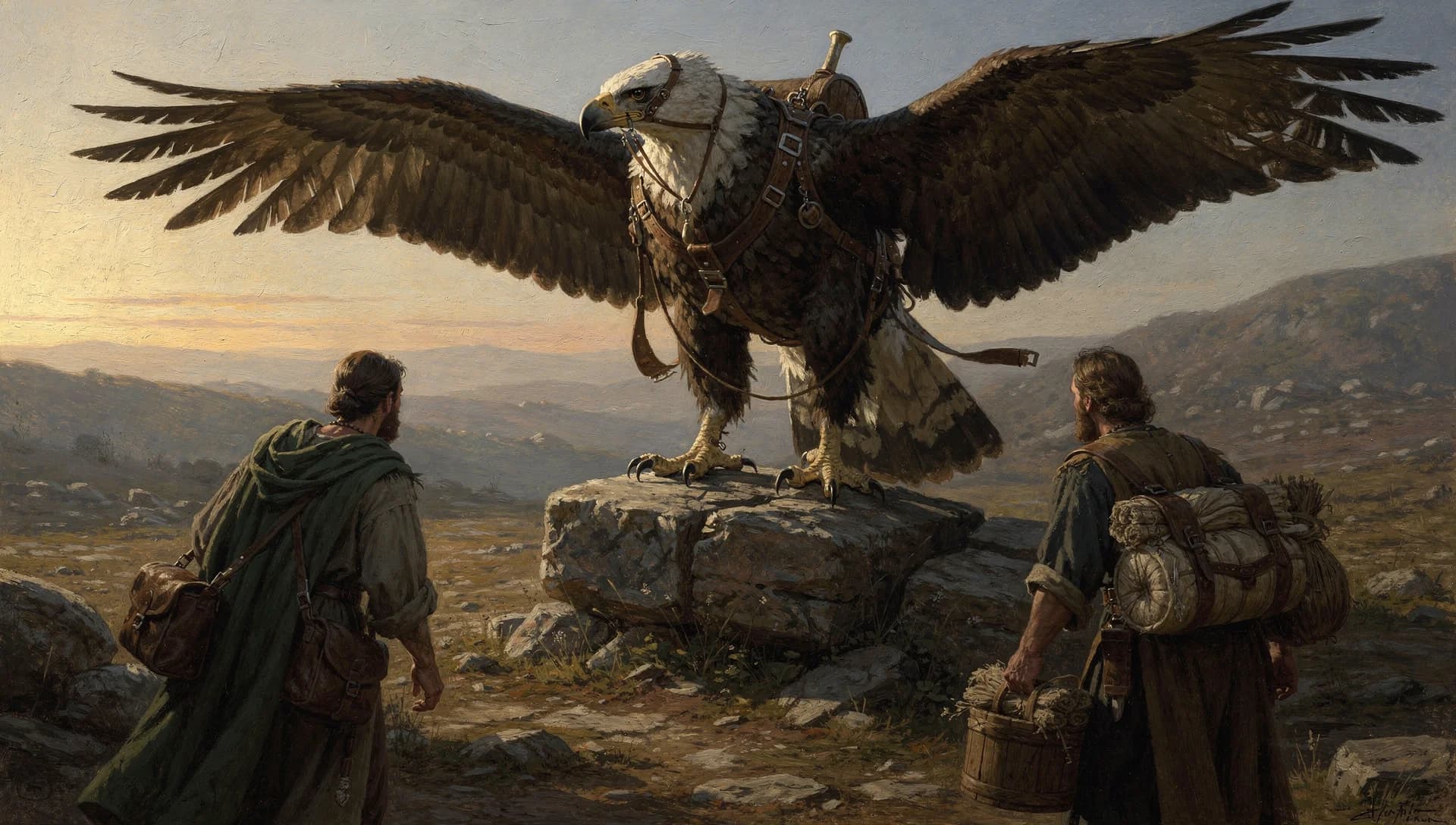
Anzu is a giant bird associated with divine power, often depicted carrying bulls or large animals. Fandor literally transported livestock and people. The image of a giant bird carrying bulls is exactly what Assyrian reliefs depict and what the UB describes fandors doing.
UB Citation
UB 66:5.6, 74:3.4
Academic Source
Dalley, Myths from Mesopotamia (2000)
Historical Evidence(Strong evidence)
British Museum BM 124571: Alabaster relief from Nineveh depicting Ninurta pursuing the Anzu bird. The Imdugud Relief (Tell al-'Ubaid, c. 2600-2400 BCE, British Museum) shows a lion-headed eagle "gripping the haunches of two stags." ORACC: "The Anzu bird had been a mainstay of cuneiform culture from at least the third millennium BC." A giant bird carrying animals is exactly what fandors did.
Deep Dive
The Imdugud Relief, excavated by Leonard Woolley at Tell al-'Ubaid in 1923 and 1924 and now hung in the British Museum, is one of the most arresting objects from early Sumer. It is roughly two meters wide, made of beaten copper sheets over a wooden core, dating to about 2500 BCE, and it depicts a great lion-headed eagle, wings spread wide, gripping the haunches of two confronted stags. The bird is enormous in proportion to the stags, and the composition is unambiguous: a giant raptor with the heads of full-grown deer in its talons. The Sumerians called this bird Anzu, sometimes Imdugud in earlier texts. The Akkadians inherited it. By the second millennium BCE the Anzu bird had its own myth cycle, in which it stole the Tablet of Destinies from Enlil and was hunted down by Ninurta, son of Enlil, in a long battle preserved in the Standard Babylonian Epic of Anzu.
The Anzu cycle has no obvious explanation in the surrounding ecology. There are no lion-headed eagles. There are no birds in the Mesopotamian fauna large enough to seize a deer. The image is excessive against any zoological reality the Sumerians would have known. Yet they kept depicting it for nearly three thousand years, on temple decorations, on cylinder seals, on Assyrian palace reliefs at Nimrud and Nineveh. ORACC, the Open Richly Annotated Cuneiform Corpus, notes that the Anzu bird "had been a mainstay of cuneiform culture from at least the third millennium BC." It is one of the most persistent monstrous birds in any ancient mythological tradition.
The Urantia Book gives us a literal explanation. UB 66:5.6 tells us that "Bon's group were successful in training the great fandors as passenger birds, but they became extinct more than thirty thousand years ago." The fandor was a passenger bird, not a metaphor: a real avian species, large enough to carry humans and livestock. UB 74:3.4 records that on the third day after Adam's arrival, "From the large passenger birds, the fandors, Adam and Eve looked down upon the vast stretches of the Garden while being carried through the air over this, the most beautiful spot on earth." A Material Son and his coordinate riding a great bird across a garden plain. That is exactly what later Sumerian and Assyrian art kept depicting in stylized form: a superhuman figure or a heroic king, with a giant rideable bird, in a sacred or paradisaical landscape.
The chronology fits. Fandors went extinct around thirty thousand years ago, well before Adamic times in some lineages but contemporaneous with early Adamite migrations in others. By the time of the Sumerian civilization roughly twenty-five thousand years later, the bird itself was long gone, but the mythological memory remained, transposed into the Anzu/Imdugud composition. The lion head was added at some point in the iconographic development, possibly merging the great bird with the lion as another symbol of regal power. The size relative to its prey was retained because that was the memorable feature: a bird big enough to grip large animals.
Paleontology has independently identified candidate species. Argentavis magnificens of South America, dated to about six million years ago, had a wingspan of roughly seven meters. Pelagornis sandersi from the eastern United States, also extinct, exceeded six meters. The smaller teratorns of the Pleistocene Americas (Aiolornis incredibilis, Teratornis merriami) had wingspans of three to five meters. The point is not that any of these is the fandor. The point is that the basic body plan of a flying bird large enough to carry a human is biologically attested. Modern eagles (golden eagle, Verreaux's eagle) routinely carry prey weighing twice their body mass; scaled-up species could plausibly carry mammalian payloads of human size, especially under glide rather than powered flight conditions.
The strongest counterargument is that giant birds in mythology are universal: thunderbirds in North America, the rocs of Persian and Arabic tradition, garuda in India, the simurgh in Iran. If the motif is everywhere, why call any of it a memory of fandors? The reply is that the universality is exactly what the UB account predicts. Fandors were a planetwide phenomenon, used for transport by the Prince's staff and remembered in every cultural region they reached. Their universality across human myth is not evidence against a historical referent; it is the expected fingerprint of a real species in widespread use that went extinct in prehistory and was preserved in oral memory until written culture could record it. The Mesopotamian Anzu, the Indian Garuda, the Native American Thunderbird, and the Persian Simurgh all converge on the same composite: a divine bird, much larger than any natural species, associated with carrying heroic riders and prey of impossible scale. They are remembering the same animal.
Key Quotes
“It was in these days that carrier pigeons were first used, being taken on long journeys for the purpose of sending messages or calls for help. Bon's group were successful in training the great fandors as passenger birds, but they became extinct more than thirty thousand years ago.”
“From the large passenger birds, the fandors, Adam and Eve looked down upon the vast stretches of the Garden while being carried through the air over this, the most beautiful spot on earth.”
“A lion-headed eagle gripping the haunches of two stags, from the temple of Ninhursag at Tell al-'Ubaid, c. 2500 BC.”
Cultural Impact
The Anzu bird is one of the most heavily transmitted iconographic motifs in the ancient Near East. It appears on cylinder seals from the Early Dynastic period through the Persian conquest, on Assyrian palace reliefs from Nimrud and Khorsabad, on temple architecture across the Levant. Through Phoenician trading networks the giant-bird motif diffused into Greek imagery, where it merged with native traditions to produce the harpies and the thunderbird-like attributes of Zeus. The Persian simurgh, the Indian garuda, and the Arabic roc are direct cultural descendants in their respective regions. Through medieval Arabic geography, the roc entered European fairy tale via the Sinbad cycle in the One Thousand and One Nights, becoming the standard "giant bird that carries off heroes" of Western fantasy. Tolkien's eagles in The Hobbit and The Lord of the Rings, and through them the entire fantasy genre's tradition of rideable raptors, descend ultimately from this same memory thread. The motif has cultural penetration disproportionate to any natural-historical inspiration the cultures could have observed firsthand, which is the signature of a genuine ancestral memory now lost.
Modern Resonance
In the ancient-aliens corner of the internet, the Anzu and its Indian cousin Garuda are sometimes claimed as evidence of extraterrestrial flying machines: rideable conveyances mistaken for divine birds. The UB explanation is more parsimonious and more interesting. Fandors were birds, real biological birds, large enough to be ridden, native to Urantia, used for transport during the Prince's administration and the early Adamic period, extinct by historical times. They were neither metal craft nor mythological inventions but a now-vanished megafauna whose memory survived in iconography for millennia. Modern paleontology has confirmed that birds at the upper edge of fandor scale once existed; the only question is whether one of those species, or a close relative, persisted into the late Pleistocene long enough to be domesticated. The UB answer is yes, and the global distribution of the giant-rideable-bird motif is the consequence.
Related Mappings
Related Articles
Where to next
The free newsletter. The research behind each piece, no spam.