
 Mythic
Inanna (Sumerian) / Ishtar (Akkadian)
 UB
UBEve, Material Daughter
Full Article
Read the deep-dive article on this connection
Eve, Material Daughter = Inanna (Sumerian) / Ishtar (Akkadian)
The Connection
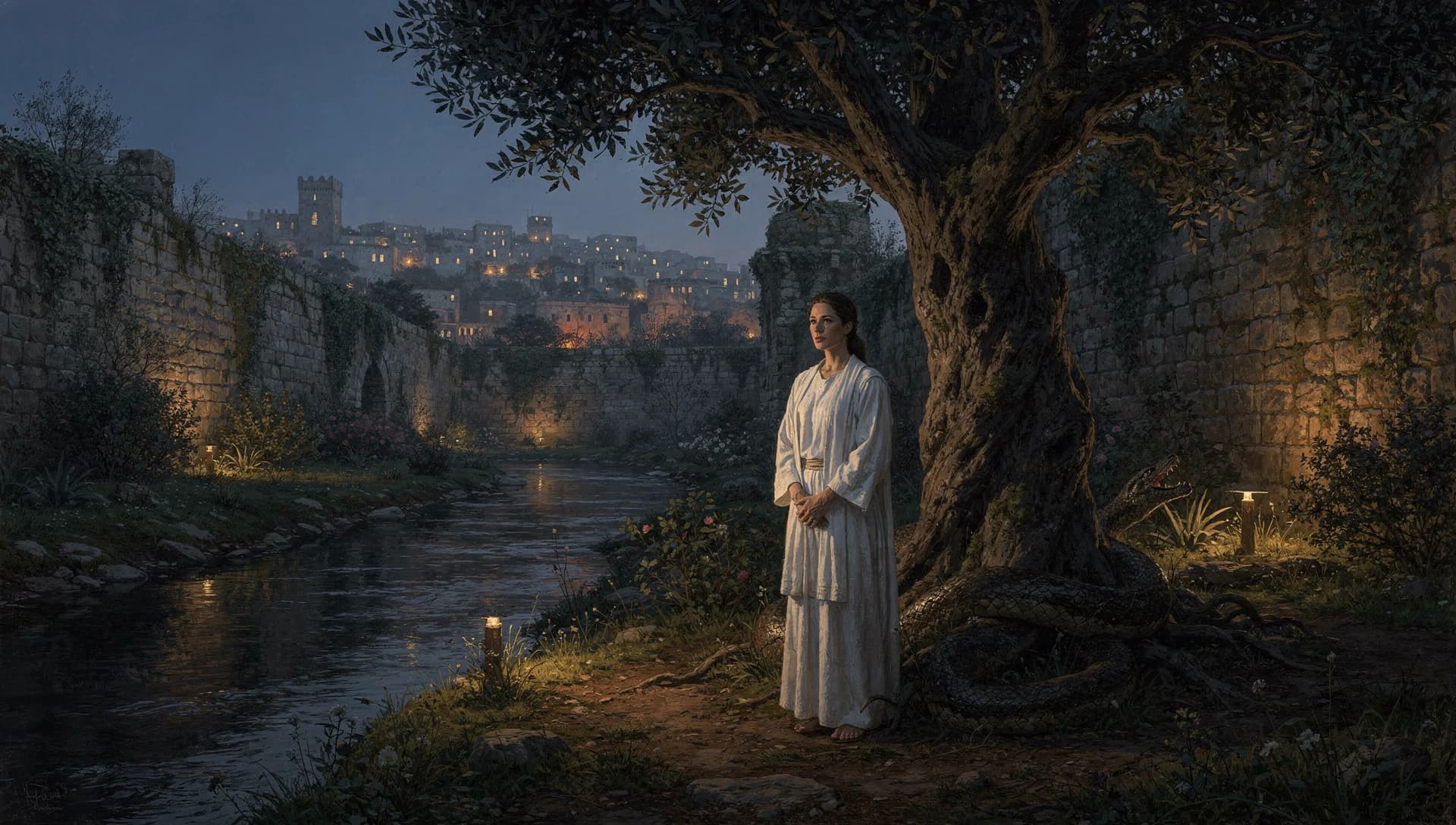
Inanna is associated with a sacred garden, a tree, fruit, a fall from grace, and a descent. The Huluppu Tree myth places Inanna in a garden with a sacred tree at Uruk. Eve is placed in the Garden of Eden with the Tree of Life. Both are powerful, beautiful, central to civilization, and experience a catastrophic fall.
UB Citation
UB 74-76
Academic Source
Wolkstein & Kramer, Inanna: Queen of Heaven and Earth (1983); ETCSL 1.3.1
Historical Evidence(Moderate evidence)
ETCSL 1.8.1.4 "Gilgamesh, Enkidu, and the Netherworld" contains a single narrative with: a divine female figure, a sacred garden, a sacred tree, a serpent associated with the tree, and a loss of status/fall. Oxford UP describes this as "a drastic demotion in Inanna's status." These elements predate Genesis by over a millennium. The Anzu bird also appears in the same tree.
Deep Dive
The cuneiform scribe writing at Uruk near the end of the third millennium BCE inscribed a tablet that opens "In those days, in those days, when destinies had been determined." It is the prologue to a remarkable composition whose full title in modern editions is "Gilgamesh, Enkidu, and the Netherworld," catalogued by ETCSL as 1.8.1.4. The first hundred lines tell the story of the Huluppu Tree. A young woman, the goddess Inanna, finds a tree on the bank of the Euphrates, uprooted by a storm. She rescues it and plants it in her garden in Uruk, hoping to make a throne and a bed from its mature wood. The tree grows. But three creatures take up residence in it: a serpent that cannot be charmed at the roots, the Anzu bird with its young in the crown, and the demoness Lilith in the trunk. Inanna weeps. Gilgamesh, summoned, slays the serpent and drives off the bird and the demon. The tree is felled, and Inanna fashions her insignia from its wood.
The Urantia Book gives us, in Eve, the Material Daughter who arrived with Adam to upstep the human races. She is placed in a garden, the first Garden, prepared by Van and his loyal staff and tended for over thirty thousand years before her arrival. The tree of life, the Edentia shrub originally given to Caligastia and rescued by Van at the rebellion, is transplanted to a central courtyard of the Father's temple in the Garden. Eve is a powerful and beautiful figure, the biological partner of Adam, central to the entire Adamic civilizational project. She experiences a catastrophic fall when she yields to Cano's premature plea for racial uplift before the Adamic mission has been completed. The default forfeits her status as Material Daughter and triggers the eviction from the Garden.
The structural elements of the two narratives align with unusual density. A divine female figure: Inanna and Eve are both supremely beautiful, supremely consequential. A sacred garden: Inanna has her garden in Uruk, Eve has the first Garden of Eden. A sacred tree at the garden's heart: the huluppu tree in Uruk, the tree of life in Eden. A serpent at the tree: in Inanna's narrative the serpent is at the roots, in the Genesis garden the serpent is in the tree. A demonic feminine figure: Lilith in the huluppu narrative, the serpent traditionally feminized in Genesis interpretation. A loss of status: Wolkstein and Kramer in their 1983 collaboration call Inanna's experience in this and related narratives a series of demotions and discoveries about the limits of divine power. Eve's default is the prototypical fall.
Beyond the structural overlap, there is a chronological argument. The huluppu narrative is preserved on tablets dated to roughly the early second millennium BCE, with literary precursors going back further. Genesis 2-3, in its Hebrew form, dates to no earlier than the first millennium BCE. The huluppu narrative predates Genesis by at least a thousand years and probably more. If both narratives are independent attempts to encode the same memory, the Sumerian version is the closer to the source. The UB perspective resolves the temporal puzzle: both narratives encode the cultural memory of the Adamic Garden episode, the Sumerian version preserving more of the structural detail, the Hebrew version simplifying it into a moral parable while retaining the central elements.
The strongest counterargument is that Inanna is a love-and-war goddess with a vast portfolio that has nothing to do with Eve, and the huluppu episode is one minor narrative among dozens. True. The mapping is not "Inanna equals Eve" in toto. The mapping is that the huluppu narrative is a fragment of cultural memory of the Adamic Garden episode, attached to Inanna because the Sumerian theological imagination crystallized the central feminine consort role around her. The other Inanna narratives, particularly her Descent (ETCSL 1.4.1), encode different memories. The decoder mapping focuses on the structural overlay where it is densest.
What the parallel implies is that Genesis 2-3 is not a freestanding revelation, nor a Babylonian borrowing, but a refraction of the same underlying historical memory that the Sumerian poets working at Uruk preserved with greater structural fidelity. Eve was real. The Garden was real. The tree was real. The serpent was a real creature in the Garden. The fall happened. The Hebrew priestly redactors preserved the moral substance and lost the architectural detail; the Sumerian poets preserved the architectural detail and lost the moral substance. Reading them together, with the UB as the framework, lets us reconstruct what actually happened.
Key Quotes
“When Van and his associates made ready the Garden for Adam and Eve, they transplanted the Edentia tree to the Garden of Eden, where, once again, it grew in a central, circular courtyard of another temple to the Father. And Adam and Eve periodically partook of its fruit for the maintenance of their dual form of physical life.”
“Inanna rescues a young huluppu tree, plants it in her garden in Uruk, and tends it for years; a serpent at its roots, the Anzu bird at its crown, and a demonic figure in its trunk eventually disrupt her possession of it. (Paraphrased from the Oxford ETCSL translation; the prologue to GEN.)”
“Wolkstein and Kramer characterize the huluppu episode as the inaugural narrative in the Inanna cycle, situating her within a sacred garden and a sacred tree from the start of her literary career.”
Cultural Impact
The cluster of motifs in the huluppu narrative, divine feminine + sacred garden + sacred tree + serpent + loss of status, becomes the most widely transmitted mythological complex in human cultural history. It enters the Hebrew tradition as Genesis 2-3 and from there flows into Christianity, Islam, and every theological system that has wrestled with original sin. Through Hellenistic syncretism it shapes the Greek Hesperides garden, with Hera's golden apples guarded by a serpent. It feeds into the Iranian Yima/Yama paradise tradition. The Hindu Pururavas-Urvashi and the gardens of Indra preserve fragments. Egyptian temple gardens with their sycamore-fig sacred trees and serpent-protected groves are part of the same family. The Norse Yggdrasil with the dragon Nidhogg at the roots and the eagle in the crown is structurally identical to the huluppu narrative, three thousand years and four thousand miles apart, suggesting common ancestry in the same Garden memory. Eve is the most influential female figure in Western religious imagination, and Inanna is arguably the most influential female figure in Sumerian. They are, on the UB reading, the same person remembered by different priesthoods.
Modern Resonance
Feminist scholarship since the 1970s has rediscovered Inanna as a powerful pre-patriarchal divine feminine, and the rehabilitation of Eve from the moral villain of patristic tradition has paralleled it. Both rehabilitations are partial; both are working toward something the texts themselves cannot quite articulate. The UB account offers the cleaner reading: Eve is not a villain, she is a Material Daughter whose default was a tactical misjudgment, not a moral failing. Inanna is not just a divine feminine archetype, she is the cultural memory of that same Material Daughter. The "fall" is not original sin in the Augustinian sense; it is a real historical default of a real planetary mission that left humanity short of the genetic and civilizational uplift it was promised. Reading Inanna and Eve together through the UB lens lets contemporary readers honor the gravity of what Eve did, the catastrophic cost of the Adamic default, while restoring her dignity as the most consequential human-form woman in our planetary history.
Related Mappings
Related Articles
Where to next
The free newsletter. The research behind each piece, no spam.