
 Mythic
The Sumerian ME, divine decrees / arts of civilization
 UB
UBDalamatia Ten Councils, civilization delivered as organized knowledge
Full Article
Read the deep-dive article on this connection
Dalamatia Ten Councils, civilization delivered as organized knowledge = The Sumerian ME, divine decrees / arts of civilization
The Connection
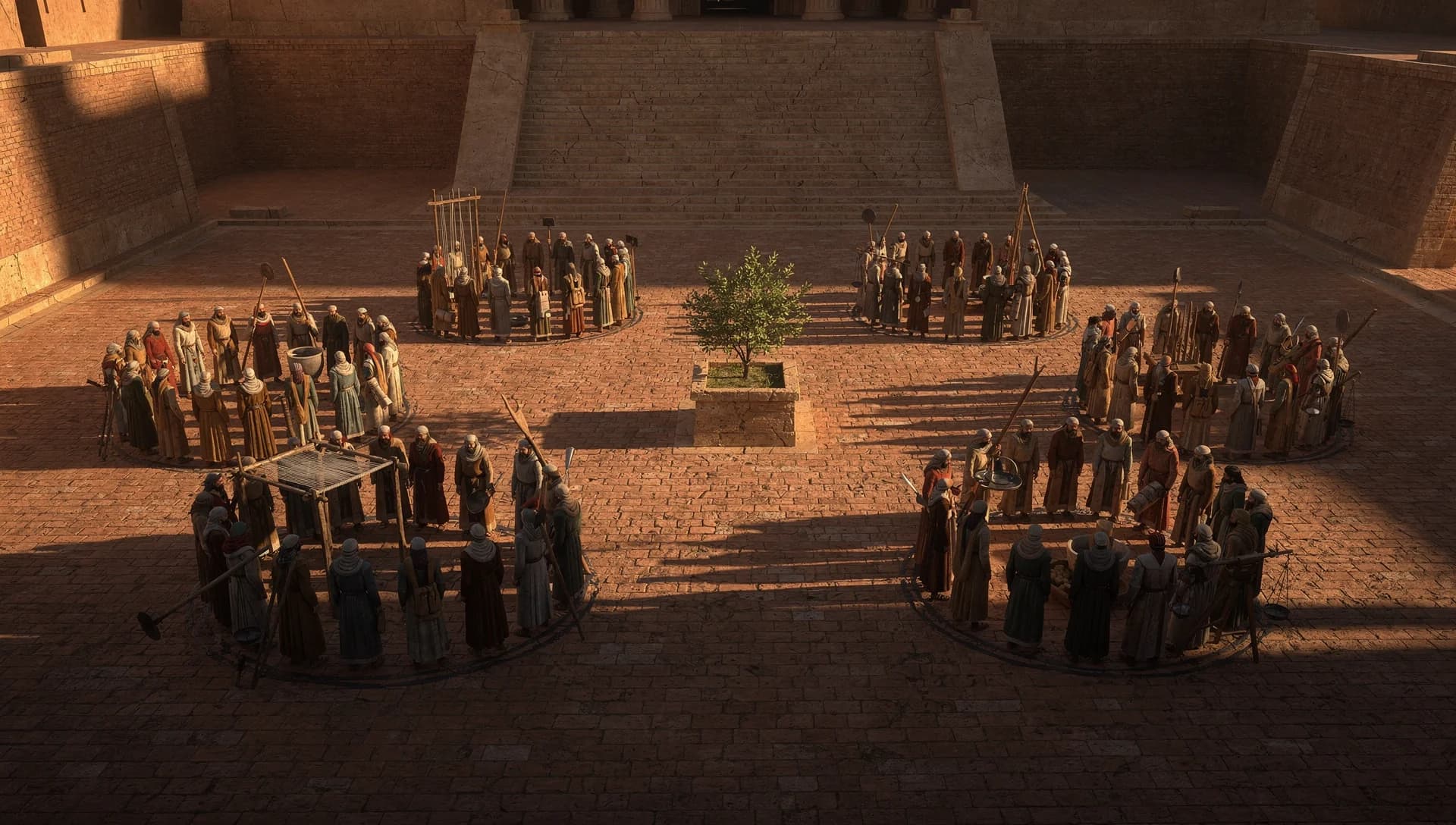
The Prince's 100 staff were organized into 10 councils of 10, each governing a domain: food, domestication, science, trade, religion, health, art, mining, tribal relations, and the supreme court. The Sumerian ME are divine decrees governing identical domains (kingship, priesthood, crafts, music, writing, law) held by Enki at Eridu. In both traditions, civilization arrives as a package delivered by superhuman beings, organized into discrete categories.
UB Citation
Academic Source
ETCSL 1.3.1: Inanna and Enki; Kramer, The Sumerians (1963)
Historical Evidence(Moderate evidence)
The myth of Inanna stealing the ME from Enki (ETCSL 1.3.1) lists over 100 divine decrees covering every domain of civilized life. S. N. Kramer: the ME represent "the fundamental, unalterable, comprehensive assortment of powers and duties, norms and standards, rules and regulations relating to civilized life." The UB describes the same concept: 10 organized councils teaching civilization to primitive humanity, predating the Sumerian literary tradition by ~200,000 years. The myth of Inanna taking the ME from Enki may encode a memory of the rebellion splitting the staff's civilizational knowledge between factions.
Deep Dive
The Sumerian word ME (often capitalized in scholarly transliteration to mark its specialized sense) denotes one of the strangest concepts in early human religious vocabulary. Samuel Noah Kramer, in The Sumerians (1963), defined the ME as "the fundamental, unalterable, comprehensive assortment of powers and duties, norms and standards, rules and regulations relating to civilized life, as conceived by the Sumerians." The ME were not laws in the legal sense, not customs in the cultural sense, not rituals in the religious sense, though they overlapped with all three. They were divine decrees, held primarily by Enki at his temple in Eridu, that constituted the categorical structure of civilization itself. To possess the ME was to possess the right to a civilized order; to lack them was to live in barbarism.
The myth of Inanna and Enki, ETCSL 1.3.1 in the Oxford corpus, tells how Inanna of Uruk traveled to Eridu, dined and drank with Enki, and convinced him to give her the ME, one set at a time, in his drunken generosity. The text lists more than one hundred ME explicitly: kingship, priesthood, the eternal lordship, the godship, the noble crown, the throne of kingship, the noble scepter, the staff, the noble shrine, shepherdship, kingship, the lasting lady-ship, the office of priestess, the office of singer, the office of clad-one, music, eldership, heroism, power, enmity, straightforwardness, the destruction of cities, lamentation, rejoicing of the heart, falsehood, art, the assembly, descent into the netherworld, ascent from the netherworld, the cult of the kurgarra, the cult of the girbadara, the cult of the sagursag, the standard, the quiver, sexual intercourse, the kissing of the lips, prostitution, justice, lawsuit, the giving of judgments, decisions, the chamberlain, the lordship, the priesthood, the carpentry craft, the metalworking craft, the scribal craft, the smithcraft, the leatherworking craft, the building craft, the basket-weaving craft, wisdom, attentiveness, holy purification, the shepherd's hut, the burning of coals, the sheepfold, fear, terror, dismay, strife, peace, weariness, victory, the troubled heart, judgment, decision-making, exalted lamentation, instruction, music, eldership, complete kingship, troubled heart, judgment, decision, the rebellion, the kindly word, treachery, justice, the destruction of cities, lamentation, rejoicing of the heart, falsehood, the kingly office, ... the list runs on. The composer of the text was attempting to enumerate the entire content of civilized order.
The Urantia Book account of the Prince's administration in Dalamatia closely matches this taxonomy. UB 66:5.1 records that the Prince's hundred staff "were organized for service in ten autonomous councils of ten members each." The councils are then enumerated: food and material welfare under Ang, animal domestication under Bon, conquest of predatory animals under Dan, dissemination of knowledge under Fad, industry and trade under Nod, revealed religion under Hap, art and science (Lut), tribal relations (Tut), supreme court of tribal coordination (Van as chairman), and the council on coordination of all the others. Each council had a defined domain. Each council taught the corresponding skills to the surrounding evolutionary humanity. UB 66:5.9 specifies that "Fad formulated the first alphabet and introduced a writing system. This alphabet contained twenty-five characters." UB 66:5.11 records that the commission on industry and trade under Nod "contributed directly to the elevation of standards of living by providing many new commodities to attract the fancy of primitive men."
The structural match with the Sumerian ME is immediate. Both are organized inventories of civilization. Both are held and dispensed by superhuman beings at a central administrative location (Eridu / Dalamatia). Both encompass the same general domains: governance, priesthood, crafts, music, writing, law, conflict, peace, food, agriculture, animal husbandry. The Sumerian myth of Inanna taking the ME from Enki, on the UB reading, is the cultural memory of the historical transmission: civilization was organized as discrete categorical knowledge in the hands of the loyal staff (Enki = Van), and was carried forward into the post-Dalamatian era through the descendants of the Material Daughter (Inanna = Eve). The mythological narrative of one god giving the ME to another, in the form of a meal and a journey, is the stylized priestly memory of the actual transfer of civilizational knowledge from the original Dalamatian center to the second garden under Adam and Eve.
Two further details. First, the number. The Sumerian text's enumeration of the ME varies between roughly seventy and over one hundred items in different recensions, but the typical organization is into thematic groups of around ten: ten ME of kingship, ten of priesthood, ten of crafts, and so on. UB tradition organizes the staff into ten councils of ten. The same decimal architecture, applied to the same categorical content, in the same geographic region, is unlikely to be coincidence. Second, the location. The ME were held at Eridu, the oldest of the Sumerian cities and traditionally the first city after kingship descended from heaven. UB tradition places Dalamatia in the same general region, on the eastern Mediterranean coast that subsequently submerged. Eridu's mythological priority is, on the UB reading, the cultural memory of the priority of Dalamatia.
The strongest counterargument is that the ME concept may be a purely intra-Sumerian theological development, with no need for a deeper historical referent. The reply is that the ME's strange specificity (organized inventory of civilizational categories) is anomalous against neighboring traditions. Egyptian theology has nothing exactly like the ME. Hittite theology has nothing exactly like it. The Sumerian ME stand out as a peculiarly explicit attempt to enumerate the totality of civilized order, which is exactly what we would expect if the underlying memory was of an actual historical administration that delivered civilization as organized knowledge. The intra-Sumerian explanation can describe the development of the ME concept; it cannot fully account for why the concept took this specific form.
Key Quotes
“The one hundred were organized for service in ten autonomous councils of ten members each. When two or more of these ten councils met in joint session, such liaison gatherings were presided over by Daligastia.”
“The faculty on dissemination and conservation of knowledge. This group organized and directed the purely educational endeavors of those early ages. It was presided over by Fad. The educational methods of Fad consisted in supervision of employment accompanied by instruction in improved methods of labor. Fad formulated the first alphabet and introduced a writing system.”
“The me are the fundamental, unalterable, comprehensive assortment of powers and duties, norms and standards, rules and regulations, relating to civilized life, as conceived by the Sumerians.”
Cultural Impact
The ME concept, though specific to Sumerian theology, transmitted its underlying logic into broader Near Eastern thought as the model of civilization-as-divine-gift. The Akkadian inheritance retained the basic structure under different vocabulary. The Hebrew tradition's law-as-divine-gift, with the Torah delivered to Moses on Sinai as the comprehensive prescription for civilized order, is structurally related: a god dispenses to a human leader the comprehensive categorical content of civilized life. The Greek tradition's culture-heroes (Prometheus giving fire and crafts, Athena giving olive cultivation, Demeter giving grain) is a polytheistic refraction of the same basic memory: civilization arrived as divine gift, distributed across functional domains. The Hindu tradition's rishis, the seven sages who received the Vedas at the dawn of the present age, preserve a more directly comparable memory: a small group of superhuman beings transmitting comprehensive civilizational knowledge to humanity. The cross-cultural pattern is one of the most durably attested mythological structures in the literate world. On the UB reading, it is the cultural fingerprint of the actual historical event: the Prince's staff delivered civilization as organized knowledge to evolutionary humanity, and every subsequent culture that inherited from the Mesopotamian core has refracted that memory in its own idiom.
Modern Resonance
The "ancient civilization-bringer" trope is a staple of contemporary alternative-history speculation. Erich von Daniken, Graham Hancock, and a long line of subsequent authors have built popular bestsellers around the claim that early civilization is too sudden, too organized, and too cross-culturally consistent to be the product of unguided evolutionary development; some external agent must have transmitted civilization to early humanity. The mainstream academic answer is that civilization arose gradually through cumulative innovation in multiple regions independently. The UB answer is closer to the alternative-history claim than to the academic consensus, but with crucial differences: the civilization-bringers were not extraterrestrials in the science-fiction sense but materialized members of the planetary administrative hierarchy; they delivered civilization in a single coherent package to a single original location (Dalamatia); the package included the categorical content that the Sumerians later remembered as the ME; subsequent civilizations are downstream from this single original transmission, refracted through the destruction of Dalamatia and the dispersal of its cultural knowledge. The modern speculation that something specific must have happened to produce the apparent organization of early civilization is, on the UB account, correct in its instinct and wrong in its details.
Related Mappings
Related Articles
Where to next
The free newsletter. The research behind each piece, no spam.