
 Mythic
Adapa (Mesopotamian), the sage who lost immortality
 UB
UBAdam, Material Son
Full Article
Read the deep-dive article on this connection
Adam, Material Son = Adapa (Mesopotamian), the sage who lost immortality
The Connection
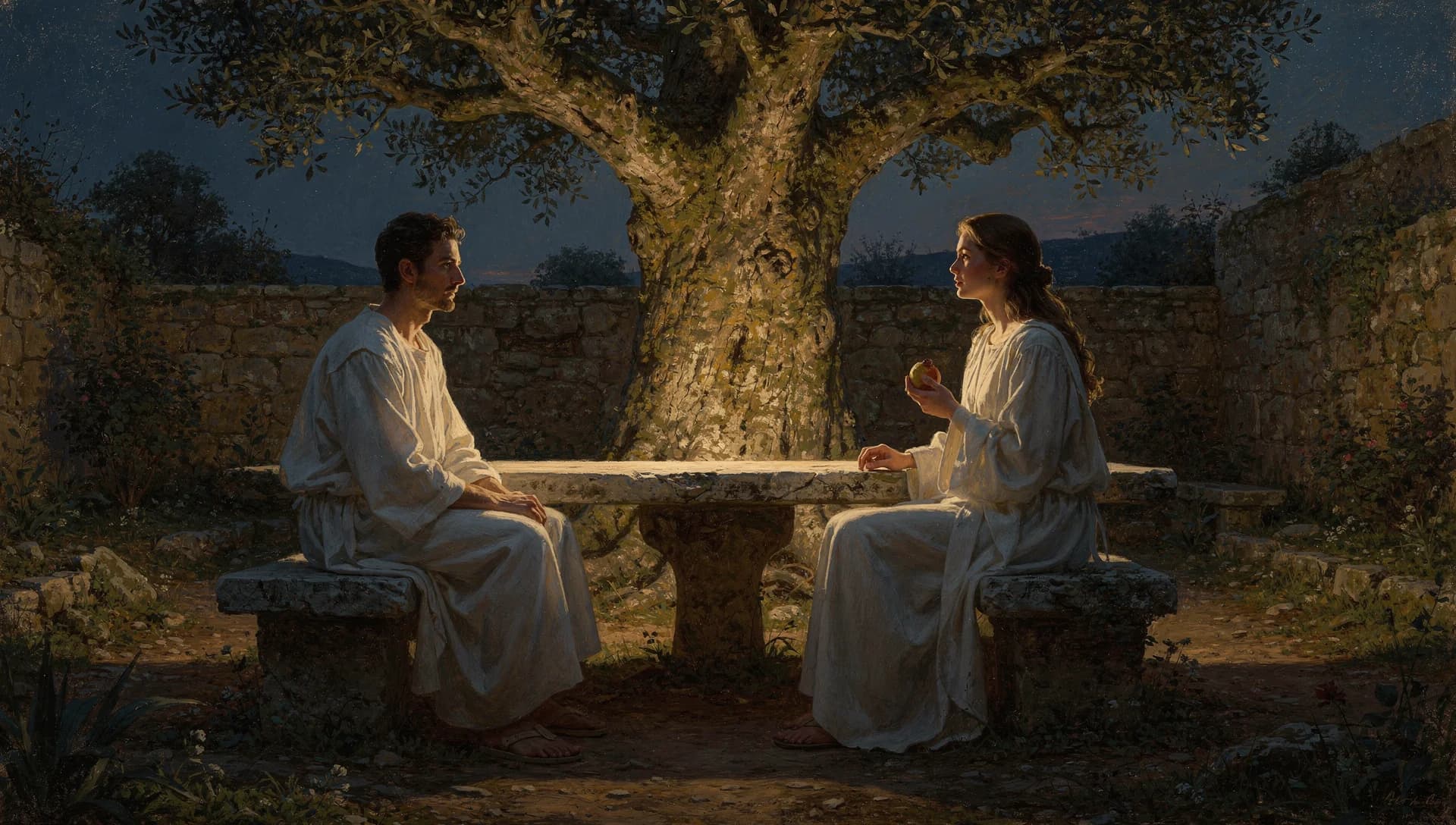
Adapa is the most direct Mesopotamian parallel to Adam. Created by Enki as a supremely intelligent human sage, Adapa is summoned before the gods and offered the "food and water of life," but refuses it, losing his chance at immortality. Adam is offered the fruit of the Tree of Life but defaults through Eve's premature union with Cano, forfeiting the Adamic mission. Both figures: created with extraordinary abilities, placed in a position of trust, face a divine test involving what they consume, and lose immortality through that test.
UB Citation
UB 74-76
Academic Source
Dalley, Myths from Mesopotamia (2000); Adapa Fragment B (Amarna); Izre'el, Adapa and the South Wind (2001)
Historical Evidence(Strong evidence)
The Adapa myth survives in four fragments (A-D), with Fragment B (found at Tell el-Amarna, Egypt) preserving the food-test scene. S. Izre'el notes Adapa was "the model of a human being" endowed with "vast intelligence" by Ea/Enki, matching the UB description of Adam as a biologically superior being sent to uplift humanity. W. G. Lambert observes that both Adapa and Adam "underwent a test before the deity based upon something they were to consume, both failed and forfeited immortality." The parallel extends to the mechanism: Adapa is deceived about the food (told it is death, when it is life); Eve is deceived about the path to accelerating the divine plan. Both stories encode the loss of a superhuman inheritance through a single critical misjudgment.
Deep Dive
In 1887, an Egyptian peasant woman digging for fertilizer in the ruins of el-Amarna struck a cache of clay tablets that turned out to be the diplomatic correspondence of Akhenaten. Among the bureaucratic letters was something stranger: a Mesopotamian myth, copied for a scribal exercise, telling the story of a man named Adapa who broke the south wind, was summoned before the high god Anu, and refused the food that would have made him immortal. Fragment B, now in the Vorderasiatisches Museum in Berlin, is the longest surviving piece of the Adapa narrative. Three other fragments have since surfaced, the oldest from the Middle Babylonian period and the latest from the library of Ashurbanipal at Nineveh. They tell a coherent story across more than a thousand years: a wise man, a perfect man, the model of humanity, was offered immortality and lost it.
Shlomo Izre'el, in his definitive 2001 critical edition Adapa and the South Wind, calls Adapa "the model of a human being," endowed by Ea/Enki with "vast intelligence" but, by the same god's deliberate withholding, denied eternal life. W. G. Lambert noted decades earlier the unmistakable parallel with Adam: "Both Adapa and Adam underwent a test before the deity based upon something they were to consume, both failed and forfeited immortality." That observation is now mainstream. The harder question is what the parallel means. The Hebrew Adam and the Akkadian Adapa cannot be borrowed one from the other in any simple way. Their cultures share a deep substrate but each tradition has integrity. Something older sits beneath both.
The Urantia Book offers that something older. Adam, the Material Son sent to Urantia 38,000 years ago, arrived with Eve to biologically and culturally uplift the evolutionary races. He was to remain in the first Garden, blend his pure-line offspring with the violet race for many generations, and only then permit limited mating with the surrounding races to spread the Adamic life plasm gradually. Eve's default, her premature union with Cano the Nodite under Serapatatia's persuasion, collapsed the plan. Adam, learning of it, made a parallel default by knowingly mating with Laotta, choosing to share Eve's fate rather than continue alone. The fruit of the tree of life, the Edentia shrub whose chemistry sustained their dual-form physical existence, was withdrawn. Without it, they aged and died. They lost immortality through a test that hinged on something they consumed, or failed to consume, at the wrong moment.
Read against Adapa, the structural map is exact. Adapa is created by Enki. Adam is created on the system capital and sent by the Most Highs. Adapa is summoned before Anu, the sky father, the supreme administrative authority. Adam is administratively responsible to the Most Highs of Edentia and the Constellation Father. Adapa is offered the bread and water of life. Adam has access to the fruit of the tree of life. Adapa refuses, on what he believed was Enki's counsel. Adam defaults, on what Eve believed was Serapatatia's well-meaning counsel to accelerate the racial uplift plan. The result in both cases: a being who should have been immortal becomes mortal, and the loss is generalized to humanity.
Two details deepen the match. First, the deception. The Akkadian Adapa is told by Enki that the food and water Anu will offer him are death; he refuses, and discovers too late that they were life. Eve is told by Serapatatia that the accelerated plan will redeem the Adamic mission; she acts on that counsel and discovers too late that it has destroyed it. Both protagonists are sincere; both are deceived; both lose what they could not afford to lose. Second, the role of Enki/Van. The Akkadian Enki engineered Adapa in the first place and remained involved in his fate. The UB's Van is the figure who guards the tree of life for one hundred fifty thousand years, transplants it to the Garden when Adam and Eve arrive, and grieves over the default. The wise loyal one who is associated with the immortality fruit, in both traditions, is the same character: the one we already mapped as Enki/Van.
The strongest counterargument is that the Adapa story is too short and too fragmentary to bear the weight of these inferences. The reply: the parallel does not depend on the surviving Adapa text alone. It depends on the structural fact that Mesopotamian literary memory preserved a story of the perfect man whose fall consisted of a refused food test, and that the Hebrew tradition preserved the same story with food-test inverted (eaten when it should have been refused). On the UB reading, both are remembering the same Material Son. The Sumerian priests, working closer to the actual events, remembered the test as a refusal. The Hebrew priests, working through Babylonian mediation centuries later, remembered it as an acceptance. Either way, the food was the means, the loss was immortality, and the protagonist was the model of humanity.
Key Quotes
“In the center of the Garden temple Van planted the long-guarded tree of life, whose leaves were for the "healing of the nations," and whose fruit had so long sustained him on earth. Van well knew that Adam and Eve would also be dependent on this gift of Edentia for their life maintenance after they once appeared on Urantia in material form.”
“Adam and Eve, like their brethren on Jerusem, were energized by dual nutrition, subsisting on both food and light, supplemented by certain superphysical energies unrevealed on Urantia. Their Urantia offspring did not inherit the parental endowment of energy intake and light circulation.”
“Both Adapa and Adam underwent a test before the deity based upon something they were to consume; both failed and forfeited immortality.”
Cultural Impact
The Adapa myth seeded a pattern that runs through every later Near Eastern reflection on why mortals are mortal. The Hebrew Genesis 2-3 inherits the food-test structure and inverts the verdict: Adam eats what he should not, rather than refusing what he should accept. Hellenistic Jewish literature, the apocryphal Wisdom of Solomon, the Pauline epistles, and patristic theology built the doctrine of original sin on this same backbone. Through Christianity the Adam story became one of the most elaborated narratives in human history: Augustine's reading set the trajectory of Western theology, Milton's Paradise Lost gave it canonical English literary form, and the entire Catholic theology of the sacraments rests on the assumption that Adam's loss is what Christ repairs. Islamic theology preserves a more nuanced reading, with Adam as a prophet who was forgiven, but the food-test core is intact. Behind the Hebrew text, the older Mesopotamian Adapa tradition was forgotten by the cultures that inherited from it but rediscovered in 1887 and now sits as the indispensable comparative material for understanding what Genesis is doing. The cultural inheritance is a single thread: the perfect man, the food test, the lost immortality, the consequent fragility of human life.
Modern Resonance
For most of the twentieth century, comparative religion treated the Adapa parallel as evidence that Genesis is just a Hebrew adaptation of older Mesopotamian myth, with no historical referent in either case. The Urantia Book proposes the opposite reading: both stories preserve fragmentary memory of a single historical event, the Adamic default, and the comparative work is therefore a recovery operation rather than a deconstruction. In an era when readers are increasingly suspicious of "just a myth" reductionism, when DNA evidence has revealed admixture from archaic populations and unexpectedly recent demographic bottlenecks, when the human story is turning out to be stranger and more specific than the secular consensus assumed, the UB framing has new traction. Adam was not a literary device or a folk archetype. He was a real Material Son whose default is preserved, refracted through the priestly imaginations of two distinct civilizations, in two of the oldest extant accounts of human origins.
Related Mappings
Related Articles
Where to next
The free newsletter. The research behind each piece, no spam.